


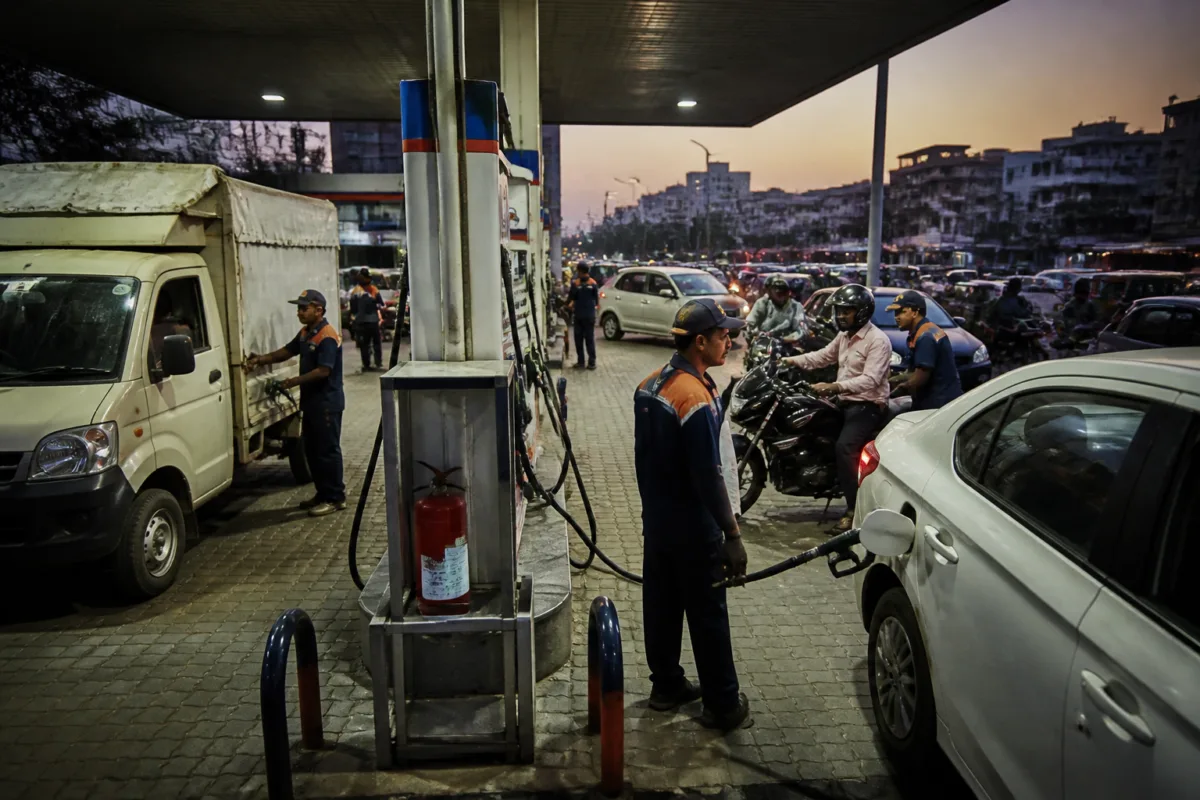
India’s state-run oil companies have posted a sharp quarterly recovery, but the headline profit numbers conceal a growing financial strain in the fuel system. Indian Oil Corporation, Bharat Petroleum Corporation and Hindustan Petroleum Corporation together reported standalone net profit of ₹30,106 crore for the July-September quarter, even as petrol and diesel prices remained frozen and losses on domestic LPG widened.
The results show how public-sector fuel companies are currently balancing three different pressures: strong refining earnings, politically constrained retail prices and delayed compensation for regulated cooking gas. For households and urban economies, this is not simply a story about corporate profitability. It is also about how the state manages transport fuels, household energy and the financial risks created when retail prices do not move in line with input costs.
The combined quarterly profit was 68.3 per cent higher than in the same period last year and marked a significant swing from a combined loss of about ₹18,150 crore in the April-June quarter, according to company filings cited in the report. The July-September result was equivalent to nearly 39 per cent of the three companies’ combined FY26 profit of ₹77,281 crore.
The recovery was led by Indian Oil. The company reported a record standalone quarterly net profit of ₹21,630 crore, compared with ₹7,610 crore a year earlier. That single-quarter profit represented nearly 59 per cent of Indian Oil’s full-year FY26 profit of ₹36,802 crore.
Bharat Petroleum and Hindustan Petroleum moved in the opposite direction. BPCL’s standalone net profit declined 22.5 per cent year-on-year to ₹4,993 crore, while HPCL’s profit fell 9 per cent to ₹3,483 crore. The divergent results underline that the recovery was not evenly distributed across the public-sector oil companies, even though all three operate within the same broad fuel-pricing environment.
The principal driver of the quarter was refining. Gross refining margins, or GRMs, rose sharply for BPCL and HPCL. HPCL earned $32.15 for every barrel of crude processed into products such as petrol and diesel, compared with $8.80 a barrel in the year-earlier quarter. BPCL’s GRM increased to $32.53 a barrel from $10.78.
Indian Oil attributed its record performance to improved refining margins and stronger contributions from its petrochemicals and gas businesses. A temporary decline in crude oil prices between mid-June and mid-August also supported the result by lowering feedstock costs and generating an inventory gain of about ₹7,000 crore.
This distinction is important. Refining margins and inventory gains can lift profits without resolving the underlying gap between the cost of fuel and the price charged to consumers. A company may benefit when crude prices fall after it has purchased more expensive inventory, while still facing losses in retail operations where pump prices have not been adjusted to reflect market conditions.
The report said petrol and diesel prices had remained unchanged since May, while domestic LPG rates had not changed since March, despite an increase in benchmark prices and crude input costs. Industry sources cited in the report said the companies were losing ₹4-5 a litre on petrol and ₹18-20 a litre on diesel until the previous month.
Petrol and diesel are formally deregulated, meaning the companies bear the loss when retail prices do not cover their costs. In practice, the absence of price changes during a period of higher input costs can create a financial burden for companies that have a large public-service role and extensive retail networks. Those costs can later appear in company accounts, government compensation decisions or future pricing adjustments.
LPG creates a different institutional problem because it remains regulated. Indian Oil Director (Finance) Anuj Jain said during an investor call that the under-recovery on LPG was ₹184 per cylinder in September. It rose to ₹229 in October and was expected to reach ₹309 in November and ₹370 in December, according to the report.
The difference between the retail price and the actual cost is expected to be made good by the government through subsidies. However, the companies had not received the compensation in time. The three firms had accumulated total fuel under-recoveries of ₹67,900 crore at the end of September, according to their filings. Indian Oil accounted for ₹32,505.69 crore, BPCL for ₹17,334.40 crore and HPCL for ₹18,048.82 crore.
That unpaid amount is the most important figure beneath the quarterly profit headline. It indicates that reported profitability can coexist with substantial receivables or losses linked to public policy. The companies’ ability to show strong profits in one quarter therefore does not mean that the pricing system has become financially settled. It means that gains in refining and related businesses have more than offset the immediate pressure from regulated and frozen retail prices during this period.
The arrangement also has a direct urban dimension. Petrol and diesel prices influence the operating costs of private vehicles, goods transport and bus services, while LPG prices affect household budgets and food preparation. When retail prices are held steady, consumers receive short-term protection from sudden increases, but the cost does not disappear. It is transferred to oil companies, the government’s subsidy obligations or both.
For cities, the institutional question is how that transfer is recorded and ultimately financed. The reported figures do not establish who will absorb the entire burden or when compensation will be paid. They do show that public-sector fuel retailers are carrying a large amount of under-recovery while relying on other parts of their businesses to protect earnings.
The quarter also illustrates the vulnerability of the model to international volatility. The three companies suffered heavy losses in the first quarter after crude prices rose above $100 a barrel amid the West Asia conflict, while domestic retail prices adjusted slowly. Lower crude prices during part of the second quarter and improved refining economics then helped restore profitability.
That recovery remains exposed to changes in crude prices and refining margins. Indian Oil itself warned in its second-quarter earnings statement that profitability in upcoming quarters could be adversely affected by inventory losses if crude oil prices fall as the situation in the Middle East normalises. The warning does not predict a specific outcome, but it makes clear that the quarter’s earnings were shaped by market movements that can reverse.
The results therefore separate three components of oil-company performance. The first is the operating spread earned by converting crude into fuels. The second is the accounting effect of changes in inventory values. The third is the policy-linked burden created when retail prices and compensation do not move with costs. Looking only at the combined ₹30,106 crore profit obscures how differently these components affect each company and how much of the system’s risk remains unresolved.
Indian Oil’s result benefited from refining, petrochemicals and gas, while BPCL and HPCL recorded lower profits despite stronger refining margins. This suggests that scale, business mix and the timing of inventory effects matter alongside the headline market environment. It also means that the financial capacity of each company to carry under-recoveries may differ.
The evidence supplied in the report does not establish whether petrol and diesel prices will change, when the LPG compensation will be paid or how the accumulated ₹67,900 crore under-recovery will be cleared. It confirms, however, that the current system is producing a combination of high quarterly profits and a substantial unpaid fuel bill.
The next stage will depend on the movement of crude prices, refining margins and government compensation. Until those factors become clearer, the second-quarter results should be read not as proof that the public-sector fuel model has stabilised, but as evidence of how refining gains can temporarily absorb the financial cost of keeping key fuel prices unchanged.

