


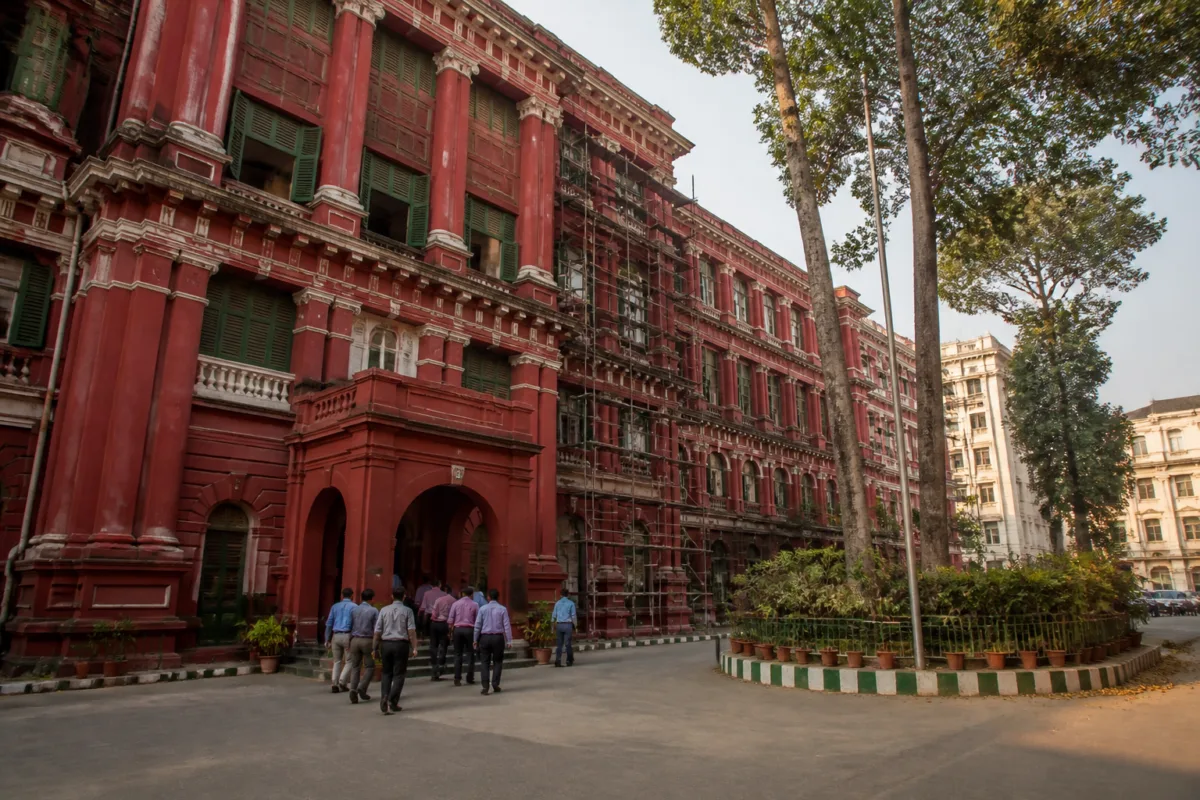
The proposed return of West Bengal’s administration to Writers’ Building is running into a problem that renovation alone cannot solve: there may not be enough usable space for the government’s expanded institutional structure. According to a report by Anandabazar – Kolkata, the historic building has been prepared for six ministers and several senior officials, but administrative officers now believe that bringing back the full secretariat may be practically impossible.
The issue places Writers’ Building at the intersection of heritage, governance and workplace infrastructure. The building has symbolic importance as the traditional seat of the state administration, but the government’s current office requirements are spread across several larger campuses, including Nabanna, New Town and Salt Lake. The question is therefore not only whether the old building can be renovated, but whether its physical layout can support the scale and functional complexity of a contemporary state government.
Writers’ Building was vacated in 2013 for renovation, after which the secretariat moved to Nabanna. Following a change of government in May, the administration announced plans to bring the state’s principal work back to the historic building after a gap of 13 years. The first phase of preparation focused on creating rooms for Chief Minister Shubhendu Adhikari and five ministers: Panchayat and Rural Development Minister Dilip Ghosh, Industry and Commerce Minister Agnimitra Pal, Tourism Minister Shankar Ghosh, Health Minister Shardwat Mukhopadhyay and Public Works Minister Ajay Poddar.
The Public Works Department also prepared rooms for the Chief Minister’s Office, the Chief Secretary, the Home Secretary and the Director General of Police. A conference room has been created for meetings involving the police chief. However, the report states that none of the ministers had begun sitting there regularly at the time of publication, and the building was not ready to accommodate the full working arrangements of the Chief Minister or the wider secretariat.
That distinction is important. Preparing individual rooms for ministers and senior officials is a limited physical intervention. A functioning secretariat requires much more: offices for supporting officials, meeting rooms, staff workspaces, records and circulation areas, as well as the operational links between departments. The report does not provide a detailed floor plan or a formal space audit, but the assessment by officials indicates that the constraint extends beyond the availability of rooms for political leaders.
A senior official quoted by Anandabazar – Kolkata said that separate meeting rooms could not be arranged for the Chief Minister, Chief Secretary or Home Secretary because of the shortage of space. The official also said that the possibility of the full secretariat returning to Writers’ Building was extremely limited because an appropriate working environment could not be created there. This suggests that the proposed return is being evaluated not simply as a ceremonial relocation, but against the everyday requirements of administrative work.
The spatial pressure is linked to the growth of government functions over the past 13 years. The report says that several important departments currently occupy the 14-storey Nabanna building. Moving those offices back to the older Writers’ Building would not be possible, according to officials. The New Secretariat Building, meanwhile, houses departments such as Labour, Power, Housing, Sports and Cooperation across all its floors. These offices would also not be easy to relocate into the historic building.
Large departments operating from Salt Lake and New Town face a similar constraint. The report identifies Education, Higher Education, Technical Education, Public Works, Public Health Engineering, Panchayat, and Municipal and Urban Development among the departments using substantial office space in those locations. Their existing footprint reflects the scale of staff and operations that has developed around the state government’s current administrative system. Recreating that arrangement inside Writers’ Building would require more than restoring rooms or repairing the building’s fabric.
This is the central institutional tension in the proposed move. The government appears to want a visible administrative presence in a building associated with the state’s political and bureaucratic history. At the same time, the working geography of the government has changed. Departments have expanded, offices have been distributed across multiple locations and the administrative system now depends on a larger physical network than the historic headquarters may be able to contain.
The report indicates that the administration is therefore considering Writers’ Building as a symbolic secretariat rather than as the sole location of the state government. The Chief Minister, Chief Secretary, Home Secretary and Director General of Police have been assigned space, while a limited number of ministers have also been provided rooms. Such an arrangement would allow the building to retain a central institutional role without requiring every department and every supporting function to return there.
However, the available information does not establish whether the government has formally adopted that model. Public Works Minister Ajay Poddar said the department would act according to the government’s instructions. He confirmed that arrangements for six ministers were to be completed by Mahalaya and that rooms for the Chief Secretary, Home Secretary and Director General of Police had also been prepared. He also said that the Chief Minister’s presence would enable the other ministers to begin working there, but added that Writers’ Building was not yet ready for the Chief Minister to operate permanently with a full secretariat.
The minister further said that the same limitation applied to the other ministers and that no final instruction had been received on whether the entire secretariat would be shifted. His statement leaves the administrative status of the project unresolved. The building has been prepared for an initial group of occupants, but there is no confirmed decision in the supplied report on the final scope of the relocation.
The uncertainty also raises a question about how public buildings are assessed before governments announce a major institutional move. A political decision to restore administrative functions to a historic headquarters must be matched by a clear operational assessment: which offices will move, which will remain elsewhere, how staff will be accommodated and how interdepartmental work will be organised. In this case, the early preparation of rooms appears to have been followed by a more difficult evaluation of the building’s total capacity.
The issue is not necessarily that a heritage building has no administrative use. Rather, its future role may need to be defined more narrowly. The report supports the possibility of a concentrated headquarters function, with the Chief Minister and senior officials working from Writers’ Building while several departments continue from Nabanna, the New Secretariat Building, Salt Lake and New Town. But whether such a model can operate efficiently would depend on decisions that have not yet been announced in the supplied material.
There is also a practical difference between a symbolic headquarters and a functioning secretariat. A symbolic headquarters can provide continuity, visibility and a physical connection with the state’s administrative history. A functioning secretariat must support routine files, meetings, staff movement and coordination across departments. The space shortage described in the report is significant because it challenges the assumption that restoring a building’s physical condition is sufficient to restore its former institutional role.
For citizens, the immediate impact is unlikely to be determined by which building houses a minister’s office. It will depend more on whether administrative work remains accessible, coordinated and operational across the government’s dispersed locations. The supplied report does not assess public access, transport arrangements, staff commuting or service-delivery outcomes. Those questions would require separate evidence. What it does show is that the government’s office geography has become too extensive to be reversed through a simple return to a single historic building.
The next step is therefore administrative clarity. Public Works has prepared selected rooms, but the minister said no final direction had been issued on a complete transfer. Until the government specifies the functions that will return, the departments that will remain elsewhere and the facilities required for senior-level work, Writers’ Building’s role will remain unsettled. The evidence currently points towards a limited headquarters function rather than a full restoration of the secretariat, but the final arrangement has not been formally confirmed.

