


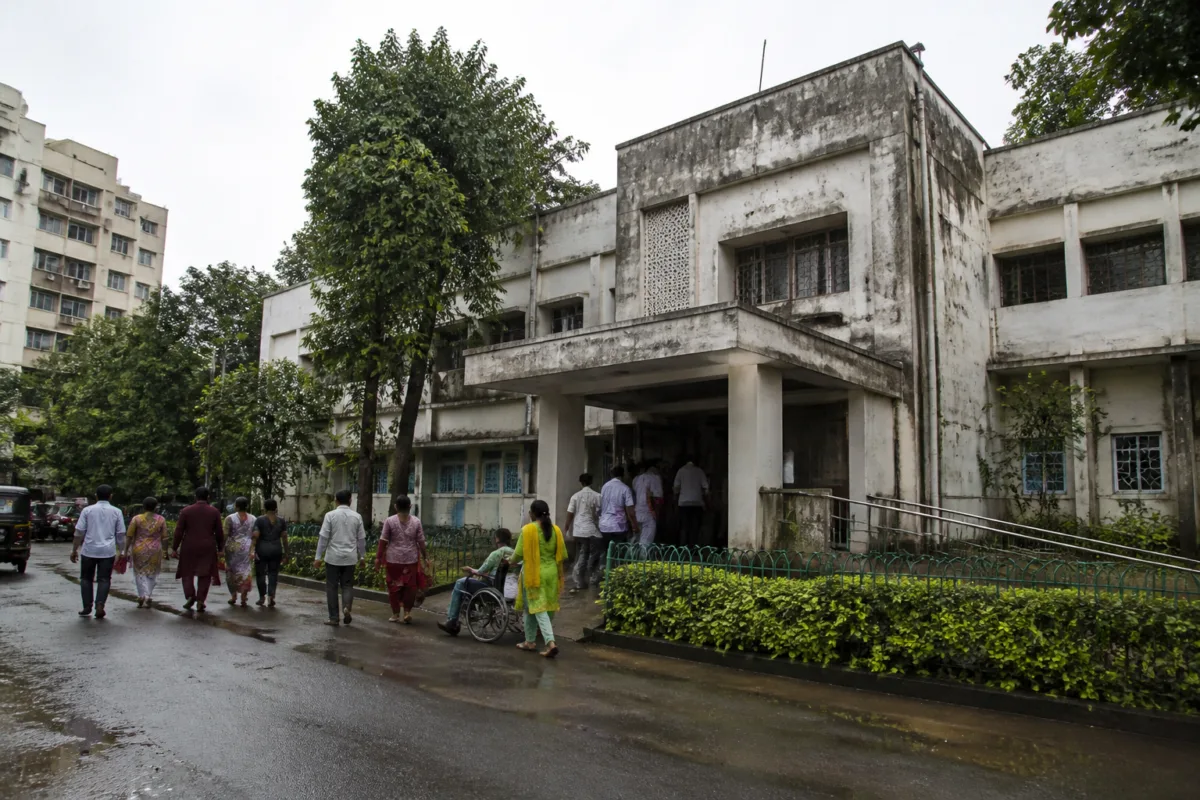
Aundh Kuti Hospital’s reported cracks, damp walls and shortage of specialist doctors point to a public-health problem that extends beyond one ageing municipal building. The Pune Municipal Corporation facility, which receives 100 to 150 outpatients daily, remains important to residents of Aundh’s housing societies, gaothans and four settlements, yet its ability to provide dependable care is constrained by both physical deterioration and staffing gaps.
The hospital began operating in 1972. According to a report by Lokmat – Pune, several parts of the building have developed cracks and its walls become significantly damp during the monsoon. The report says the condition has raised concerns because a facility meant to treat illness may itself expose patients to an unhygienic and wet environment. The account also describes pending repair work and inadequate infrastructure, although it does not provide a structural audit or an official assessment of the building’s safety.
That distinction matters. Visible cracks and dampness are serious maintenance signals, but the supplied report does not establish whether the building is structurally unsafe or whether any portion has been declared dangerous. What it does establish is that the condition of the premises has become a recurring public-service concern, with repairs reportedly pending despite follow-up with the administration.
The hospital’s role is defined by the population around it. Aundh has large residential societies as well as older settlements and informal residential pockets. Private hospitals have expanded in the area, but the municipal facility remains particularly important for economically weaker residents who depend on lower-cost public healthcare. The daily outpatient volume reported by Lokmat – Pune indicates that the hospital is not a marginal or unused facility. Its patient load includes women registering for childbirth services and children visiting for immunisation.
This makes the infrastructure question inseparable from the service question. A hospital can remain open on paper while becoming less useful in practice if patients cannot access the right doctor, diagnostic service or emergency referral pathway. At Aundh Kuti Hospital, the reported shortcomings are connected: an ageing building, limited staffing, restricted clinical capacity and dependence on other hospitals for services that residents may expect to find locally.
The staffing numbers illustrate the gap. The report states that the hospital has 40 employees, including two doctors, and that approximately 18 employees work on a contractual basis. It also says that, 54 years after the hospital began operating, permanent services from a gynaecologist and an anaesthetist have still not been made available. As a result, caesarean deliveries cannot be performed at the hospital even though the facility has a maternity department and the infrastructure for such a procedure is reported to exist.
Women who require those services must instead be sent to Dalvi Hospital or Aundh District Hospital. The report says that between 10 and 12 women register for maternity services on each Tuesday and Thursday. This does not by itself indicate the total number of deliveries or referrals, but it shows that maternity care is a regular part of the hospital’s workload. The absence of the required specialists therefore affects a defined service line rather than an occasional or hypothetical need.
The same pattern appears in emergency and diagnostic care. The hospital offers testing for tuberculosis, blood-related conditions and urine-related conditions. From January to October 2026, 1,100 people were tested, of whom 27 were reported positive. Of 223 dengue tests, 28 were reported positive. The report says critically ill patients and those with serious injuries are not treated at the facility.
A citizen quoted in the report alleged that some women waiting to see doctors were advised by employees to go directly to Aundh District Hospital instead of being examined at Kuti Hospital. This is a citizen account and is not independently established in the supplied material. Even so, it highlights an important operational issue: when frontline facilities lack staff or capacity, referral can shift from a defined clinical process to an informal instruction given at the point of contact. The report does not state whether the municipal corporation has reviewed this allegation or issued a formal response.
The hospital’s history also shows how questions about location and infrastructure can remain unresolved for years. In 2021, a proposal was made to shift the facility to Balewadi. Local residents, doctors and employees protested, after which the proposal was pursued with then mayor Murlidhar Mohol, former Member of Parliament Girish Bapat and MLA Siddharth Shirole. The relocation decision was subsequently cancelled. Keeping the hospital in Aundh preserved local access, but the report indicates that the decision did not resolve the building’s repair needs or its staffing deficiencies.
This is the institutional challenge at the centre of the story. A municipal hospital is not only a building; it is a chain of public decisions involving land, repairs, recruitment, procurement, clinical responsibility and referrals. Reversing relocation may respond to residents’ need for a nearby facility, but it must be followed by a clear plan for maintaining the premises and delivering the services for which the hospital is expected to function.
The available staffing structure suggests that continuity is another concern. With 18 of the 40 employees reportedly working on contract, a substantial part of the workforce is not permanent. The report does not provide details of the contract terms, vacancies, sanctioned posts or recruitment timelines, so the effect on staff retention and service quality cannot be quantified from the available evidence. However, the reported absence of a permanent gynaecologist and anaesthetist demonstrates how a hospital’s nominal service list can differ from its operational service capacity.
The maternity department is a clear example. A facility may list caesarean delivery as a capability, but without the specialist and anaesthesia support required to conduct the procedure, patients must be transferred elsewhere. This creates an additional step for women and families, and makes the local hospital dependent on the capacity and availability of other institutions. The source report does not provide travel times, referral numbers or outcomes, so the wider impact of these transfers cannot be measured here. It does, however, document that the service is unavailable locally despite reported demand.
The diagnostic figures similarly show a facility performing routine public-health work while lacking the capacity to handle more complex cases. The 1,100 tests conducted between January and October and the positive dengue results indicate that residents continue to use the hospital for screening and treatment-related services. But the exclusion of critically ill and seriously injured patients limits the hospital’s role in the local care network. Residents may approach the facility first, only to be directed to a larger hospital when their condition requires more specialised attention.
For the municipal administration, the issue is therefore not simply whether Aundh Kuti Hospital should remain open. The more consequential question is what level of care the facility is expected to provide, and whether its staffing, building and equipment match that declared role. A neighbourhood hospital can be a primary-care centre, a maternity facility, a diagnostic unit or an emergency access point, but each function requires defined personnel and infrastructure. The supplied report indicates that these elements are not currently aligned.
Local voices quoted by Lokmat – Pune reflect both dependence on and frustration with the hospital. Resident Sachin Ingole said he and his parents receive medicines and treatment there and that staff members provide cooperation. Corporator Bhakti Gaikwad said efforts were being made to secure a gynaecologist and anaesthetist, as well as infrastructure and building repairs, and that a positive response from the administration was expected. These statements show that the facility retains community value even as concerns over its condition remain.
The evidence does not establish whether the Pune Municipal Corporation has approved a repair package, commissioned a structural inspection, sanctioned specialist posts or fixed a deadline for implementation. Those are the missing administrative details that would determine whether the reported problems are being treated as a maintenance issue, a staffing issue or a broader redesign of municipal healthcare provision.
Aundh Kuti Hospital’s reported condition thus exposes a familiar weakness in urban public infrastructure: access is preserved geographically, but reliability is weakened institutionally. Residents may have a hospital nearby, yet still need to travel elsewhere for maternity procedures, critical illness or serious injuries. The building’s future, the availability of specialists and the formal scope of care now require coordinated decisions rather than isolated repairs or temporary referrals.
The immediate record confirms three things: the hospital continues to serve a significant local patient base, its building and facilities are reported to require attention, and key specialist services remain unavailable. What remains unclear is the municipal corporation’s formal assessment, budget, recruitment plan and implementation timetable. Those next steps will determine whether keeping the hospital in Aundh translates into dependable public healthcare or only preserves its physical presence.

