


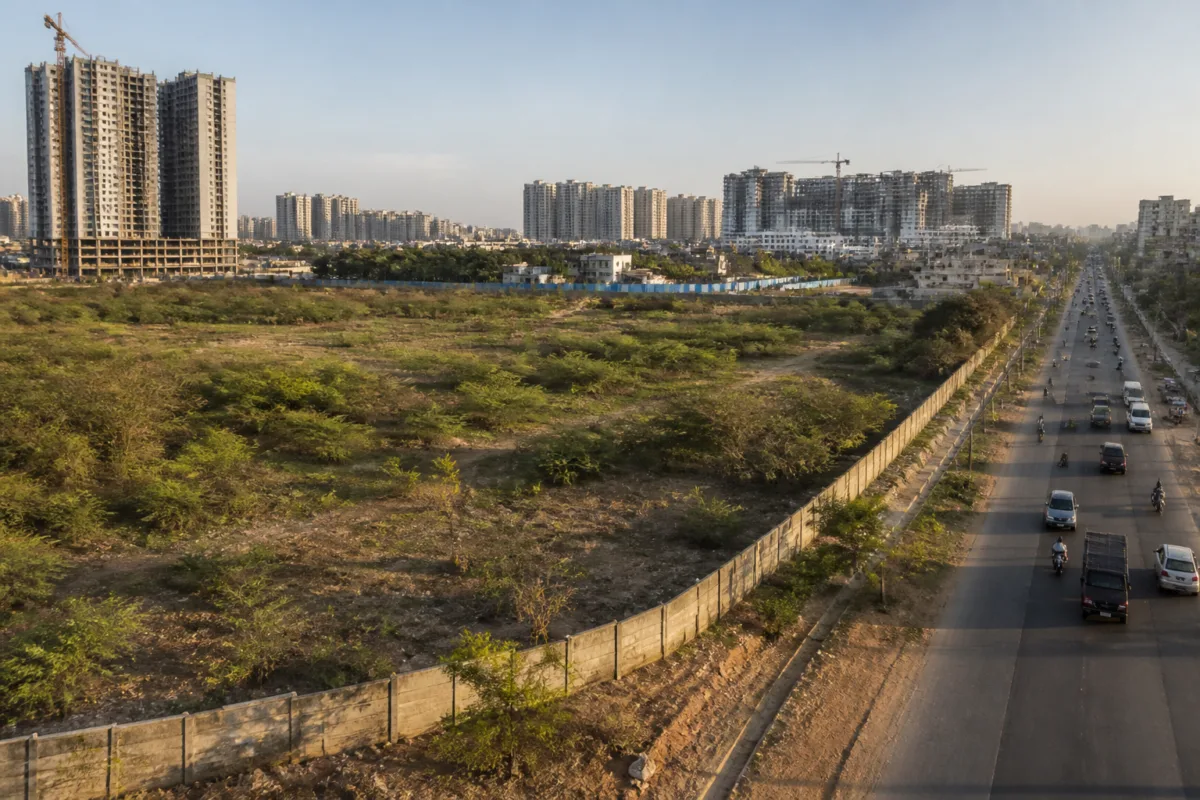
The proposed auction of 550 acres in Miyapur has reopened a central question in Hyderabad’s urban governance: should scarce government land be converted into immediate revenue, or reserved for public facilities and social infrastructure whose value may emerge over decades? The decision by Chief Minister A Revanth Reddy, announced after the Supreme Court delivered a verdict in favour of the Telangana government over the land, has brought that conflict into sharp focus.
The dispute is not only about one parcel in west Hyderabad. Miyapur is described as one of the city’s prime locations, making the land valuable both as a financial asset and as a possible site for facilities that are increasingly difficult to establish in a rapidly urbanising city. Representatives of SC, ST and BC communities have demanded that the land be used for welfare and development needs, including community halls, hospitals and housing for poorer residents.
The controversy also draws strength from the Chief Minister’s own earlier statements. In August 2025, after laying the foundation stone for the Sardar Sarvai Papanna Goud memorial at Tank Bund, Reddy said the government had no land available for allotment to SCs, STs and BCs. During Sevalal Maharaj Jayanthi celebrations in February this year, he again said there was no land available for distribution to tribals.
Those remarks establish the practical tension at the heart of the Miyapur decision. Government land is finite, and the most valuable parcels are often located where demand for housing, transport access, healthcare, education and community facilities is strongest. Once sold, such land is difficult for a future government to recover without paying the market price created by the original auction. The immediate fiscal benefit therefore has to be considered alongside the loss of future public-use options.
The issue has also become politically sensitive because Reddy had taken a different position while serving as Telangana Pradesh Congress Committee president and opposing land sales by the previous BRS government. According to the supplied report, he had described government land as a public asset that should be preserved for future generations. He had argued that the government would need land to build hospitals, schools and crematoriums, and had called for plans to sell such land to be dropped.
The present government’s approach is instead linked to a wider programme of land monetisation. The report places the Miyapur proposal after the sale of land belonging to the Telangana State Industrial Infrastructure Corporation and the Hyderabad Metropolitan Development Authority. This suggests that the question is not limited to a single auction but concerns how the state is defining the role of public land in financing development.
Reddy has defended the Miyapur auction on two grounds. Addressing a press conference in New Delhi, he said the government wanted to protect the land from encroachments and that the proceeds would be used for welfare and development works. The argument presents the auction as a means of converting a vulnerable or underused public asset into funds for public purposes.
That justification, however, leaves an important institutional question: what kind of public value is being lost when land is sold, and how reliably can the proceeds replace it? Money generated through an auction can finance welfare works, but it does not automatically provide a site for a hospital, school, community facility or affordable housing project in the same location. The distinction matters in a city where land prices and development pressure are unevenly distributed.
A land parcel in Miyapur carries location value that cannot be replicated simply by allocating the auction proceeds elsewhere. A future public facility placed in a distant or less connected location may serve a different population and may require additional spending on access, utilities and transport. The supplied material does not establish how the government plans to allocate the proceeds or whether specific welfare projects have been identified for the money. That absence makes the debate principally one about public-asset governance rather than only about revenue mobilisation.
The proposed sale is also being viewed through the lens of housing affordability. A member of CREDAI Telangana has warned that outright sale could prove counterproductive, while supporting government-land allotments for infrastructure and social needs. The concern is based on the effect of earlier land sales: the sale of TGIIC land at Raidurg reportedly fetched record prices and created a benchmark for land values in the region.
If the Miyapur auction establishes a similarly high benchmark, builders acquiring land would face a larger upfront cost. The CREDAI representative said that this financial burden could eventually be passed on to homebuyers. The report does not quantify the possible increase in land or housing prices, so the affordability impact remains a stated industry concern rather than a measured outcome. But the mechanism is clear: when land acquisition becomes more expensive, developers must recover a larger cost through the projects built on that land, unless other costs or margins absorb the difference.
This creates a three-way policy trade-off. The state can obtain substantial revenue through a competitive auction. Developers can gain access to a large, strategically located parcel for construction. But the same transaction may raise the land-cost floor for future development and remove land that community groups view as necessary for social infrastructure. Each objective is urban in character, yet they operate on different time scales.
The state’s argument about encroachment adds another layer. Protecting public land from illegal occupation is a legitimate administrative concern, but the available report does not specify the extent of encroachment risk at Miyapur, the measures already taken to secure the parcel or whether alternatives to outright sale were assessed. Options such as long-term leases, purpose-specific allotments or development models retaining public ownership are not discussed in the supplied material. Their absence from the report does not establish that they were rejected, but it highlights the limited information currently available about the government’s land-management framework.
The controversy therefore points to the need for clearer rules around land held by the state and its agencies. Public land can serve as a reserve for hospitals, schools, housing, transport infrastructure, utilities and other civic purposes. It can also be used to raise funds for such purposes. The policy challenge is to distinguish between land that can be monetised without weakening future planning capacity and land whose location gives it a long-term public function.
That distinction becomes particularly important in Hyderabad, where the report identifies Miyapur as a prime location and links the proposed sale to broader development pressures. Once urban expansion increases the value of a parcel, the opportunity cost of selling it also rises. A government may receive more revenue, but it may also lose one of the few remaining sites capable of supporting large public facilities in a high-demand area.
The supplied evidence confirms the immediate facts: the state has announced plans to auction 550 acres in Miyapur after the Supreme Court verdict; community representatives are seeking the land for welfare uses; the Chief Minister has defended the sale as a way to prevent encroachment and fund welfare and development; and a builders’ representative has warned about possible effects on land and housing costs. What remains unclear is the auction timetable, the reserve price, the proposed use of the proceeds, the government’s assessment of welfare-site requirements and the safeguards it intends to apply to future public-land decisions.
Those details will determine whether Miyapur becomes primarily a revenue transaction or part of a broader, transparent land-use strategy. Until they are disclosed, the debate will continue to revolve around the same unresolved urban question: how should a city use the public land it may not be able to replace?

