


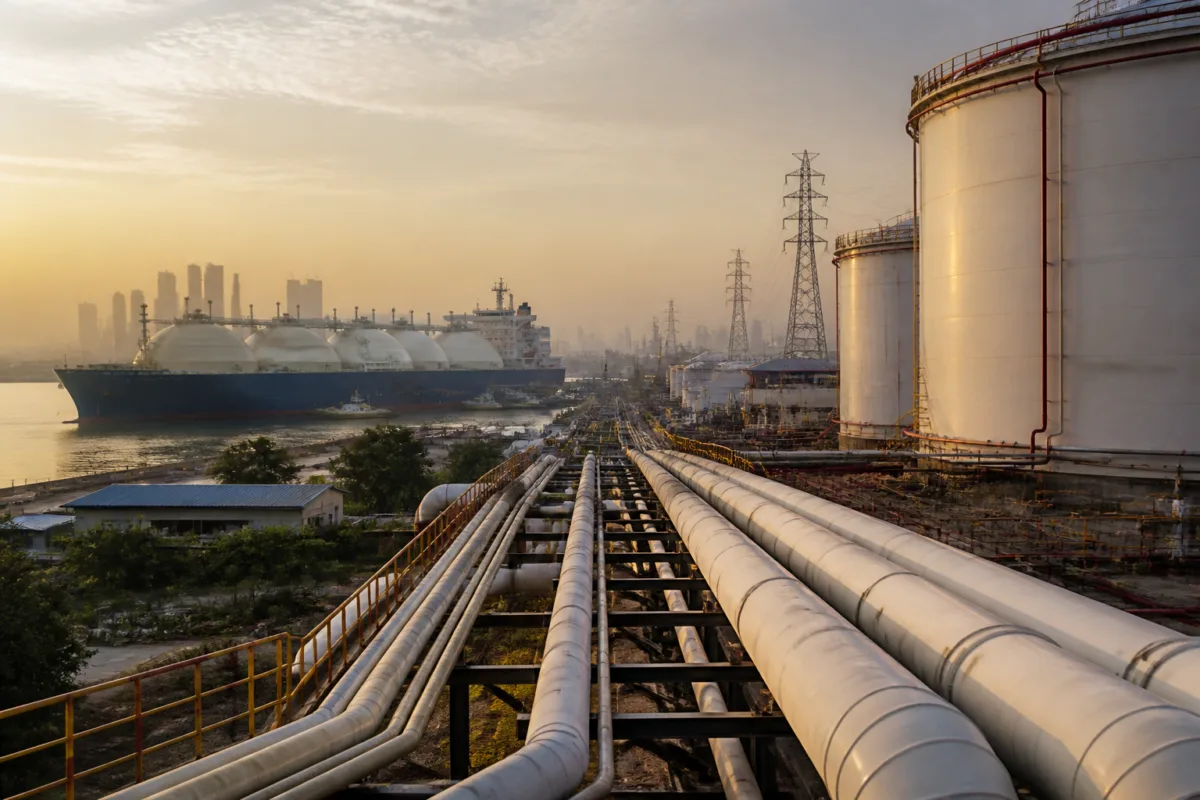
India’s record LNG imports in October point to more than a temporary increase in energy demand. They show how power generation, fertiliser production and city gas distribution are becoming more dependent on imported fuel at a time when domestic gas production is declining. For cities, that dependence links household and commercial gas availability to international shipping routes, supplier decisions and the delivered cost of energy.
Data from maritime intelligence and research firm Kpler, cited by The Times of India, showed that India’s LNG imports rose 17.4% to a record 2.7 million tonnes so far in October. Import dependence increased from 50% to nearly 52% as domestic production declined. The same report said crude oil imports reached a record 5.6 million barrels per day during the month, 14% higher than a year earlier.
The LNG increase was attributed to higher demand from the power, fertiliser and city gas distribution sectors. These sectors serve different parts of the urban economy, but their fuel requirements are connected. Electricity generators need gas when other sources are less available, fertiliser plants use gas as feedstock, and city gas distributors supply compressed natural gas and piped natural gas to transport users, households and businesses.
That combination makes the October data significant. It is not simply a story about cargo volumes arriving at Indian terminals. It is also an indication that the reliability of essential urban services is increasingly tied to the country’s ability to secure gas from external markets and move it through import, transmission and distribution systems.
The power sector is one of the immediate reasons for the increase. Companies were reported to be stocking gas because solar energy generation is expected to decline during winter. The source does not establish how much additional electricity will be generated from gas, or whether all of the imported LNG will be used for power generation. It does, however, identify a procurement response to anticipated seasonal changes in the electricity mix.
This matters because gas-fired generation is often used within a wider electricity system that includes multiple fuel sources. When the availability of one source changes, generators and system planners must manage the resulting requirement through other sources. In the reported case, companies appear to have increased LNG supplies before the winter period, creating additional pressure on import infrastructure and fuel procurement.
The fertiliser sector adds another layer of demand. Natural gas is not only an energy source for fertiliser plants; it is also a feedstock for production. Higher gas requirements therefore affect an industrial supply chain linked to agricultural output. The report does not provide plant-level consumption figures or identify specific fertiliser facilities, but it places the sector among the main contributors to the increase in LNG demand.
City gas distribution brings the issue closer to daily urban life. The supplied report does not quantify the increase in household, commercial or transport demand, and it does not say whether consumers faced shortages or price changes. But the inclusion of city gas distribution among the demand drivers underlines the fact that gas imports support networks operating within cities, not only large industrial facilities outside them.
The structural pressure comes from the widening gap between domestic production and demand. According to the report, India’s import dependence rose from 50% to nearly 52% as domestic production declined. Even a change of a few percentage points is important when the underlying market is large and demand is spread across power, industry, fertiliser and urban distribution networks. It means a greater share of consumption must be supported by supplies whose availability is affected by overseas production, freight, contracts and maritime access.
The geography of supply also changed during the month. Qatar, traditionally India’s biggest LNG supplier, accounted for 40-50% of total imported volumes, according to the report. Supplies from Qatar had previously been curtailed because of disruptions to shipments through the Strait of Hormuz during the West Asia conflict. India received more than 0.4 million tonnes from Qatar in October, the highest monthly volume from the country since the war began. That was 370% more than the 0.1 million tonnes received from Qatar in September and only marginally below India’s cumulative imports from Qatar between March and September.
The rebound from Qatar shows why import dependence is also a question of route security. A country may have long-term supply commitments and available demand, but deliveries still depend on whether cargoes can move through strategic maritime routes. The report said sources indicated that Qatar was willing to increase LNG supplies and meet its long-term commitments despite impacts on its production facilities. That helped restore volumes, but it did not remove the exposure created by dependence on international shipping.
The United States remained India’s largest LNG supplier in October, with 0.6 million tonnes supplied until October 29. The United Arab Emirates, Oman, Angola, Nigeria and Australia were also identified as major suppliers. This spread of suppliers provides a broader import base, but the report does not establish whether it represents a permanent change in India’s procurement strategy or a response to temporary disruptions and seasonal demand.
The crude oil figures provide a parallel view of the same energy system. India’s crude imports reached 5.6 million barrels per day in October, 14% higher than a year earlier. Russia remained the largest supplier, accounting for nearly 36% of total imports, although Russian crude flows fell from a peak of 2.8 million barrels per day in July to nearly 2 million barrels per day in October.
Kpler’s lead analyst for refining, Nikhil Dubey, said elevated freight costs for Russian barrels had eroded their delivered-price advantage, while improved supplies from West Asia offered competitive alternatives to Indian refiners. Gulf-country supplies stood at around 2.3 million barrels per day in October, compared with 2.7 million barrels per day in September, with Saudi Arabia leading followed by Iraq.
The crude and LNG movements are not identical markets, but together they show the importance of delivered cost. Supply decisions are shaped not only by the price of fuel at its origin, but also by freight, route conditions and the cost of bringing it to Indian facilities. For urban energy systems, this means that a disruption far from a city can affect procurement choices for power generators, transport networks, industrial users and gas distributors.
The institutional challenge is therefore larger than arranging additional cargoes. Import terminals, pipelines, storage facilities, power plants and city gas networks must work as a connected system. The supplied report does not provide capacity figures for these assets, nor does it identify bottlenecks in unloading, transmission or distribution. It does show that demand is being managed through increased imports and stock-building, making the coordination of these systems increasingly important.
The report also points to a policy tension. Imported LNG can support continuity in power, fertiliser and city gas supply when domestic production is insufficient. At the same time, higher import dependence exposes users to international supply disruptions and freight costs. The evidence supplied does not establish whether the October increase will continue, whether domestic production will recover, or how the additional cost will be distributed across consumers and industries.
For city governments and urban planners, the immediate lesson is that energy resilience cannot be assessed only within municipal boundaries. Urban gas and electricity systems depend on national procurement, ports, maritime corridors, cross-country pipelines and industrial supply chains. Decisions taken by importers and suppliers can influence the operating conditions of urban transport, homes, businesses and power facilities even when no local infrastructure project has changed.
The October data confirm a sharper reliance on imported LNG at a moment of demand from several essential sectors. They also show how supply geography is being reshaped by the recovery of Qatari deliveries, continuing US shipments and changing freight economics for Russian crude. What remains unclear from the available evidence is whether this is a short-term seasonal response or part of a longer increase in import dependence. Future monthly import data, domestic production figures and information on city gas and power-sector consumption will determine whether October was an isolated peak or a sign of a deeper shift in India’s urban energy system.

