


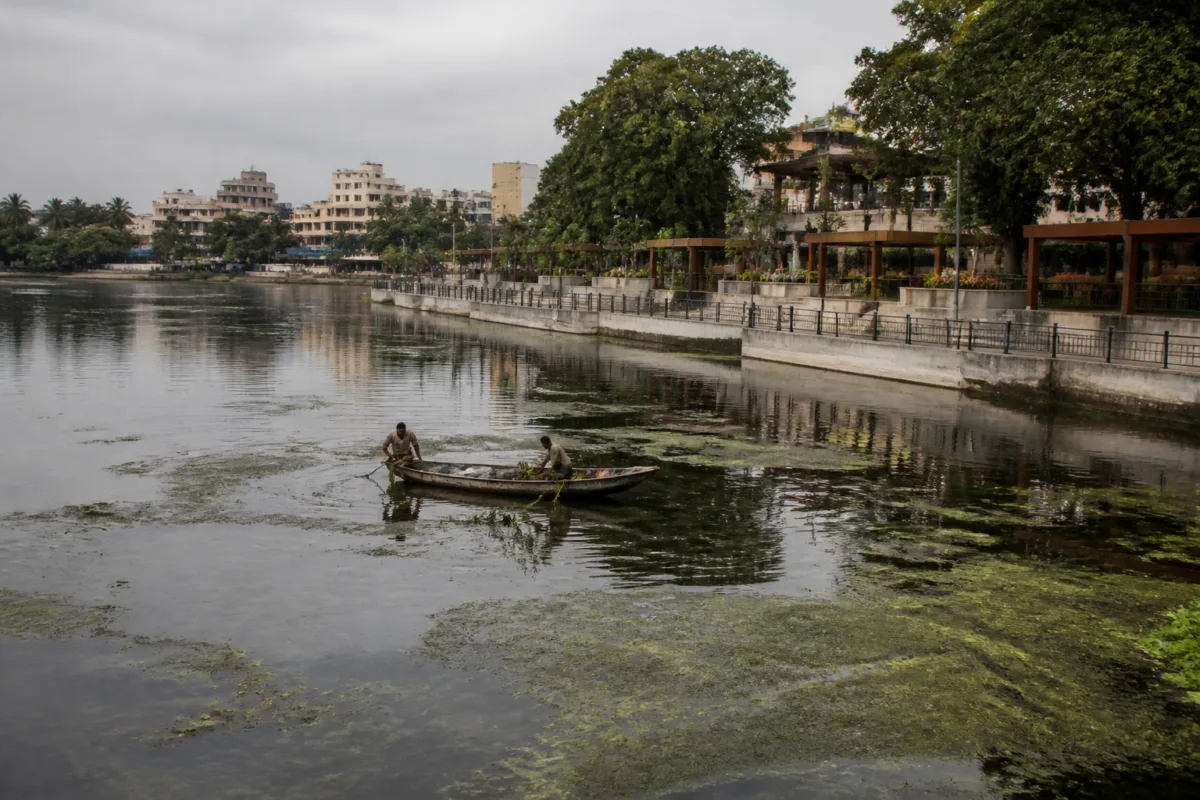
Coimbatore’s lake rejuvenation programme has made several urban waterbodies more attractive to visitors, but a less visible ecological change is taking place beneath the improved public-facing infrastructure. Invasive and exotic fish species, including tilapia, African catfish, mosquito fish, sucker-mouth catfish and common carp, are reported to be dominating several lakes, raising questions about biodiversity, food chains, pollution and the limits of lake restoration that prioritises appearance and amenities over ecological recovery.
The concern is not simply that non-native fish are present. The central issue is that they may be displacing indigenous species and altering how the lake ecosystem functions. According to the report, invasive fish are now said to outnumber native varieties in several Coimbatore lakes. Environmentalists and researchers cited in the report link this dominance to competition for food and habitat, predation on native fish and other aquatic organisms, and disruption of relationships between fish, aquatic insects, crabs and birds.
This creates a difficult challenge for urban lake management. A lake is not restored merely when its bunds, walking paths, lighting and visitor facilities are improved. Its ecological condition also depends on the quality of inflows, the composition of aquatic species, dissolved oxygen, habitat diversity and the functioning of the food web. The reported spread of invasive fish suggests that physical rejuvenation and ecological restoration may not always be advancing together.
The issue is particularly important because Coimbatore’s lakes are connected to the Noyyal river system. R Manikandan, founder of Kovai Kulangal Pathukapu Amaipu, told the Times of India that tanks linked to the system are filled with exotic species. He also said tilapia had been observed as far as the foothills of Kovai Kutralam and that many residents were no longer familiar with indigenous fish because of the dominance of exotic varieties.
The observation points to a wider institutional problem: the absence of a comprehensive, regularly updated inventory of fish populations across the city’s waterbodies. Without such a baseline, authorities may know that invasive species exist but not their proportion, spread, seasonal movement or impact on native species. S Raja, an assistant professor in the department of zoology at Kondunadu College of Arts and Science, said a stock assessment was needed to determine the ratio of exotic to indigenous fish in individual lakes.
That distinction matters. A list of species recorded in wetlands can establish presence, but it cannot by itself show ecological dominance. The Tamil Nadu Wetland Mission has identified tilapia, mosquito fish, guppy, sailfin catfish or sucker-mouth catfish, African catfish and common carp among the major invasive species recorded in and around wetlands in the state. The report, however, does not provide lake-wise population estimates for Coimbatore or a citywide assessment of how these species have changed over time.
The lack of such data makes it difficult to measure whether restoration projects are improving ecological conditions or merely creating more accessible public spaces around stressed waterbodies. It also limits the ability of agencies to decide which interventions are appropriate for particular lakes. A lake dominated by tilapia may require a different response from one where African catfish, pollution and fishing pressure are the principal concerns.
Tilapia’s reported success is linked to its ability to survive in water with relatively low dissolved oxygen. A researcher associated with the World Wide Fund for Nature told the newspaper that tilapia could survive when dissolved oxygen levels were four or lower. In urban waterbodies receiving sewage inflows, that ability can give the species an advantage over native fish that may require better water conditions.
This is where water quality and invasive species become part of the same urban problem. The report raises concerns about pollutants, including heavy metals entering lakes through sewage inflows. These pollutants could enter aquatic food webs and potentially accumulate in fish. At the same time, the report notes that major biomagnification studies have not been conducted to establish whether fish in these lakes contain heavy metals or toxic elements at levels that would pose a consumption risk.
That qualification is important. The presence of sewage inflows and concerns about heavy metals indicate a need for testing, but they do not establish that fish from every lake are contaminated or unsafe to eat. The available report does not provide laboratory results, pollutant concentrations, consumption advisories or lake-specific water-quality data. The evidence therefore supports an urgent monitoring question rather than a confirmed finding of toxic fish across Coimbatore.
The ecological consequences may also be visible in the city’s bird populations. The WWF researcher cited the relationship between fish size and bird feeding patterns, noting that darters consume smaller fish while tilapia can grow to much larger sizes. The researcher suggested that a decline in sightings of such birds could indicate a reduction in the availability of suitable prey. This is an ecological indicator, not conclusive proof of a single cause, but it shows why lake assessment cannot be limited to counting fish.
The reported disappearance of crabs from Kurichi lake adds another dimension. Manikandan said crabs were present there around 30 years ago but are no longer found. He attributed the change to exotic and invasive fish preying on aquatic organisms and breaking the food chain. The report does not provide historical ecological surveys or establish that invasive fish alone caused the disappearance, but the observation reflects the kind of local change that a formal biodiversity assessment should investigate.
Fishing and fish sales further complicate the management problem. Environmentalists cited in the report have raised concerns that fishing practices may have contributed to the dominance of exotic varieties. The continued sale of African catfish in the city has also been cited as an enforcement concern despite a ban on the species. During visits to Ukkadam Periyakulam, Selva Chinathamani and Perur Periyakulam, the newspaper reported seeing African catfish kept for sale, with tilapia described as the dominant breed.
This suggests that control cannot be limited to removing fish from individual lakes. If prohibited or invasive species remain available through local markets, the pathways for their continued spread remain open. Enforcement would involve more than lake-side action: it would require attention to fish vendors, stocking practices, transport, awareness among residents and coordination between civic, fisheries and environmental authorities. The report does not identify the agency responsible for the alleged enforcement failures or record an official response, leaving an important governance gap.
The use of mosquito fish illustrates how well-intentioned interventions can produce unintended ecological effects. Gambusia is introduced into waterbodies in some settings to control mosquito larvae, but the report notes that studies have identified it as invasive and warned of adverse effects on native aquatic ecosystems. This raises a broader planning question for urban administrations: whether species introduced to address one public-health concern are assessed for their long-term impact on wetlands before being released.
Coimbatore’s lake system therefore sits at the intersection of urban infrastructure, public health, biodiversity and governance. Lake rejuvenation can improve access, recreation and the public visibility of waterbodies. But if sewage continues to enter lakes, invasive fish remain available for sale, and species populations are not measured, the visible improvements may not reflect ecological recovery.
The evidence currently available confirms the presence of multiple invasive species and records concerns from environmentalists, a zoology academic and a WWF-associated researcher. It does not yet establish the precise population ratios in each lake, the extent of heavy-metal contamination, the causes of changes in bird or crab populations, or the effectiveness of existing enforcement. Those uncertainties are not minor details; they determine what action would be scientifically and administratively appropriate.
The immediate institutional requirement identified by the report is a systematic stock assessment of Coimbatore’s lakes, combined with water-quality testing and biodiversity monitoring. A credible assessment would need to distinguish between species presence and dominance, map links between sewage inflows and fish populations, and track whether native species and aquatic organisms are returning or declining. Until that evidence is assembled, the city’s lake restoration story remains incomplete: the public realm may look renewed, while the ecological system beneath it continues to change.

