


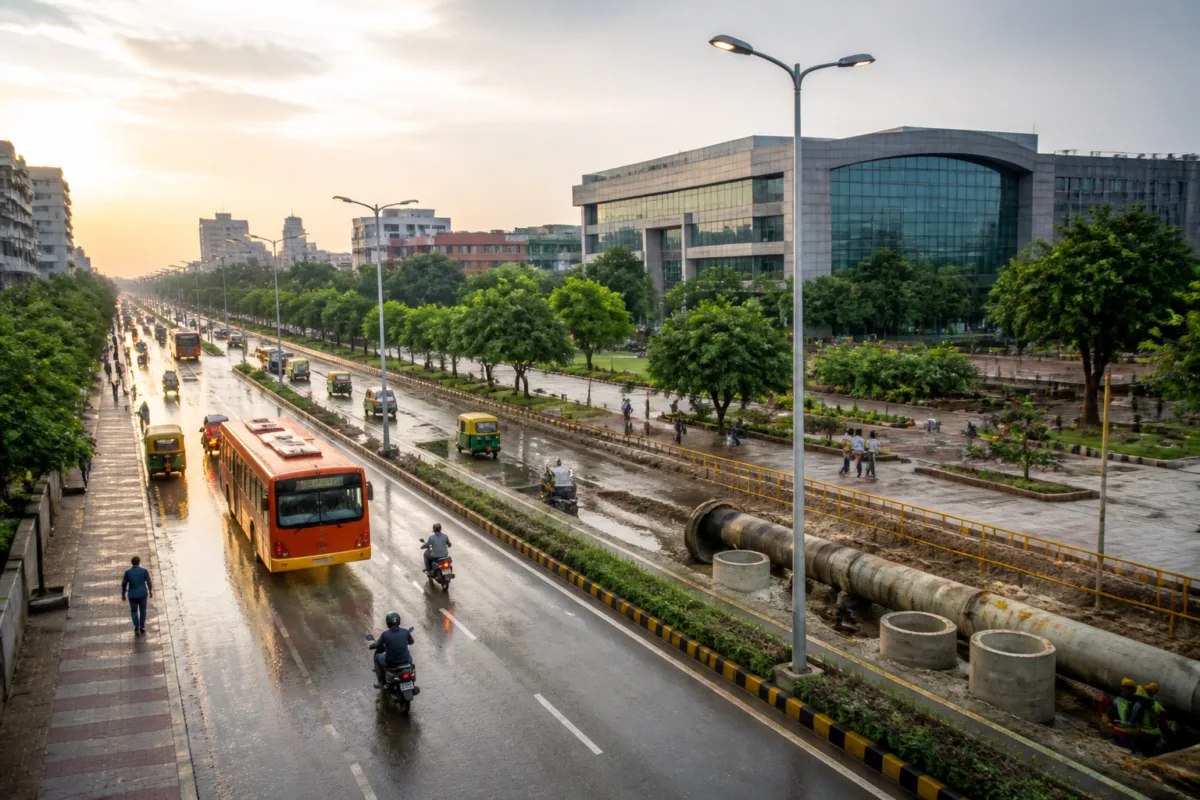
Uttar Pradesh’s Smart Cities and AMRUT programmes have created a large pipeline of urban infrastructure, but their lasting value will depend on what happens after construction. The state’s 17 Smart Cities and 637 AMRUT 2.0 projects are intended to improve mobility, water supply, sewerage, public spaces and urban management. The more difficult test is whether these assets deliver reliable services across neighbourhoods and whether municipal bodies can operate and maintain them over time.
The scale of the intervention is substantial. Ten Uttar Pradesh cities—Agra, Aligarh, Bareilly, Jhansi, Kanpur, Lucknow, Moradabad, Prayagraj, Saharanpur and Varanasi—were selected under the Central Smart Cities Mission. Seven more—Ayodhya, Firozabad, Ghaziabad, Gorakhpur, Mathura, Meerut and Shahjahanpur—were included under the state’s own Smart Cities initiative. Together, these programmes represent an attempt to improve urban systems across cities with very different economic roles, physical forms and infrastructure pressures.
That diversity matters because Uttar Pradesh does not have a single urban problem. Lucknow and Kanpur function as large administrative and economic centres where traffic management and road infrastructure affect daily movement and commercial activity. Agra and Varanasi must manage tourism and pilgrimage alongside the needs of permanent residents. Ayodhya is dealing with an expanding pilgrimage economy, while cities such as Meerut, Ghaziabad and Aligarh are absorbing residential and commercial growth. Smaller urban centres, including Jhansi, Saharanpur, Gorakhpur and Shahjahanpur, require basic municipal services to keep pace with changing demands.
The Smart Cities framework was designed around the idea that urban management should use better planning, reliable information and responsive services rather than rely only on physical construction. Integrated Command and Control Centres, intelligent traffic management, smart roads, public lighting, parking facilities and upgraded public spaces form part of this approach. The programme therefore combines visible infrastructure with digital systems intended to help administrations monitor and manage city functions.
According to official statistics cited in the report, the ten centrally selected Smart Cities in Uttar Pradesh had 893 projects worth Rs 21,161 crore. By March 31, 2026, 889 projects worth Rs 20,959 crore had been completed. The figures indicate a high level of project execution in the centrally selected cities. They do not, by themselves, establish whether every completed project is being used effectively, whether service levels have improved or whether the assets are being maintained adequately. That distinction is central to assessing the programme’s urban impact.
A command centre, for example, can improve the way a city receives and processes information, but it cannot substitute for functioning roads, trained staff, timely repairs or accountable grievance redressal. Similarly, intelligent traffic systems can support better monitoring, but their usefulness depends on enforcement, maintenance and the wider design of the road network. The technology component is therefore an administrative tool, not an independent measure of urban performance.
AMRUT addresses a different layer of the urban system. Launched in 2015 and followed by AMRUT 2.0 in October 2021, the programme focuses on drinking water, sewerage, water conservation, water-body rejuvenation and green spaces. These services are less visually prominent than landmark roads or newly built control rooms, but they shape household health, expenditure and the daily experience of living in a city.
Uttar Pradesh has approved 637 AMRUT 2.0 projects with an estimated investment of Rs 29,716.29 crore. Figures reported in September 2026 showed that 114 projects had been completed and work was progressing on 453 others. The numbers indicate both the size of the programme and the amount of implementation still underway. Unlike the Smart Cities figures for the ten centrally selected cities, these AMRUT 2.0 numbers describe a programme in a more active construction and execution phase.
The focus on water and sewerage is particularly important as urban populations grow and existing networks come under pressure. Extending piped water supply and sewerage can reduce dependence on inadequate arrangements and support planned expansion. Yet construction alone cannot guarantee service delivery. The relevant questions are whether households receive water reliably, whether water quality is maintained, whether sewerage networks function as designed and whether municipal agencies have the resources to operate them after completion.
This is where the two programmes intersect. Smart Cities projects seek to make urban management more informed and responsive, while AMRUT invests in the physical systems that make everyday urban life possible. Digital monitoring may help identify service failures, but it cannot replace sound engineering, adequate staffing and regular maintenance. Conversely, new water and sewerage networks may not deliver their full value without institutions capable of monitoring connections, responding to complaints and managing demand.
The programmes also expose the difficulty of applying common national or state frameworks to cities with different local needs. In Varanasi, traffic management and civic infrastructure must operate alongside a historic urban fabric and intense religious tourism. In Ayodhya, public infrastructure must serve residents as well as a large visitor economy. In western Uttar Pradesh, expanding residential and commercial activity places pressure on mobility, drainage and water supply. In smaller cities, public spaces, lighting and basic services may have a more immediate effect on urban life than complex digital systems.
The report’s examples suggest that urban transformation cannot be judged by project counts alone. The same number of completed projects can produce different outcomes depending on location, design, usage and maintenance. A road improvement in a major commercial corridor, a sewerage extension in a growing peripheral settlement and a restored public space in a smaller city address different forms of urban need. Their success must be measured against the problem each intervention was intended to solve.
The economic dimension is also significant. Better roads and transport management can improve access to markets and workplaces. Reliable water and sewerage can make cities more suitable for businesses and residential development. Public spaces and improved civic amenities can support tourism and commercial activity. For smaller cities, dependable infrastructure may strengthen their role as centres for surrounding rural economies, including agricultural trade, traditional industries, retail and local services.
However, the available figures do not establish the extent of these economic outcomes. They show approved investments, project completion and ongoing work, but not changes in travel times, household water access, sewerage reliability, business activity or municipal revenue. That gap between implementation data and service-outcome data is an important limitation in evaluating urban programmes. Completion is a necessary milestone, but it is not the same as performance.
The institutional challenge is equally important. Assets created through centrally or state-supported programmes eventually have to be operated within municipal systems. This includes maintaining roads and public spaces, managing water and sewerage networks, staffing control centres, repairing equipment and responding to residents. The long-term contribution of Smart Cities and AMRUT will therefore depend partly on the capacity of urban local bodies to absorb and sustain the infrastructure created through these schemes.
The question of inclusion also remains material. The report identifies the need to look beyond major projects and selected areas to low-income settlements and rapidly expanding urban peripheries. If improved services remain concentrated in showcase corridors or central districts, city-level project completion may coexist with uneven household-level access. Inclusive urban development requires infrastructure and services to reach residents across the urban area, including places that receive less visibility and investment.
The evidence currently confirms a significant expansion of urban investment in Uttar Pradesh. It also shows that the Smart Cities programme has reached a high level of reported completion in the state’s ten centrally selected cities, while AMRUT 2.0 remains substantially under implementation. What remains less clear from the available figures is how these projects are performing after completion, how evenly benefits are distributed and whether municipal systems have the capacity to maintain them. Those service-level outcomes—not construction alone—will determine whether the programmes produce lasting improvements in mobility, water security, sanitation, public spaces and everyday urban governance.

