


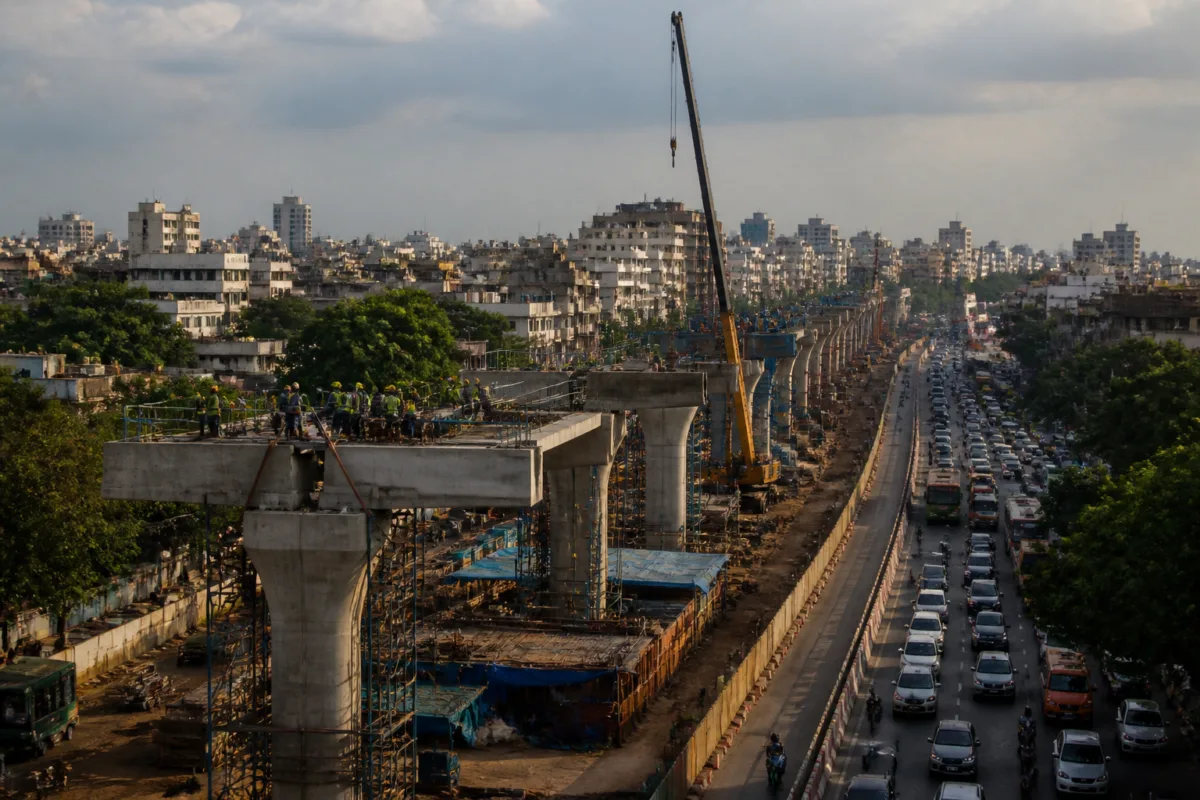
India’s fiscal deficit reached Rs 7.14 lakh crore in the first six months of FY27, according to government data reported by Economic Times, placing the Centre at 42.1% of its full-year target. The number is not, by itself, evidence that the annual target will be breached. But the year-on-year increase in the first-half share, rising from 36.5% in the comparable period, shows that the government’s fiscal consolidation path is beginning the year with a wider gap between expenditure and receipts.
That matters beyond the balance sheet. The Union government’s fiscal position determines the room available for subsidies, capital expenditure and transfers that support infrastructure and public services. For cities, the immediate question is not simply whether the Centre meets its headline deficit target. It is how revenue collection, expenditure timing and committed subsidy bills shape the funds available for the projects and programmes through which the urban system is built and maintained.
The Centre has budgeted a fiscal deficit of Rs 16.96 lakh crore for FY27 and has set a target of 4.3% of GDP. By September, the accumulated deficit was below half of the annual rupee target, at 42.1%. That proportion is lower than 50%, but it is higher than the 36.5% recorded at the same point in the previous year. The comparison indicates a less favourable first-half position even though the latest figure remains within the annual envelope.
## What the fiscal numbers show
The receipts data present a mixed picture. Total receipts during April-September stood at Rs 18.35 lakh crore, or 50.3% of the full-year budget estimate. This was higher than the 49.5% achieved in the comparable period last year. Revenue receipts were Rs 17.57 lakh crore, equivalent to 49.7% of the annual estimate.
Net tax revenue contributed Rs 12.76 lakh crore, reaching 44.5% of the full-year estimate. That compares with 43.3% during the corresponding period a year earlier. On this measure, tax receipts were progressing at a faster pace than last year. Non-tax revenue, however, stood at Rs 4.81 lakh crore, or 72.2% of the annual target, compared with 79.9% in the year-ago period. The lower proportion suggests that the composition and timing of receipts matter as much as the aggregate total.
This distinction is important for interpreting the deficit. A government can record receipts close to or above the halfway mark while still facing pressure if expenditure is rising faster, or if some revenue streams arrive later than expected. The data reported for the first half show precisely this tension: receipts were at roughly half of the annual estimate, but the fiscal deficit’s share of the annual target was higher than last year.
The expenditure figures provide the other side of the explanation. Revenue expenditure reached Rs 18.95 lakh crore, or 45.9% of the full-year estimate. Major subsidies, including food, fertiliser and petroleum subsidies, amounted to about Rs 6.55 lakh crore and represented 53.6% of the revised annual aim. That share was wider than the 51.8% of budgeted expenditure recorded in the comparable period last year.
The report also separately puts major subsidy expenditure at Rs 2.2 lakh crore through September, equivalent to 54% of the Rs 4.1 lakh crore budgeted for the year. Food subsidy spending was Rs 1.02 lakh crore, urea subsidy expenditure was Rs 85,585 crore, nutrient-based fertiliser subsidies stood at Rs 33,664 crore and petroleum subsidies amounted to Rs 1,149 crore. These figures show that subsidy commitments are a substantial component of expenditure during the first half of the financial year.
The reported figures contain two different subsidy presentations: one refers to about Rs 6.55 lakh crore in major subsidies against a revised annual aim, while another identifies Rs 2.2 lakh crore against the specific Rs 4.1 lakh crore budget provision. Since the source does not explain the accounting distinction between these amounts, they should not be treated as interchangeable. What can be established is that subsidy spending had reached more than half of the relevant annual provision by September.
## Why the spending mix matters for cities
The fiscal deficit is a national indicator, but its consequences are distributed through institutions and programmes that affect urban India. The supplied data do not establish a reduction in any particular city project, metro corridor, road programme or municipal transfer. Nor do they show that capital expenditure has been cut. Any such conclusion would go beyond the evidence currently available.
The figures do, however, highlight the administrative trade-off that accompanies a widening deficit. A larger share of expenditure committed early in the year can reduce flexibility later, particularly when receipts do not arrive evenly across the financial calendar. Subsidies are not discretionary in the same way as a new project announcement: food and fertiliser support are tied to established policy commitments, while petroleum subsidy spending is separately tracked. Their scale therefore forms part of the fiscal conditions under which other spending decisions are made.
Urban infrastructure depends on predictable funding across multiple years. Construction of transport systems, public facilities and utility networks requires more than a one-time allocation. It involves land, contracts, payments, clearances and operating commitments. The fiscal data reported for FY27 do not reveal how these processes are performing. They do show why the annual deficit target cannot be read in isolation from the pace and composition of expenditure during the year.
The Centre’s revenue expenditure of Rs 18.95 lakh crore was already at 45.9% of its full-year estimate by September. Revenue expenditure generally covers recurring government spending, but the supplied report does not provide a complete break-up between departments or programmes. As a result, it is not possible to determine from these figures alone whether urban-facing allocations are being protected, accelerated or delayed.
That limitation is itself relevant to public scrutiny. A headline deficit number communicates the overall gap between receipts and expenditure, but not the distribution of spending. For citizens and city governments, the more operational questions concern the timing of releases, the status of sanctioned projects and the division of responsibilities between the Centre, states and local authorities. Those details are not contained in the reported first-half fiscal statement.
## The fiscal consolidation test
Finance Minister Nirmala Sitharaman set the FY27 fiscal deficit target at 4.3% of GDP while presenting the Union Budget, signalling that the government intends to continue fiscal consolidation. The first-half data do not invalidate that objective, because 42.1% of the annual rupee target remains below the halfway point. But the year-on-year increase from 36.5% makes the path more demanding than it was at the same stage last year.
Fiscal consolidation is therefore not only an end-of-year target. It is also a matter of managing the sequence of receipts and payments. The reported tax-revenue figure, at 44.5% of the annual estimate, is ahead of the previous year’s 43.3%. Non-tax revenue, at 72.2% of the annual target, is below the year-ago share of 79.9%. Together, these numbers point to a fiscal position in which different revenue channels are moving at different speeds.
The revenue deficit stood at Rs 1.38 lakh crore, or 23.4% of the annual target, compared with 5.2% in the corresponding period last year. The primary deficit was Rs 68,000 crore, also reported at 23.4% of the budget estimate. These indicators add detail to the headline deficit by showing that the first-half position is not only about the total gap, but also about the relationship between recurring expenditure, receipts and the cost of government borrowing, although the supplied material does not provide a separate interest-payment breakdown.
For the urban economy, the significance lies in the policy environment created by these numbers. Cities require sustained public investment, but they also operate within a wider fiscal system where subsidies, revenue expenditure and infrastructure commitments compete for budgetary space. The data do not establish that one has displaced another. They establish that the government is managing a first-half deficit that is wider as a share of the annual target than it was last year, while maintaining a full-year consolidation target.
The next stage of the financial year will clarify whether the first-half pattern is temporary or indicative of a more persistent pressure on the budget. The key evidence will be the movement of tax and non-tax receipts, the pace of subsidy spending, revenue expenditure and the treatment of capital and programme-level allocations. Until those figures are available, the most defensible conclusion is limited but important: FY27 has begun with a larger fiscal gap than the previous year at the same point, and the government’s ability to meet its 4.3% of GDP target will depend on how the remaining receipts and expenditure are managed.

