


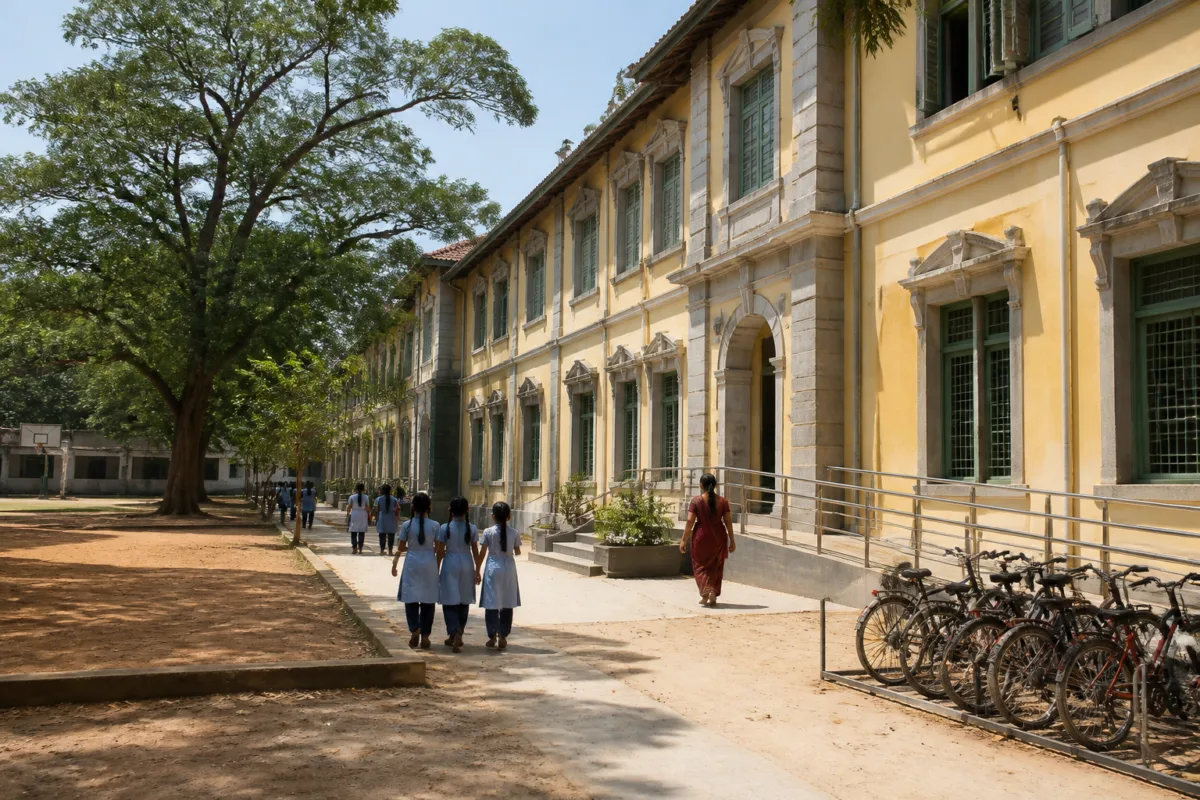
A proposal to create a comprehensive policy for Karnataka government schools has placed two connected challenges on the public agenda: how to strengthen Kannada-medium education and how to preserve schools with 50, 75 and 100 years of history. The appeal by Congress member of the Legislative Council Dinesh Gooligowda asks the state to treat these not as separate administrative tasks, but as parts of a single institutional renewal programme.
Gooligowda submitted the appeal to Chief Minister D.K. Shivakumar and School Education Minister S. Madhu Bangarappa. According to the report, he identified declining enrolment in government schools, shortages of teachers and the need to improve basic infrastructure as central concerns. His proposal also seeks to retain Kannada as the principal medium of instruction while developing students’ English communication skills.
That combination is important because the debate around government schools is not limited to the availability of classrooms. It also concerns whether families believe that public schools can provide an education that is locally rooted, academically credible and relevant to future opportunities. The proposal’s emphasis on both Kannada-medium education and English communication reflects that tension. It does not present the two as mutually exclusive. Instead, it calls for the state to preserve the primary language of instruction while improving a skill increasingly associated with mobility and access.
The appeal also links the condition of government schools to their physical and institutional history. Schools that have operated for five decades or more are not only service-delivery sites. They can also be repositories of local memory, public investment and community relationships. Yet age alone does not guarantee that a school remains useful or adequately equipped. A historic building may require conservation, while its classrooms, laboratories, sanitation facilities and teaching resources may need modernisation.
This is the central design challenge in the proposed Karnataka heritage school revival policy: preservation cannot become a substitute for educational improvement, and modernisation cannot erase the identity of institutions that communities have built around over generations. The appeal calls for both heritage conservation and contemporary educational facilities, suggesting that the state should approach these schools as functioning public institutions rather than as monuments frozen in time.
The proposal includes several measures. Historic schools would first need to be identified and classified. Special grants could then be provided for heritage schools, while educational memorial galleries could be established to record their histories. Selected institutions could be upgraded into model schools offering education from kindergarten to pre-university level. The appeal also proposes greater participation by former students and gives priority to teacher recruitment.
Each of these measures addresses a different part of the problem. Identification creates an administrative list and establishes which institutions qualify for special treatment. Dedicated grants could address the risk that conservation work competes with routine school needs. Memorial galleries could make school history visible to students and residents. Model-school status could expand the role of selected institutions, while alumni participation could bring local knowledge and additional support into the system. Teacher recruitment addresses the human capacity needed to make physical improvements meaningful.
The proposal’s strength lies in bringing these strands under one policy rather than treating them as isolated schemes. A building repair programme, by itself, would not reverse declining enrolment. Similarly, a branding exercise around historic schools would have limited value if classrooms remain understaffed or facilities are inadequate. The suggested framework recognises that enrolment depends on a combination of access, trust, teaching quality, infrastructure and the perceived future available to students.
The source report does not provide statewide enrolment figures, the number of teacher vacancies, a list of eligible historic schools or an estimated financial requirement. Those omissions matter because a policy cannot be assessed only by the breadth of its proposals. Its eventual effectiveness would depend on the size of the problem, the number of schools covered, the criteria for selecting model institutions and the funding committed for recurring as well as capital expenditure.
A heritage-focused programme would also require a clear division of responsibilities. The school education department would be responsible for academic standards, staffing and day-to-day administration. Heritage or culture-related authorities could have a role in documenting historically significant structures and advising on conservation. Local administrations and school-level committees would be important for site management and community engagement. Without defined responsibilities, a policy could create overlapping expectations without a single institution being accountable for delivery.
The proposed model of upgrading selected schools from kindergarten to pre-university level raises a further administrative question. Such an institution would cover a long educational pathway, potentially requiring different teaching capacities, facilities and regulatory arrangements at different stages. The appeal calls for selected schools to be developed as model institutions, but the supplied report does not specify how these transitions would be governed or financed. Those details would determine whether the model becomes a replicable public-school format or remains limited to a small number of showcase campuses.
Teacher recruitment is equally important. New buildings, heritage galleries and improved equipment cannot by themselves address the reasons families may move away from government schools. The appeal specifically identifies teacher shortages and calls for recruitment to receive priority. That places staffing at the centre of the proposed policy rather than treating it as a secondary operational matter. A school’s public reputation is closely connected to whether classes are consistently conducted and whether students receive attention across subjects.
The proposal also points to the role of former students. Alumni participation can help schools document their histories, support facilities and build stronger links with the surrounding community. However, the appeal as reported does not establish whether alumni involvement would be voluntary, institutionalised or linked to a formal funding mechanism. A policy would need to distinguish between community participation and dependence on private contributions. Public schools would still require predictable state funding for core responsibilities.
The language question adds another layer to the policy. Retaining Kannada as the main teaching medium is presented alongside the need to develop quality English communication skills. This approach seeks to address two public expectations at the same time: cultural and linguistic continuity, and preparation for wider educational and employment environments. The report does not specify the proposed curriculum, teacher-training model or assessment system for achieving that balance. Those mechanisms would be essential if the language objective is to move beyond a policy declaration.
The focus on schools with 50, 75 and 100 years of history also creates a measurable starting point for the government. The age thresholds could help authorities prepare a first inventory and develop categories for intervention. But age should not become the only basis for allocation. A school’s current enrolment, physical condition, location, community dependence and educational needs would also be relevant to decisions about conservation and upgrading. The source material does not state what selection criteria have been proposed.
For urban areas, the issue has a particular significance. Older government schools are often embedded in established neighbourhoods and may occupy valuable public land. Their future affects not only students but also the distribution of educational facilities within the city. If such schools are strengthened, they can continue serving communities close to where families live. If they decline without a planned response, residents may face longer journeys or greater dependence on private institutions. The report does not provide city-level evidence, but the institutional question is relevant wherever historic public schools remain part of the urban fabric.
The appeal therefore presents school renewal as more than a question of preserving old buildings. It asks whether the state can use existing public institutions as the foundation for better educational provision. The proposed policy would have to connect heritage conservation, infrastructure, staffing, language education, alumni participation and school governance in a single implementation framework.
What is established so far is that Gooligowda has asked the chief minister and school education minister to create such a framework and announce a Karnataka heritage school revival policy around Kannada Rajyotsava. What remains unestablished is whether the government will accept the proposal, how many schools would be included, what funding would be provided and what administrative milestones would follow. Those decisions will determine whether the appeal becomes a broad public-school renewal programme or remains a set of individual recommendations.

