


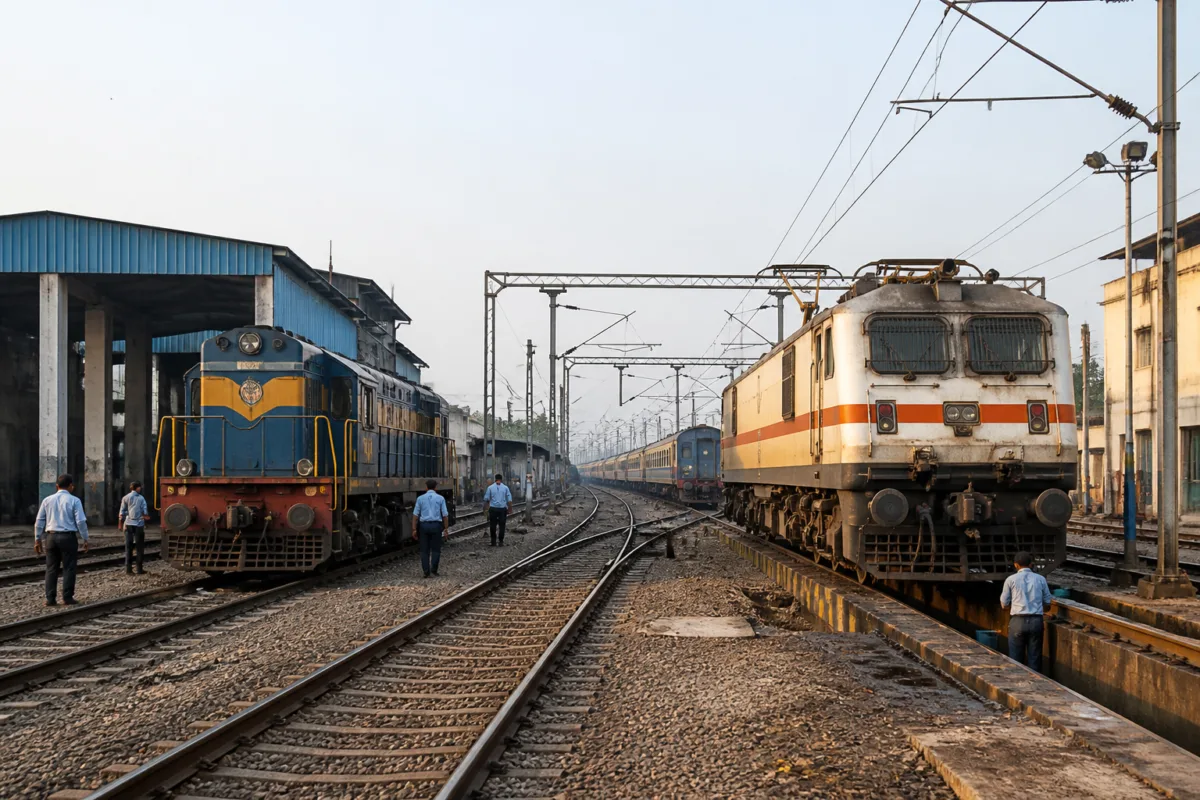
Bhopal rail electrification has removed diesel locomotives from regular passenger and freight hauling across the division, but it has not made diesel traction unnecessary. At Itarsi, a major railway maintenance hub under Bhopal Railway Division, diesel engines continue to perform the less visible tasks that keep an electrified network functioning: moving coaches and wagons inside yards, carrying out inspections and rescuing trains when the overhead power supply fails.
That distinction is important because electrification is often understood as a complete replacement of one traction system by another. In operational terms, however, the shift is more layered. Electric locomotives now handle regular services on all routes in the division, while diesel locomotives remain available for work that depends on flexibility, local movement or the ability to operate independently of overhead wires.
The figures supplied by the railways illustrate this arrangement. Itarsi Locomotive Shed currently houses 84 diesel locomotives and 104 electric locomotives. The fleet is therefore no longer organised around diesel as the principal means of hauling trains, but neither has diesel disappeared from the railway’s operational system. The two technologies now occupy different roles within the same network.
## Electrification changes the mainline, not every railway task
For regular passenger and freight services, the move to electric traction represents the central outcome of the division’s electrification programme. Railway officials cited higher energy efficiency, lower operating costs and reduced emissions as reasons electric locomotives have become the preferred option for routine operations.
The practical railway, however, extends beyond the mainline movement of scheduled trains. Stations, yards and maintenance facilities require locomotives to move rakes, wagons and coaches over short distances. These movements may not involve long-distance hauling, but they are essential to assembling trains, positioning rolling stock and supporting maintenance activity.
The report says diesel locomotives are frequently used for this shunting work. Their role is particularly suited to locations where a locomotive may need to move independently of the electrified running network or where the task is confined to a yard or facility. The continued presence of diesel engines is therefore not evidence that electrification has failed to displace diesel from regular operations. It shows that the railway’s operational boundary is wider than its mainline routes.
The same logic applies to inspection and departmental trains. Railway officials said diesel locomotives are used for trains that examine tracks, signalling systems, bridges and other infrastructure. These activities support the safety and reliability of the electric network itself. An electrified railway still requires inspection teams to access its physical assets, and it needs locomotives that can be deployed for work outside the normal passenger and freight timetable.
## The value of an independent power source
Bhopal division railway PRO Nawal Agarwal said diesel locomotives remain valuable because they can operate independently of the overhead electric supply. According to the official, this becomes especially important during power failures, maintenance blocks, accidents and other disruptions on electrified sections.
This is the central operational lesson from the mixed fleet at Itarsi. Electrification increases the efficiency of normal operations, but the network still needs a means of movement when the power system is unavailable or when an incident interrupts the normal flow of trains. A diesel locomotive provides that capability without depending on the overhead equipment that may have failed, been isolated for maintenance or become inaccessible during an emergency.
The distinction is also significant for railway resilience. A network designed only for normal conditions can perform efficiently while its systems are working, but disruptions test whether it can recover. Rescue locomotives, inspection trains and yard engines are part of that recovery capacity. They may not be visible to most passengers, yet their availability can determine how quickly railway personnel respond when regular operations are interrupted.
The supplied report does not establish how frequently such diesel deployments occur, how much they cost or how long they typically remain in service. It does, however, document the institutional reasoning for retaining them: the need to preserve operational capability when the electric traction system cannot be relied upon in a particular location or moment.
## Itarsi’s mixed fleet reflects a transition, not a contradiction
The coexistence of 84 diesel and 104 electric locomotives at Itarsi can appear contradictory if electrification is treated as a simple replacement programme. It becomes more understandable when the shed is viewed as a maintenance and operations hub serving multiple railway requirements.
The railway’s transition has changed the balance between the two traction types. Electric locomotives support regular passenger and freight movement across the division’s electrified routes, while diesel locomotives have been retained for support functions and contingencies. The diesel fleet is therefore smaller in strategic importance than it was before electrification, but it remains operationally significant.
This arrangement also demonstrates why infrastructure transitions cannot be measured only by the disappearance of an older technology from the most visible service. The mainline may be fully electrified while yards, rescue operations, inspections and maintenance continue to require a different form of traction. The network’s headline technology and its everyday support systems do not necessarily change at the same pace.
For Bhopal division, the result is a two-tier operating model. Electric traction is the default for routine services. Diesel traction is a reserve and support capability. The model allows the division to pursue the efficiency and emissions benefits associated with electrification without giving up the ability to respond when the electric network is disrupted.
## The infrastructure behind the headline
Railway electrification is often represented through visible assets such as overhead wires, electric locomotives and electrified routes. But the report points to a broader system involving sheds, yards, inspection facilities, signalling, bridges and emergency response arrangements.
Each of these assets requires coordination. Track and signalling inspections must be carried out. Bridges and other infrastructure must be examined. Coaches and wagons must be positioned. Trains affected by accidents or power failures must be moved. The railway’s operating model depends on the ability to perform these tasks even when the mainline traction system is temporarily unavailable.
That is why the diesel locomotive continues to have a role after the completion of route electrification. It is not being retained as an alternative to electric hauling on ordinary services. It is being retained as an operational tool for spaces and situations in which the electric system may not be available, convenient or sufficient.
The role also highlights the difference between reducing emissions in regular operations and eliminating fossil-fuel dependence across every railway activity. The source report attributes lower emissions to the use of electric locomotives for routine services, but it does not provide an emissions comparison for the retained diesel fleet or quantify its fuel use. The available evidence supports a narrower conclusion: electrification has transformed the division’s mainline traction, while diesel continues to support essential non-routine functions.
## What Bhopal’s railway transition reveals
The Bhopal division example shows that infrastructure modernisation is rarely a clean substitution. New systems may become dominant without making older systems redundant. Instead, the older technology can be concentrated in specialised roles where reliability, mobility or independence from the main system matters more than efficiency during normal operations.
For passengers, this means that an electric train journey depends on more than the locomotive pulling the train. It also depends on the railway’s capacity to inspect infrastructure, manage rolling stock, maintain stations and respond to failures. Much of that work takes place away from the passenger platform and outside the scheduled timetable.
For the railway administration, the challenge is to maintain this backup capability without allowing it to undermine the benefits of electrification. The figures from Itarsi show that both traction systems remain part of the division’s current operating structure, but the source does not provide details on future fleet plans, diesel retirement schedules or the investment required to maintain the two systems.
The evidence therefore confirms a significant but carefully bounded transformation. All routes in Bhopal division have been electrified, and electric locomotives now handle regular passenger and freight services. Yet a fully electrified railway still requires diesel locomotives for shunting, inspection and rescue operations, particularly during failures, maintenance blocks, accidents and other disruptions.
The next stage to watch is not simply whether diesel locomotives disappear from the sheds. It is how Indian Railways defines and maintains backup capacity as electrification expands. In Bhopal division, the wires have changed the mainline. The diesel locomotives at Itarsi remain part of the system that keeps that mainline moving when normal conditions break down.

