


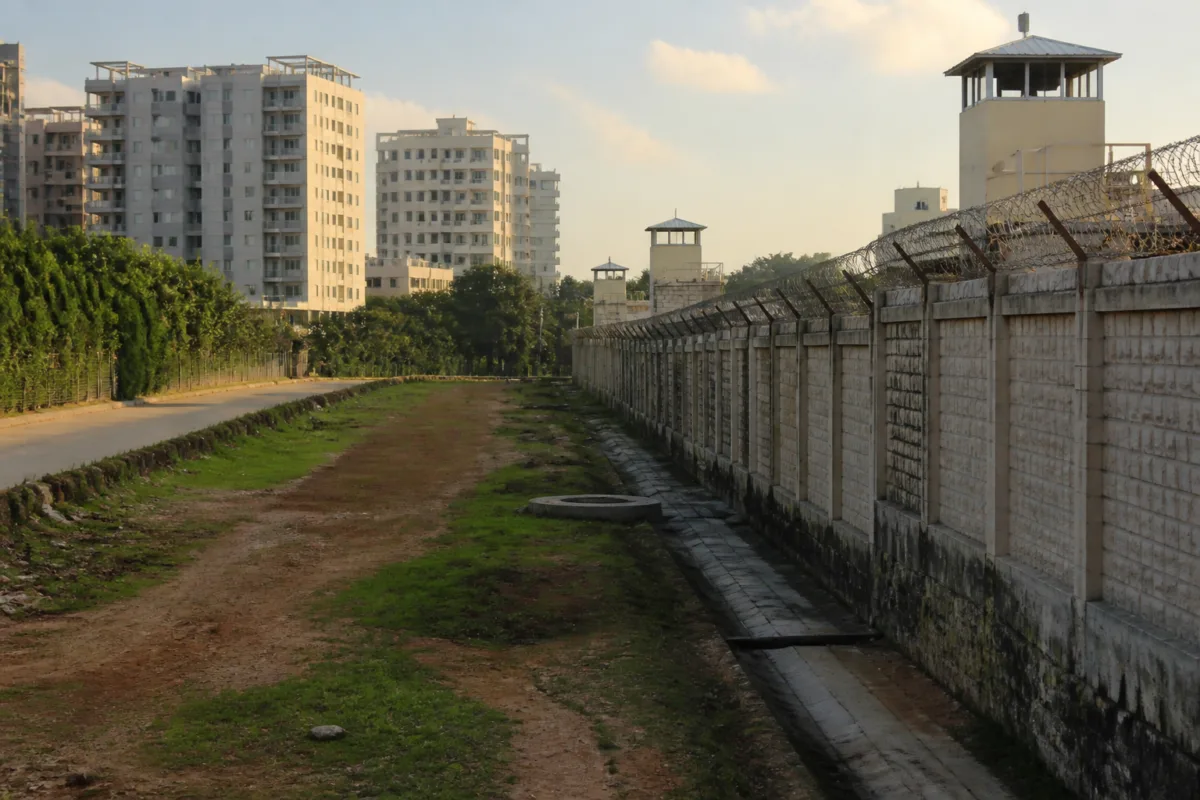
The Karnataka High Court has upheld the land acquisition process for security measures, expansion and staff housing at Bengaluru’s Parappana Agrahara Central Prison, rejecting landowners’ argument that an alternative site in Devanahalli could be used for the facility.
A division bench comprising Justices D.K. Singh and H. Shantibhushan passed the order while hearing writ appeals filed by the Karnataka government against an earlier decision by a single-judge bench. The division bench accepted the government’s argument that the prison, which houses more than 5,000 inmates, could face security risks if multi-storey buildings were allowed to come up around it.
The court held that Parappana Agrahara Central Prison serves a public purpose. It said the state government has a constitutional responsibility to expand prisons in response to rising inmate numbers, strengthen security, support prisoner reform and provide housing facilities for prison staff.
The acquisition covers 19 acres and 18 guntas in several survey numbers in Naganathapura village in Begur Hobli of Bengaluru South taluk. The government had issued a preliminary notification for the acquisition in 2012 and a final notification in 2013. The land was intended to help preserve a 200-metre buffer zone around the prison as a secure area, besides supporting expansion and related facilities.
More than 65 landowners had challenged the notifications. In an order dated May 2, 2025, the single-judge bench had partly allowed their petitions and cancelled the final acquisition notification on a technical ground. The court had held that the government had not properly considered a report submitted by the Special Land Acquisition Officers.
The division bench has now restored the acquisition process while directing the state government and relevant authorities to take appropriate action under law regarding reinforced concrete buildings, residential layouts, engineering workshops and developed sites already constructed or created on the acquired land. The direction places the implementation of the acquisition within the legal framework governing existing structures and development.
The ruling also addressed the broader purpose of custodial infrastructure. The court observed that imprisonment under modern penal theory is not limited to retribution, but also includes creating conditions for the reform and rehabilitation of offenders. The judgment therefore linked the prison’s physical expansion and security requirements with its functioning as a public institution.
The immediate administrative next step is for the state government and the concerned authorities to act on the division bench’s directions, including determining the lawful course for structures and developed properties located on the acquired land.

