


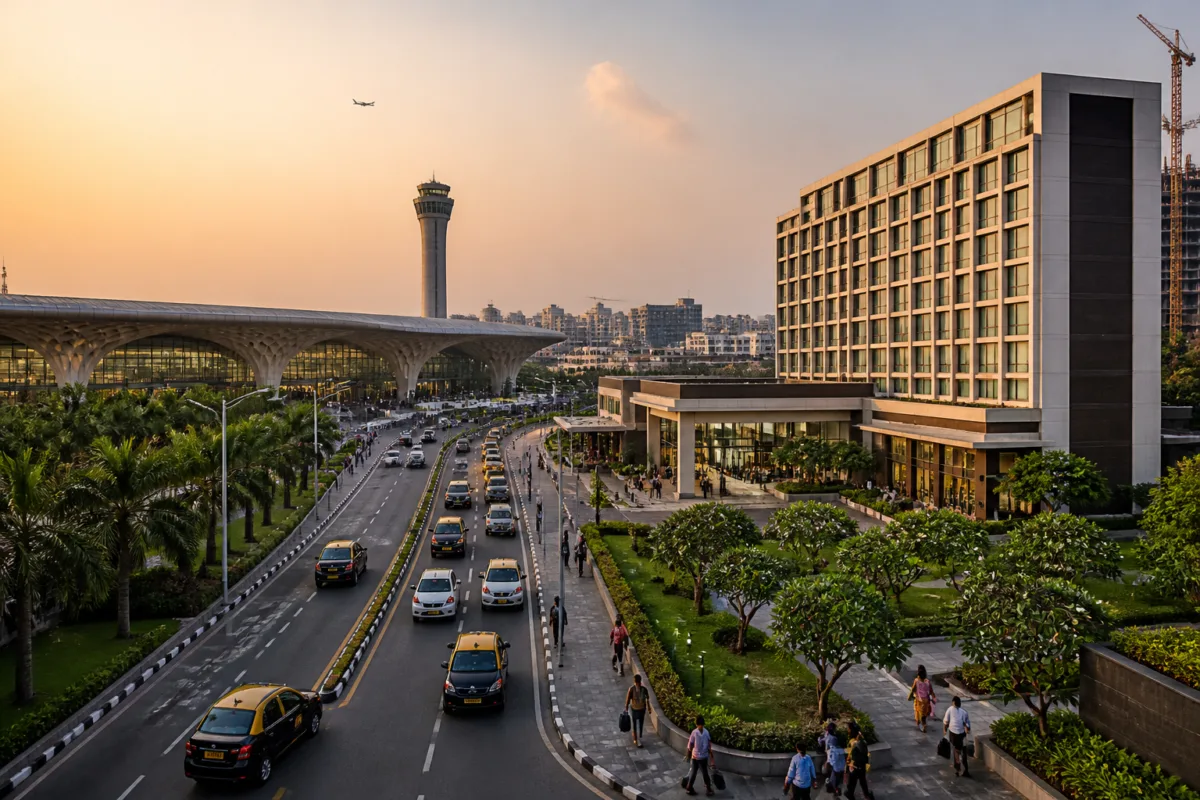
The agreement between Indian Hotels Company Limited (IHCL) and Adani Airport Holdings Limited (AAHL) to develop eight hotels with more than 2,000 rooms across Mumbai, Ahmedabad, Lucknow and Guwahati is more than a hospitality expansion. It is a significant step in the wider airport city development model, in which airport land and passenger flows are used to create commercial districts combining hotels, offices, retail, events and other urban services.
The eight properties will operate under IHCL’s Taj, Vivanta, Gateway and Ginger brands. AAHL will develop the hotels, while IHCL will operate them across luxury, upscale and midscale segments. Construction has begun on the Mumbai, Lucknow and Ahmedabad properties, according to people aware of the details cited in the announcement, while most of the hotels are expected to become operational in three to four years.
The locations show how airport-linked development is moving beyond the traditional idea of a terminal as a transport facility. In Mumbai, the portfolio includes a Taj hotel under construction at Terminal 2. Lucknow will have a Vivanta and a Ginger, while Ahmedabad will include a Taj and a Vivanta, both described as being in advanced stages of construction. Guwahati is set to receive a Taj, Gateway and Ginger.
Together, the hotels will provide accommodation, dining, meetings and events, wellness and recreational facilities. Their positioning across several price and service categories is intended to serve business travellers, leisure visitors, airport users and people attending events connected to these urban gateways. The arrangement also gives IHCL a wider presence across airport-linked districts, taking its planned portfolio to 25 hotels across its brands at key airports in India, according to IHCL managing director and chief executive officer Puneet Chhatwal.
The immediate commercial logic is clear. Airports concentrate passengers, employees, airlines, cargo operators, contractors, visitors and businesses in locations that often sit at the edge of established city centres. As air travel grows, these areas can generate demand for short stays, conferences, food and retail services and business accommodation. The hotel agreement attempts to capture that demand within planned airport developments rather than leaving it to scattered properties in surrounding areas.
But the larger urban significance lies in the scale of land and investment associated with the airport city programme. AAHL has formed Adani Airport City Limited to develop a land bank of more than 655 acres across six airports in five locations, including Mumbai, Ahmedabad, Lucknow, Jaipur and Guwahati. In its first phase, the company plans to invest more than Rs 20,000 crore to develop about 22 million sq ft across these locations, including Navi Mumbai.
These figures place the hotel announcement within a much larger real estate and infrastructure framework. Eight hotels with more than 2,000 rooms represent one component of a proposed 22-million-sq-ft development programme. The way that larger development is planned, connected and governed will determine whether airport cities function as integrated urban districts or as isolated commercial enclaves around terminals.
The distinction matters because airport-linked development requires more than buildings. It depends on road access, public transport, pedestrian connections, parking, utilities, drainage, security systems and the ability to manage large fluctuations in daily demand. A hotel may be physically close to a terminal but operationally disconnected from the city if access roads are congested or public transport links are weak. Conversely, a well-connected airport district can provide a new employment and services centre for a metropolitan region.
The partnership’s four-city footprint also highlights the different urban roles airports play. Mumbai’s airport is embedded within a dense metropolitan fabric, where land is constrained and terminal-area development must coexist with established neighbourhoods, major roads and high passenger volumes. Navi Mumbai introduces a separate metropolitan growth context, with airport-linked development being planned alongside a newer urban expansion area.
Ahmedabad, Lucknow and Guwahati present different development conditions, although the supplied announcement does not provide city-level investment or traffic data for comparison. The hotel mix nevertheless indicates an attempt to serve multiple types of demand rather than build only luxury accommodation. Taj properties target the luxury segment, Vivanta the upscale segment, while Gateway and Ginger extend the portfolio into other market categories.
That multi-brand structure is important for airport districts because demand is not uniform. International or corporate travellers may require full-service hotels and meeting facilities. Airline crews, transit passengers and short-stay visitors may prioritise convenience and price. Local businesses may use conference and dining facilities without booking rooms. A mixed portfolio can therefore support different operating patterns across the day and across travel seasons.
The institutional arrangement is also significant. AAHL is responsible for developing the properties, while IHCL will operate them. This separates the functions of land and project development from hospitality management and branding. It reflects a broader model in which airport operators seek to diversify beyond aeronautical revenue by monetising surrounding land and creating commercial ecosystems.
IHCL’s Chhatwal described airport-centric developments as emerging commercial and hospitality hubs as India’s aviation market expands. AAHL director Jeet Adani said airports around the world were evolving into integrated destinations and that the partnership would strengthen the hospitality ecosystem within the company’s Airport City developments. These statements establish the strategic intent, but they do not by themselves establish how the proposed districts will be integrated with municipal planning or public transport networks.
That question will become more important as airport operators develop larger non-terminal assets. A land bank of more than 655 acres and a planned 22 million sq ft of construction can influence surrounding property markets, employment patterns and traffic demand. It can also shift the location of commercial activity, particularly where airport districts are connected to new roads, metro systems or regional transport routes. The announcement does not specify the transport, utility or municipal arrangements supporting the full programme, leaving those details central to how its urban effects should be assessed.
The earlier AAHL agreement with IHG Hotels & Resorts adds another layer to the expansion. That partnership covers five hotels with 1,200 rooms across Jaipur, Mangaluru, Thiruvananthapuram and the Mumbai Metropolitan Region. Taken together with the IHCL agreement, it shows AAHL pursuing a multi-operator hospitality strategy across several airport markets rather than relying on a single hotel group.
For cities, the central issue is whether airport-led commercial growth can be absorbed into the wider urban system. Airports are often planned as specialised infrastructure, but their surrounding districts become ordinary city spaces once hotels, offices, retail, workers and visitors arrive. They require local roads, public services, emergency access, waste management and connections to residential and employment areas. The success of an airport city therefore depends not only on room supply or terminal proximity, but also on how responsibilities are divided between airport companies, hotel operators and public authorities.
The current agreement confirms the scale and direction of the proposed hospitality expansion. It does not yet provide a full implementation schedule for each property, detailed infrastructure plans, project costs by location or information on how the developments will connect with city-level planning. Those details will determine whether the projects operate mainly as airport amenities or become durable mixed-use districts within Mumbai, Ahmedabad, Lucknow and Guwahati.
For now, the most concrete milestones are already visible: construction is under way in Mumbai, Lucknow and Ahmedabad; the Ahmedabad Taj and Vivanta are in advanced stages; and most of the eight properties are expected to open within three to four years. The next stage will be to track project completion, supporting infrastructure and the extent to which these airport developments are integrated into the urban networks around them.

