


The Bombay High Court’s decision to create a task force for determining compensation to fisherfolk affected by Thane Creek Bridge III has shifted the dispute from a broad question of entitlement to a more difficult administrative question: how should a city measure livelihood loss when the baseline data did not exist before construction?
The court’s order, reported after a hearing on October 16, asks a task force led by the principal secretary of the Fisheries Department to complete the exercise within six months. The panel will include representatives of the Central Marine Fisheries Research Institute, Tata Institute of Social Sciences, Navi Mumbai Municipal Corporation and the Maharashtra State Road Development Corporation, with the option of involving other agencies.
That structure places a major infrastructure compensation dispute inside the machinery of government rather than leaving it to a single consultant’s assessment. It also reflects the court’s concern that affected fishing communities should not be made to wait indefinitely while agencies debate the value of losses linked to a public project.
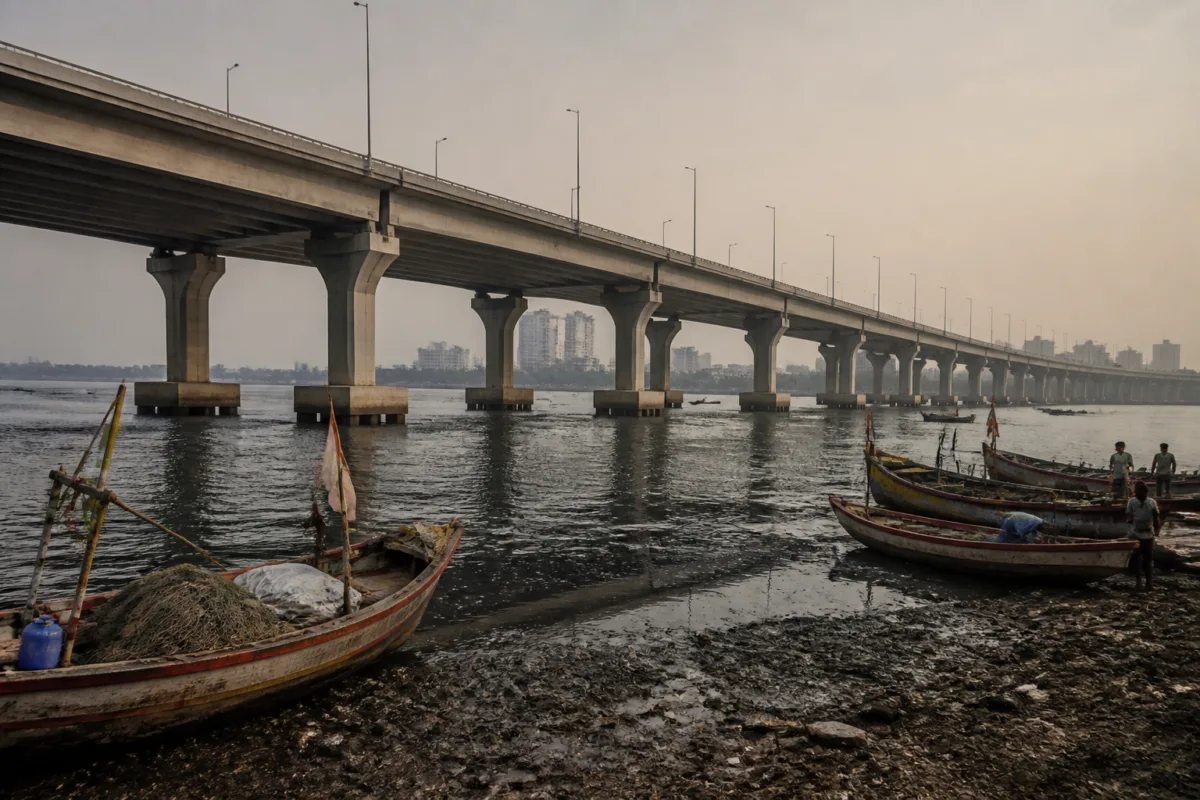
The underlying petition was filed in 2021 by a society representing fisherfolk from koliwadas including Vashigaon, Juhugaon, Koparkhairane, Ghansoli and Diva. These settlements are located around the Thane Creek region and were identified in the case as communities affected by the construction of the 1.83-kilometre, pier-supported bridge.
The dispute is not about whether the fisherfolk experienced any impact. The judges recorded that the fishing community was “definitely” affected to some extent by the construction. The disagreement is over the scale of that impact, the method used to calculate it and the period for which compensation should be paid.
In February 2022, the court directed MSRDC to deposit Rs 10 crore as ad hoc interim compensation for 937 families. That interim amount provided immediate relief while the larger claim was assessed. The subsequent process, however, exposed the institutional difficulty of converting a disruption to fishing activity into a defensible compensation figure.
MSRDC had appointed the Central Marine Fisheries Research Institute to study the issue. According to the report, the institute did not quantify the loss or recommend a consequent compensation amount. The court then appointed TISS to undertake the assessment.
TISS proposed compensation of Rs 141 crore. Its proposal included Rs 94 crore for direct losses over three years and Rs 47 crore for livelihood security over six years. The recommendation therefore went beyond a calculation of immediate income loss and included a longer-term support component.
The court questioned that approach. It said TISS had relied on income reported by fishermen in a socio-economic survey, which the judges described as “completely erroneous”. The court also held that TISS had travelled beyond its mandate by including livelihood security or support compensation without first assessing the actual impact on livelihoods.
The disagreement over the TISS report reveals two different ways of understanding compensation. One approach begins with reported household income and applies a period of disruption or livelihood support. The other seeks evidence of the specific physical and economic effect of the project: changes in access, catch, landing locations, drying areas, auction volumes and sales records.
The state’s position, presented through Advocate General Milind Sathe for MSRDC, was that TISS had not collected relevant records from the Fisheries Department or NMMC, including auction registers and sales data. Those records could have helped establish the value and volume of fish handled before or during construction, although the report states that the Fisheries Department did not have data on fisherfolk income.
The petitioners’ advocate, Zaman Ali, defended the TISS assessment. He said the institute had reviewed compensation literature and policies in coastal states, interacted with stakeholders and physically verified fish landing sites and drying zones. That account points to a different evidence problem: where formal administrative records are incomplete, researchers may have to combine field verification, stakeholder testimony and comparable policy frameworks.
The court’s criticism does not eliminate that problem. It makes the absence of a reliable baseline more visible. Amicus curiae senior advocate Sharan Jagtiani told the court that no scientific tools had been deployed to assess the actual impact and that there was no baseline data on fish catch or diversity before construction. Without such information, it becomes difficult to distinguish project-related loss from ordinary variation in fishing activity.
This is the central administrative challenge in the Thane Creek Bridge III case. Compensation requires a counterfactual: what would the affected families have earned or accessed if the project had not been built? For a fixed structure such as a building acquired for a road, the loss can often be tied to ownership, area or recorded market value. Fishing livelihoods are more dependent on access, ecological conditions, seasonal catch, landing infrastructure and market records.
The court also distinguished TCB-III from larger coastal infrastructure projects. It noted that construction of the 18.2-kilometre Mumbai Trans Harbour Link and the Coastal Road involved reclamation and permanent alteration of near-shore fishing access. TCB-III, by contrast, was described as a 1.83-kilometre pier-supported bridge addition with no reclamation, no coastline alteration and continued fishing during construction.
That comparison matters because compensation frameworks can become distorted when the impacts of different projects are treated as interchangeable. The judges said TISS had imported parameters from the MTHL into the TCB-III assessment. The observation suggests that the scale and type of physical intervention must be connected directly to the loss being claimed rather than borrowed from another project simply because both involve coastal infrastructure.
At the same time, the court’s distinction between projects does not settle the question of how temporary disruption should be valued. A project may cause no reclamation and still affect movement, access to fishing grounds, landing arrangements or the timing of daily work. The supplied report does not establish the extent of any such changes, which is precisely why the task force has been asked to reassess the matter.
The composition of the new task force indicates an attempt to combine technical, academic, municipal and project-authority perspectives. The Fisheries Department will lead the process. CMFRI brings a fisheries research role, TISS represents the institution that previously conducted the socio-economic assessment, NMMC holds local administrative relevance, and MSRDC is the implementing agency for the bridge project.
This multi-agency arrangement also creates a practical test of accountability. Each institution holds a different part of the record, and the court’s observations indicate that those records have not previously formed a common baseline. The panel will have to reconcile field evidence, administrative records, stakeholder accounts and the project’s physical characteristics within six months.
The financial gap between the figures discussed in the case illustrates the stakes. MSRDC was directed to deposit Rs 10 crore as interim compensation for 937 families. TISS later proposed Rs 141 crore, comprising direct-loss and livelihood-security components. The court described the proposed amount as disproportionate to the bridge’s Rs 500 crore construction cost, while also questioning the methodology used to arrive at it.
These figures should not be treated as competing price tags for the bridge itself. They represent different compensation concepts: interim assistance, direct loss and longer-term livelihood support. The court’s task force will need to determine which categories are legally and factually justified under the state government’s policy for project-affected fishermen.
The case therefore raises a wider issue for urban infrastructure administration. Large projects are often planned through engineering estimates, construction schedules and land or property requirements. Livelihood disruption can be less visible because it may not appear as a permanent change in land ownership. Yet when a project intersects with a working waterfront, the relevant urban asset is not only the bridge or road. It is also the access system that supports local economic activity.
The Thane Creek dispute shows why impact assessment cannot end with a project’s physical footprint. The court recorded that fishing continued during construction and that the bridge involved no reclamation or coastline alteration. Those facts are relevant, but they do not by themselves measure whether working conditions, access routes or fishing returns changed. Establishing that link requires evidence collected before, during and after construction.
The proceedings also show the limits of using general compensation literature to fill local data gaps. Comparable policies may provide useful reference points, but the court’s criticism indicates that they cannot substitute for project-specific assessment. A bridge, a reclaimed road corridor and a sea link may all affect coastal communities differently, even if they fall within the same broad infrastructure category.
For the affected families, the next stage is not an immediate final payout but a new assessment process. The task force has six months to complete its exercise, and the court expects the outcome to be consistent with the state government’s policy for project-affected fishermen. The panel may involve additional authorities or agencies if required.
What the court has established so far is a process, not a final compensation amount. The Rs 141 crore TISS proposal has been questioned, the Rs 10 crore interim deposit remains part of the case history, and the full extent of project-related livelihood loss is still to be determined. The outcome will depend on whether the new task force can build the baseline that earlier assessments lacked and connect its findings to the specific physical and economic effects of Thane Creek Bridge III.

