


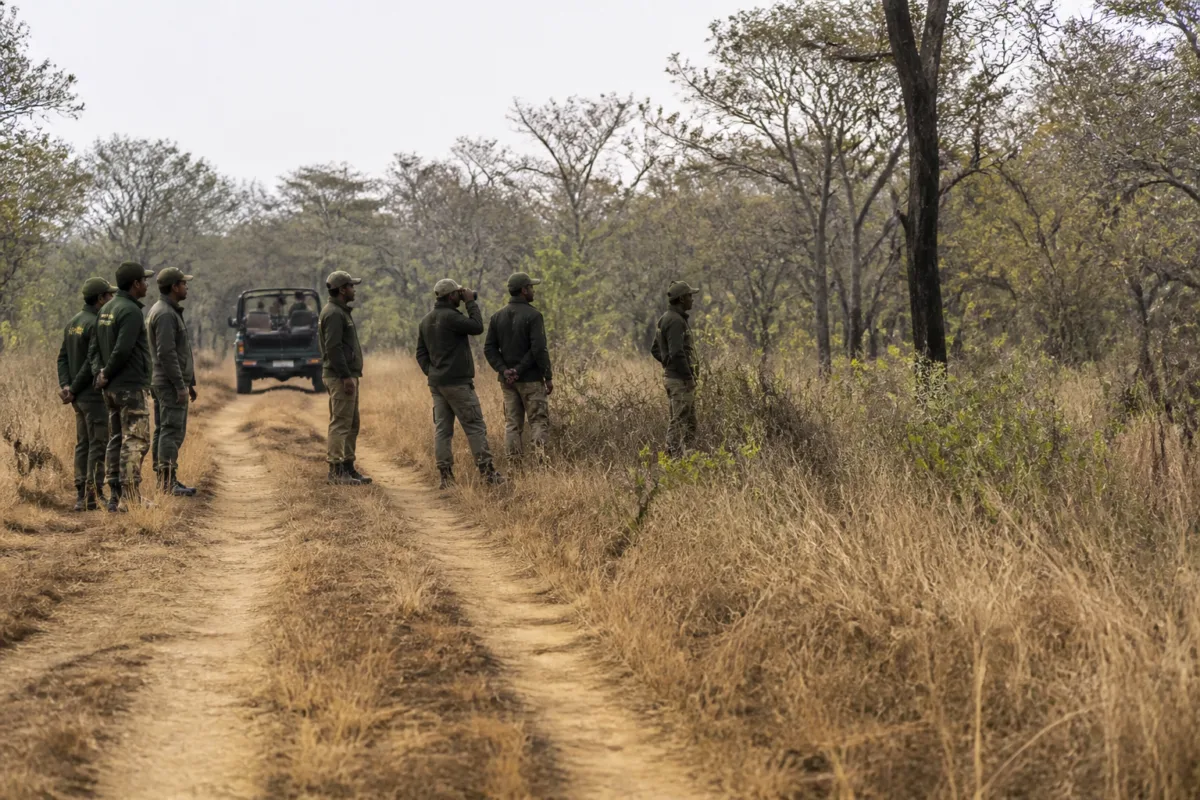
The death of a 19-month-old cheetah cub at Kuno National Park has become more than a suspected wildlife crime. Medical evidence indicates that KNG22 was struck by multiple firearm pellets, while the subsequent investigation is examining how armed hunters could operate near a high-profile reintroduction landscape and whether existing protection systems were sufficient to detect the threat.
The Union government has deputed a team comprising senior officials from the National Tiger Conservation Authority and the Wildlife Crime Control Bureau to examine the case. The team is working with a four-member Special Task Force formed by Madhya Pradesh after veterinarians recovered pellets from the cub’s body. The state task force is expected to submit its report to the government around November 3.
That response places the incident within two overlapping systems: the protection of an individual reintroduced animal and the wider enforcement network around Kuno. The first question is what happened to KNG22. The larger question is whether the systems created to protect an internationally prominent conservation project are sufficiently connected to the intelligence, policing and field surveillance needed to prevent wildlife crime.
The evidence from the veterinary examination is the clearest established element of the case. KNG22 was brought to Jabalpur late on October 26 after trackers found it in the same location on October 25 and again around noon that day without movement. Veterinarians recorded multiple wounds, hindlimb paralysis and urinary retention, indicating possible spinal trauma.
A CT scan at Nanaji Deshmukh Veterinary Science University found metallic foreign bodies in and around the spine, including in the body of the first lumbar vertebra, between the first lumbar and thirteenth thoracic vertebrae, and below the thirteenth thoracic vertebra. Two further objects were located beneath the skin near the left shoulder, while another was found in the right lung. Doctors removed five firearm pellets during surgery, but the cub died at about 5.10 am on October 27.
The medical findings establish that the injuries were associated with firearm pellets and affected the spine, shoulder and lung. They do not, by themselves, establish who fired the weapon, why the animal was shot or whether the shooting was deliberate. Those questions remain with the state and central investigators. No arrest had been announced in the supplied report, and officials had not identified the people being questioned or attributed a role to them.
The investigation has nevertheless identified a potentially important field-security issue. Officials reportedly questioned several suspects, while a group of traditional poachers living in huts belonging to another nomadic community was said to have left the area after forest officers began their inquiry. Investigators are trying to establish who the group members were, how long they had stayed and where they went. Their departure is a lead, not proof of involvement in the cub’s death.
The area had already attracted the attention of investigative agencies because of suspected leopard poaching. The report refers to the recent seizure of 10 leopard skins in Agra, but officials have not established whether that case is connected to the Kuno shooting or whether the same network was involved. Investigators are examining that possibility rather than presenting it as a confirmed link.
One line of inquiry is that a hunter may have mistaken the cheetah for a leopard or fired during an encounter while pursuing other wildlife. This possibility illustrates the difficulty of protecting reintroduced predators in landscapes where conservation areas, settlements and mobile hunting groups can exist close to one another. It also shows why the investigation must examine not only the shooting site but movement patterns, local intelligence, access routes and the response time after the animal was found injured.
Kuno’s importance makes the case particularly consequential for India’s cheetah programme. Cheetahs were brought back from Namibia in September 2022 under Project Cheetah, with Kuno designated as the main site. KNG22 was one of the offspring of Nirva and belonged to that restored population. The programme therefore depends not only on the survival of individual animals but also on the ability of institutions to manage threats around the landscape into which they have been introduced.
India’s previous cheetah history adds a historical dimension to the incident. The last widely recorded killing of wild cheetahs in India took place in December 1947, when Maharaja Ramanuj Pratap Singh Deo shot three animals in the sal forests of Koriya, now in Chhattisgarh. India declared the cheetah extinct in 1952. The return of the species in 2022 transformed Kuno into the centre of a national conservation effort, making the alleged shooting an unusually direct test of how the country protects a species it has chosen to restore.
The institutional response shows that responsibility is distributed across several levels. The state forest department initiated the local investigation and formed the STF. The team includes the officer in charge of the State Tiger Strike Force as chairman, a deputy superintendent of police from the STF unit in Gwalior, a deputy forest officer from the Kuno Wildlife Forest Division and a member secretary from the Sheopur Regional Forest Division. The Union-level team brings together the NTCA and WCCB, while the Ministry of Environment, Forest and Climate Change is expected to issue directions after receiving its findings.
This structure provides specialised capacity, but it can also make accountability dependent on coordination. Forest officials may control the protected landscape, police units may investigate firearms and suspected poaching, and the WCCB may examine wildlife-trafficking networks. The Kuno case requires these functions to work from the same evidence rather than as separate inquiries. The central team’s stated review of security, monitoring and protection measures suggests that investigators are examining the system as well as the incident.
The timeline also matters. Trackers observed that the cub remained in one location on October 25 and again at noon. Officials then decided to rescue it and arrange medical treatment, transporting it to Jabalpur at 11.50 pm on October 26. The cub died a few hours later. The available account does not establish whether the delay between the first observation and transport affected the outcome, and it would be inappropriate to draw that conclusion without a veterinary or administrative assessment. It does, however, make the response timeline an important part of the official review.
The case also demonstrates the limits of monitoring when it is focused primarily on animal location and health. Tracking can identify that a cheetah has stopped moving, but protection requires the ability to determine why, secure the area, identify human activity and preserve evidence quickly. The investigation’s attention to people who may have left the area indicates that field intelligence and local information could be as important as technology or animal tracking.
The available evidence confirms a firearm injury, a fatal outcome and the mobilisation of state and central agencies. It does not yet confirm the shooter, motive, criminal network or failure by any specific official or institution. Those distinctions are essential in a case where public attention is likely to outrun the investigation. The high court petition seeking a Central Bureau of Investigation inquiry is another development, but the supplied report does not record any judicial decision on that request.
The next significant test is the state STF’s report, alongside the central team’s assessment of the circumstances, evidence, security and protection arrangements at Kuno. Until those findings are released, the death of KNG22 should be understood both as an alleged wildlife crime and as an examination of whether India’s institutional architecture for protecting reintroduced species can operate effectively beyond the boundaries of the conservation programme itself.

