


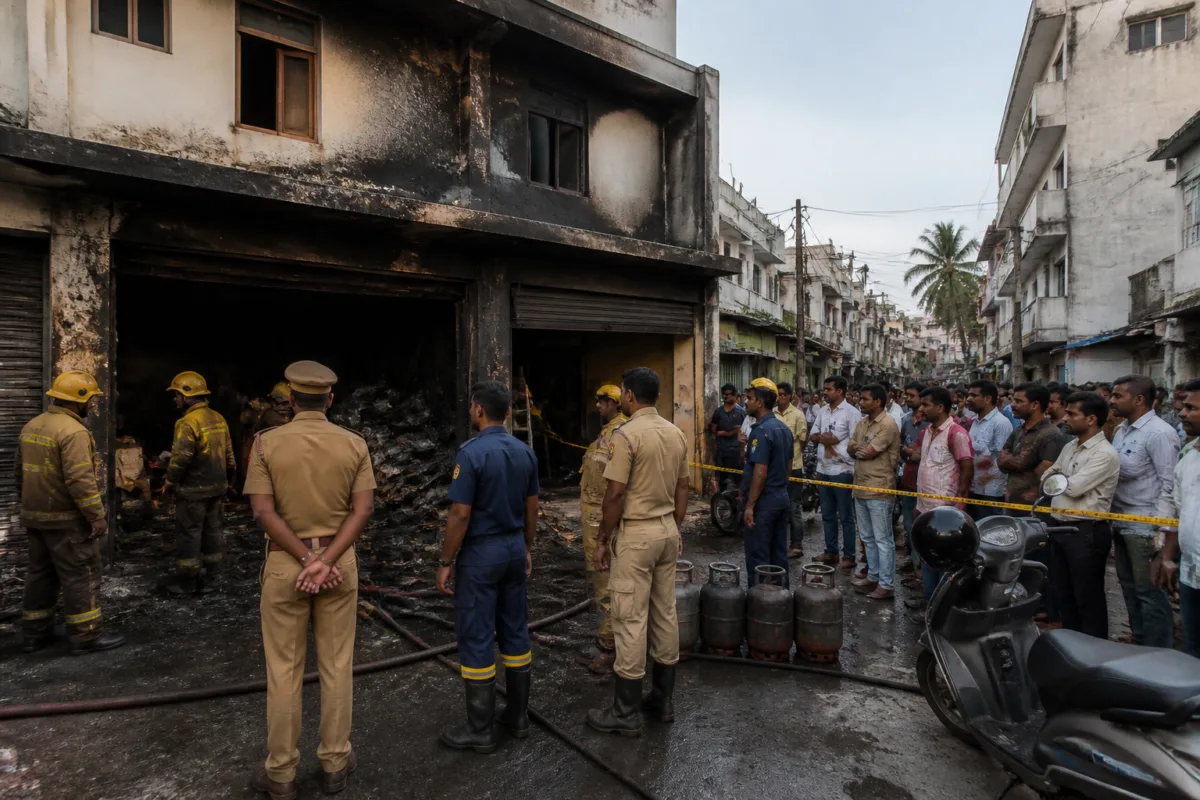
The Bengaluru gas fire that killed a couple in Kammagondanahalli was not only a fatal incident inside a small commercial premises. It also exposed how hazardous commercial activity, residential occupation and weak safety separation can coexist within the same urban building. The deaths of Akash and Nagaratna, who were trapped in a room above the shop, show how a fire on the ground floor can become a deadly residential emergency when escape routes, storage practices and enforcement fail together.
The fire occurred at about 8.30pm on Saturday, October 24, in an auto-mobile shop within the limits of Gangammanagudi police station. The couple lived in a room on the first floor and worked at an Indian Oil petrol bunk. According to the report by Prajavani, residents informed the authorities on Monday after noticing a foul smell. Police later found the bodies inside the upper-floor room.
The immediate human tragedy was shaped by the building’s internal arrangement. The fire began in the shop on the ground floor, while the couple was in the residence above it. They were unable to get out and died of suffocation, according to the report. This detail matters because fire risk in a city is not determined only by the material that catches fire. It is also determined by whether people living above or beside a hazardous activity have a safe, usable and independent way to escape.
The premises was reportedly being used for gas refilling, while allegations of illegal retail sale of petrol and kerosene from outside sources were also under examination. Police registered a first information report against shop owner Sabeek Pasha and building owner Hinayath Ullah on allegations of negligence. The report said the shop owner had for several years sold auto-mobile materials, different oils and cylinders.
The account contains an important distinction about the source of the fire. More than 20 gas cylinders were reported to have exploded in succession after a gas leak was noticed. However, Deputy Commissioner of Police Nagesh said preliminary investigation indicated that the incident was not caused by a cylinder explosion. The fire department and Bescom were expected to submit reports to establish whether a short circuit or another source caused the fire. That distinction remains unresolved in the supplied account and is central to determining responsibility.
The difference between a gas leak, ignition, fire spread and subsequent cylinder explosions is not merely technical. Each stage points to a different failure and potentially involves different regulatory responsibilities. A leak may indicate unsafe handling, defective equipment or poor storage. Ignition may involve an electrical fault or another source. Explosions may occur after fire reaches cylinders stored in an unsafe location. A final determination therefore depends on the fire department’s examination, electrical assessment and police investigation rather than on the visible result alone.
The case also raises the question of how a small urban shop came to handle multiple categories of hazardous material. The reported activity extended beyond ordinary automobile retailing. Police were examining allegations that gas refilling was being conducted illegally and that petrol and kerosene were being sold in small quantities. The source does not establish whether the premises had any valid licence, whether the storage quantities complied with safety rules, or whether inspections had previously taken place. Those unanswered questions are significant because the regulatory status of the activity will determine whether the incident was an isolated act of negligence or evidence of a wider enforcement failure.
Mixed-use buildings are common in Bengaluru, particularly in established neighbourhoods where shops occupy ground floors and families live in rooms above them. This arrangement can support affordable livelihoods and reduce travel for residents, but it also creates a direct interface between commercial risk and domestic life. A shop storing ordinary consumer goods presents one kind of risk. A premises handling gas cylinders, fuel or kerosene presents another. The safety system has to recognise that difference instead of treating every ground-floor business as equivalent.
The deaths in Kammagondanahalli demonstrate the consequences of treating the upper floor as a separate household when the ground floor functions as a hazardous workplace. The couple’s inability to leave suggests that the building’s escape conditions were not sufficient once the lower level caught fire. The supplied report does not say whether there was a second staircase, an accessible external exit, a fire alarm, emergency lighting or any other protective system. It also does not establish the building’s approved use. These facts will be important to understanding whether the danger arose from illegal activity, inadequate building design, poor maintenance or a combination of these conditions.
Responsibility in such cases is distributed across several institutions. The police investigate negligence and other possible offences. The fire department examines the origin and spread of the fire and can assess fire-safety conditions. Bescom’s report is relevant if an electrical fault is suspected. Building and local enforcement authorities may also have a role in determining whether the premises was being used lawfully and whether hazardous storage or refilling activity was permitted. The report specifically identified the police, fire department and Bescom, but it did not state whether municipal or licensing authorities had inspected the premises.
This institutional division can make accountability difficult after a disaster. Each agency may examine a different part of the chain: the police may focus on negligence, the fire department on the origin of the blaze, the electricity utility on wiring, and licensing authorities on the legality of the business. Yet the victims experienced the outcome as one connected failure. For urban safety, the relevant question is not only who caused the ignition but also why a dangerous activity could operate below a residence without effective prevention, detection or evacuation measures.
The available numbers underline the intensity of the incident. The report said more than 20 cylinders exploded in succession, although the police account cited in the same report said preliminary investigation did not establish a cylinder explosion as the initiating cause. Two people died from suffocation. The fire was reported at approximately 8.30pm, and the bodies were found only after residents reported a foul smell on Monday. The time between the fire and discovery is another important operational detail, although the supplied material does not explain why the couple was not located earlier or whether they had been reported missing.
The incident therefore sits at the intersection of three urban systems: land use, hazardous-material regulation and emergency response. Land-use controls determine whether residential occupation and a risky commercial activity can share a building. Safety regulation determines how cylinders and fuels may be stored or handled. Emergency systems determine whether residents can detect a fire, move through smoke and reach safety. A failure in any one system can be serious; when all three overlap in a small building, the consequences can be fatal.
What the evidence confirms is that a couple died after becoming trapped in a room above a burning shop, that an FIR was registered against the shop owner and building owner on allegations of negligence, and that authorities were investigating the source of the fire and the reported fuel-handling activity. What remains unsettled is whether the fire began with a gas leak, an electrical short circuit or another source; whether cylinders actually exploded or were affected after ignition; and whether the premises had the required permissions.
The next meaningful development will be the reports from the fire department and Bescom, followed by the police investigation and any action based on those findings. Those reports should establish not only how the fire started but also how hazardous materials were stored, whether the building’s use complied with applicable requirements and why the residents above the shop had no effective route to safety.

