


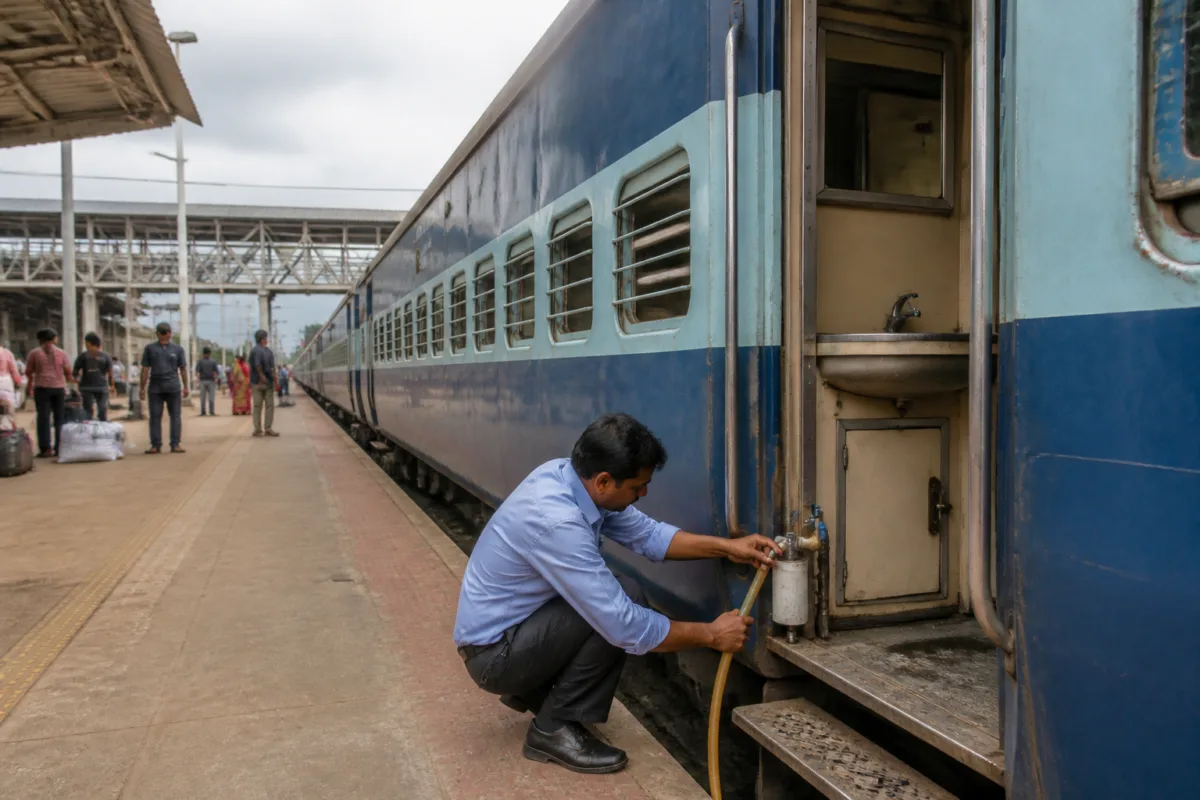
A consumer commission’s order against South Western Railway over the absence of water in train toilets turns a seemingly routine passenger complaint into a clear test of how railway service failures are recorded, escalated and compensated. The case involved 24 passengers travelling from Yesvantpur to Shivamogga, but its wider significance lies in the gap between a railway service being available on paper and being usable during an actual journey.
The District Consumer Disputes Redressal Commission in Shivamogga found deficiency in service after passengers travelling on train No. 66575 reported that the toilets had no water. The passengers said they alerted the Tumakuru station master but received no response. They eventually got off at Tumakuru and spent an additional Rs 1,760 on tickets for another train.
The commission ordered the station masters of South Western Railway in Bengaluru and Tumakuru railway station to refund the original Rs 1,000 fare, with 6% annual interest from April 15, 2025. It also directed them to pay Rs 10,000 as compensation for the inconvenience and Rs 5,000 towards court expenses. The payments were ordered within 45 days. If the deadline is missed, the interest rate will rise to 10% annually until the amount is paid.
The order, reported by the Times of India and attributed to a release issued by the information department, was passed on October 23 by a bench comprising commission president T Shivanna and member BD Yoganand Bhandya. The complaint was filed by Nagendra, a resident of PWD Quarters in Basavanagudi, Shivamogga, after a legal notice went unanswered.
The facts show how a minor-looking infrastructure failure can produce a chain of consequences for passengers. The absence of water was not confined to an inconvenience inside a railway toilet. According to the report, the passengers changed trains, incurred an additional expense and pursued a legal remedy after their initial complaint did not receive a response. The case therefore connects physical maintenance with communication and grievance handling.
That connection matters because passenger-facing infrastructure is experienced as a combined system. A toilet without water is one problem. A complaint that does not receive a timely response is another. When both occur during a journey, passengers have limited ability to solve the problem themselves. They may not know which authority controls the facility, whether the train can be serviced at the next station or how quickly a complaint will be acted upon.
The case does not establish how often similar failures occur across South Western Railway or whether the problem was limited to this train. The supplied report also does not identify the operational reason for the absence of water, the point at which the facility became unusable or the response taken by railway officials after the complaint was made. Those gaps are important because the commission’s order addresses the passenger outcome, while the underlying maintenance failure remains unexplained in the available material.
Even without that operational detail, the order offers an identifiable accountability pathway. The passengers first alerted the Tumakuru station master. After receiving no response, they issued a legal notice. When that notice went unanswered, Nagendra approached the consumer commission. The sequence shows that service accountability can depend not only on the condition of infrastructure but also on whether institutions create an effective route for complaints to be acknowledged and resolved.
The order also places a monetary value on the consequences of the failure. The refund of Rs 1,000 addresses the fare paid for the journey. The Rs 10,000 compensation recognises the inconvenience, while the Rs 5,000 court-cost award accounts for the expense of pursuing the complaint. The additional interest provision creates a further deadline-based obligation for the railway authorities.
This separation between refund, compensation and costs is significant in understanding the structure of the decision. The passengers were not directed only to receive back the original fare. The commission also imposed amounts linked to inconvenience and litigation. That makes the order a response to the service experience as a whole rather than only to the price of the ticket.
The passenger group also adds an important ground-level dimension. Nagendra travelled with 23 family members and relatives, and the group used general tickets costing Rs 1,000 in total. A failure affecting one coach or one journey can therefore affect several people at once. The reported additional expenditure of Rs 1,760 exceeded the original fare, demonstrating how quickly a basic service failure can create a disproportionate cost for passengers who have to abandon their planned journey.
The incident further illustrates the difference between transport infrastructure and transport usability. A train can operate on schedule and still fail passengers if essential facilities are not functional. In this case, the reported issue was not a delay, cancellation or fare dispute. It concerned a basic facility within the train, and the passengers’ decision to leave the service indicates that the problem affected their ability to continue the journey as planned.
For railway administration, the case raises a question about where responsibility is located. The order names station masters of South Western Railway in Bengaluru and Tumakuru railway station. The available report does not explain the precise division of responsibility between the train, the originating station, the receiving station or the railway department responsible for onboard water supply. That institutional detail would be necessary to understand whether the failure arose from train preparation, station-level intervention, communication, or another maintenance process.
The complaint also demonstrates the importance of a documented response system. The passengers said they alerted the station master, but received no response. The report does not state whether the complaint was entered into a formal register, forwarded to another department or followed by an inspection. Without such information, it is difficult to determine whether the breakdown was primarily physical, administrative or both. The commission’s order, however, makes clear that the absence of an effective response did not prevent the passengers from seeking a remedy later.
The public-interest value of the case lies in this relationship between everyday infrastructure and institutional conduct. Water supply in train toilets is not normally treated as a major transport policy question. Yet when it fails, passengers experience the railway as a service provider rather than simply as a network of tracks, trains and stations. The quality of that service depends on small systems that are often invisible until they stop working.
The case should not be read as proof that all South Western Railway trains face the same problem. The supplied report contains no network-wide data, inspection findings or statement from the railway department explaining whether corrective measures were taken. It records one complaint, the commission’s finding and the financial directions issued against the railway authorities. That distinction is essential: the order establishes accountability in this case, but not the scale of the underlying maintenance issue.
What it does establish is that passengers can seek compensation when a failure in a basic train facility causes measurable disruption and the complaint is not resolved. The commission’s deadline gives the railway authorities a defined next step: refund the fare with interest and pay the ordered compensation and court expenses within 45 days. The further 10% interest provision will apply if the payment is delayed.
The next significant development is therefore administrative rather than symbolic. The railway authorities must comply with the commission’s order or face the higher interest liability specified in the decision. Whether the case leads to any disclosed internal review, maintenance response or change in passenger grievance handling is not established in the available report and remains the point requiring further reporting.

