


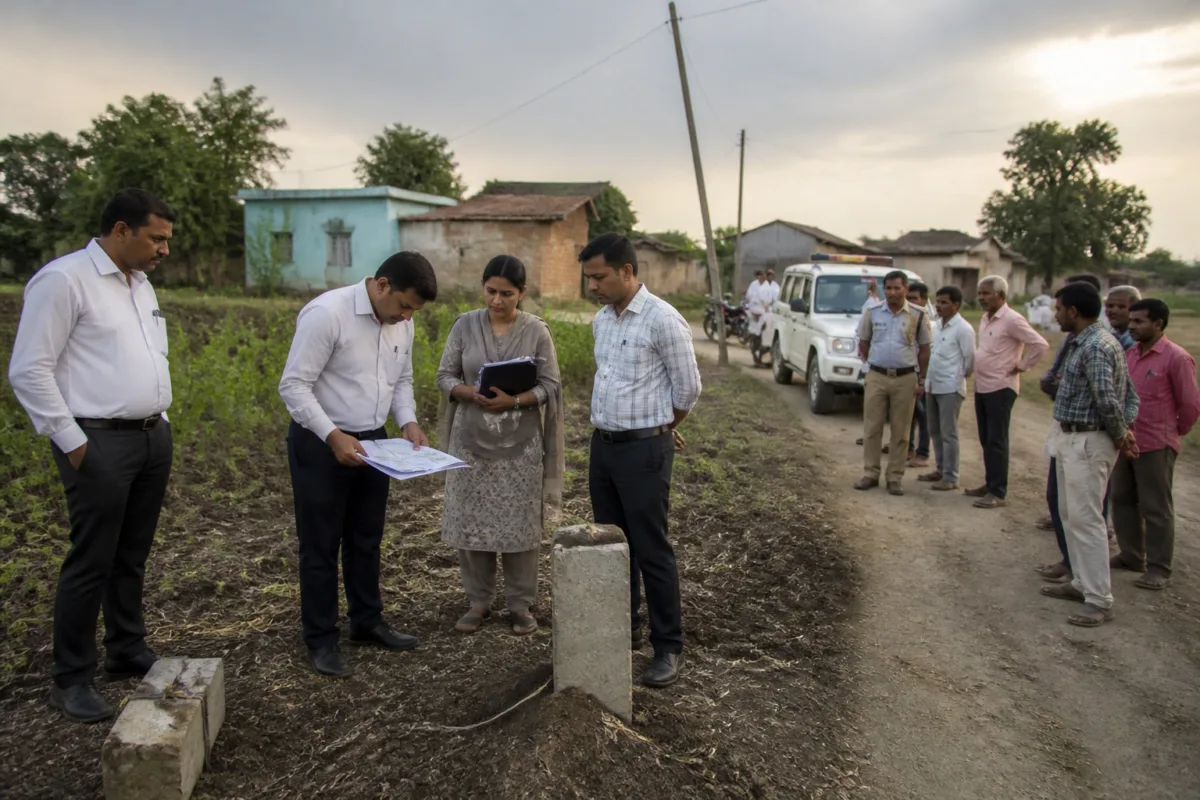
The attack on a revenue team during land demarcation in Bhaklay village, Khargone, has moved beyond a local criminal case. The constitution of a Special Investigation Team, the arrest of eight of 14 identified suspects and the addition of an attempt-to-murder charge show the seriousness with which the administration is treating the incident. But the demands raised afterwards by patwaris point to a wider weakness: the state’s ability to protect officials who perform essential, often contentious, field-level work.
Revenue administration is one of the most direct points of contact between citizens and the state. Land demarcation can affect boundaries, possession, records and disputes between parties. In this case, the work was being carried out in Bhaklay village under the Mandaleshwar police station area when Revenue Inspector Abhishek Jamra and patwari Raja Kumar were injured on October 24. Both were given primary treatment and referred to Indore.
The immediate official response has been investigative and punitive. Superintendent of Police Ravindra Verma said the SIT would be headed by the Mandleshwar sub-divisional officer of police. Police had identified 14 suspects and arrested eight, while an attempt-to-murder provision was added to the case. These steps establish an enforcement response, but they do not by themselves answer the administrative question raised by the incident: how should land-related field operations be conducted when the officials involved may face resistance or violence?
That question is important because the work of a revenue inspector or patwari is not confined to an office. The incident occurred during land demarcation, a process that requires officials to work at the site where competing claims, disputed boundaries or local tensions may be present. The supplied report does not establish the specific dispute or motive behind the attack. It does, however, show that a routine administrative exercise created conditions in which two officials were injured and field staff subsequently sought institutional protection.
The response from patwaris is therefore significant. On Tuesday, they submitted memorandums to the collector and the superintendent of police, demanding security for field staff, fixed working hours, exemption for women employees from late-night duties and resolution of technical problems affecting departmental portals. They warned of an agitation if their demands were not addressed.
Taken together, these demands describe a system under pressure at several points. Security is the most visible concern because it follows a physical attack. Working hours and late-night assignments concern how field duties are organised. The demand to exempt women employees from late-night duties adds a workplace-safety dimension. Technical problems affecting departmental portals point to a different but connected problem: even when officials reach the field, administrative processes may be slowed or disrupted by digital systems that do not function reliably.
The incident therefore cannot be understood only as a question of policing. Police action is necessary in a case involving injuries and an attempt-to-murder charge, but land administration also depends on coordination between revenue officials, district authorities and the police. The SIT’s creation places the investigation within a dedicated structure. The memorandums show that field staff are asking for protection and operational changes that sit across the same administrative chain.
The institutional roles mentioned in the report make that coordination visible. The police are handling the criminal investigation and arrests. The SIT is being led by a sub-divisional police officer. Patwaris have approached both the collector and the superintendent of police, indicating that their concerns involve district administration as well as law and order. No details have been provided about whether a standard security protocol existed for the land-demarcation exercise, whether a police presence had been requested beforehand or whether the technical portal problems contributed to the confrontation. Those gaps are important because they define what remains unknown about the operational failure.
The case also illustrates the difference between an administrative service and the public perception of that service. A land survey or demarcation exercise may appear procedural from an office perspective, but at ground level it can have immediate consequences for people who occupy, cultivate, buy or claim land. The report does not identify the parties involved or describe the disputed property. It does establish that the officials were attacked while performing the task, which means the state’s capacity to carry out land-related decisions safely is itself a public concern.
The demands for fixed working hours and restrictions on late-night duties suggest that field administration is not governed only by the formal assignment of a task. Timing affects the safety of employees, the availability of support and the ability of senior officials to respond when an operation becomes contentious. The request for security indicates that staff do not view personal protection as an exceptional requirement limited to high-profile operations. They are asking for it as part of the normal conditions under which field work is performed.
The mention of departmental portals adds a service-delivery dimension. The supplied material does not specify which portals are affected, what technical failures have occurred or how many cases have been delayed. It would therefore be incorrect to claim that digital problems caused the attack or directly produced the administrative dispute. Their inclusion in the patwaris’ memorandum nevertheless shows that staff see technology failures, workplace conditions and physical security as connected parts of their daily work. A digital land-administration system cannot substitute for safe and adequately supported field operations when officials must verify or mark conditions on the ground.
The events also raise a question about how the administration measures continuity. Eight arrests and the formation of an SIT address accountability after the incident. The staff memorandum raises continuity before and after such incidents: whether officials can continue attending field assignments, whether women employees can do so without being placed in unsafe situations, and whether delayed or malfunctioning portals increase pressure on frontline staff. The report does not state whether work in the area has been suspended or whether the demands have been accepted. Those are the next administrative facts that will determine whether the response remains limited to the investigation or leads to changes in field operations.
There is also a clear distinction between a criminal remedy and an administrative remedy. The criminal case may establish responsibility for the attack through investigation and prosecution. An administrative response would have to address the conditions that officials say make their work unsafe or inefficient. The collector and the superintendent of police have received the memorandums, but the supplied report contains no formal response from either authority. Until such a response is recorded, it is not possible to say whether security arrangements, working-hour rules or portal repairs will follow.
For citizens, the practical issue is not only the safety of government employees. Revenue fieldwork affects the ability of residents to obtain decisions and records from the state. If officials cannot safely conduct demarcation, or if staff action is disrupted by unresolved technical problems, land-related processes may become slower and more contested. The report does not provide data on delays, pending cases or the number of affected employees, so the scale of the problem cannot be quantified from the available evidence. The incident does show, however, how a failure at the field level can affect both institutional trust and the delivery of a basic administrative function.
The Khargone case thus presents a layered governance test. The SIT must establish what happened during the land-demarcation exercise and pursue the criminal case against those identified. District authorities must also respond to the operational demands raised by the patwaris. The evidence currently confirms the attack, the injuries, the arrests, the enhanced charge and the staff memorandum. It does not yet establish the motive, the precise dispute, the adequacy of prior security arrangements or the status of the employees’ demands. Those are the facts that will show whether the administration has treated the episode as an isolated assault or as a warning about the safety and reliability of field governance.

