


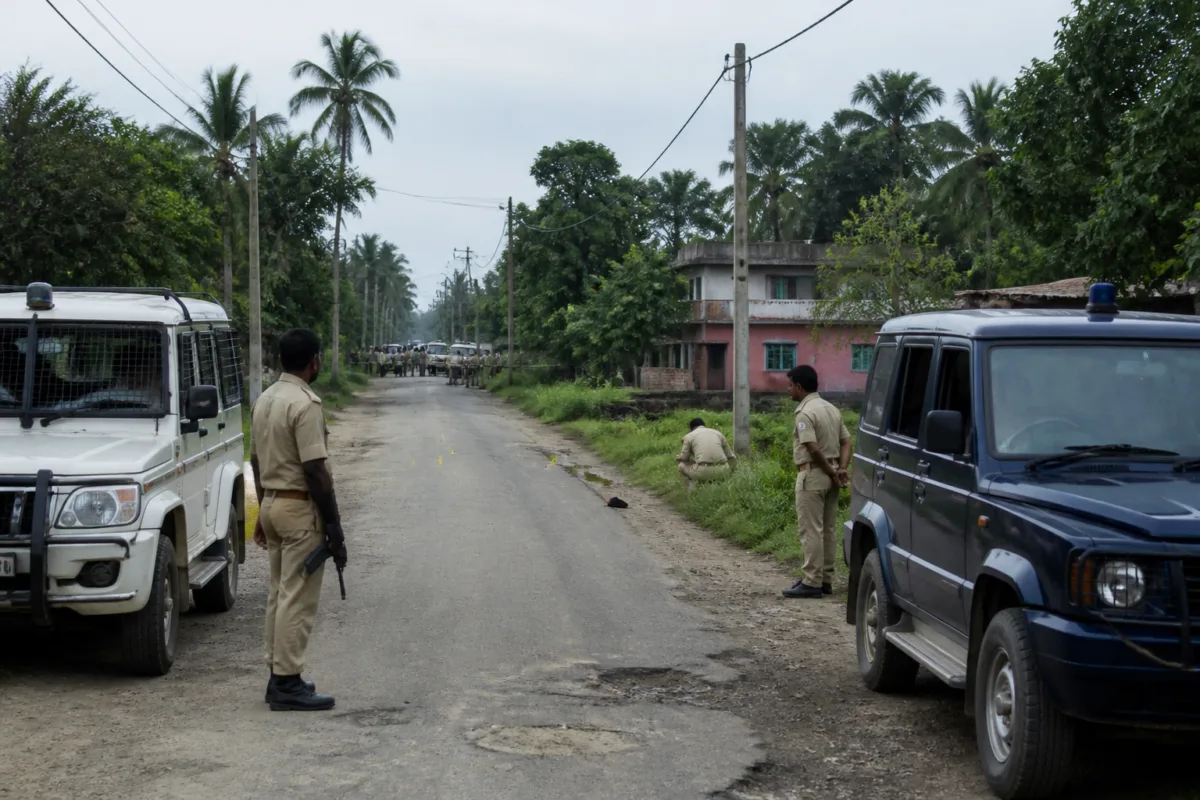
The killing of a rape-and-murder accused in police firing in North 24-Parganas, followed hours later by a similar shooting in Murshidabad, has brought Bengal’s approach to custodial violence, police discretion and criminal justice under scrutiny. The police have described both incidents as acts of self-defence, while a human rights activist has called for an independent examination of the official account.
The first incident took place in Gaighata, around 70km from Calcutta, after officers took Prahlad Das to the alleged crime scene for a reconstruction. Das was accused of raping and murdering a 17-year-old Class XI student whose body was found behind a relative’s house after she went missing following a musical programme. According to the police account reported by Telegraph India, Das allegedly snatched a sub-inspector’s revolver, fired three rounds and injured the officer lightly. Other officers then fired four rounds, hitting Das.
The second shooting was reported in Murshidabad. The man killed there had been arrested in connection with the kidnapping and murder of a BJP worker. The report says he allegedly snatched a CID officer’s revolver and opened fire. The two incidents, occurring within hours of each other, have therefore been presented by the authorities through a similar sequence: an accused person in custody, an alleged attempt to seize a service weapon, gunfire directed at police and retaliatory firing.
That recurring sequence is central to the public-interest question. In the Gaighata case, the police said the shooting occurred after the reconstruction exercise, when the accused asked to leave the vehicle to relieve himself. The account says the vehicle stopped, Das stepped out, seized the officer’s revolver and fired. The duty medical officer at Chandpara block primary health centre declared him dead. These details establish the police version of events, but they do not by themselves settle whether the use of lethal force was necessary or whether the sequence can be independently reconstructed.
The distinction matters because a police encounter is not only an operational incident. It is also an event involving the death of a person who had not been convicted by a court. The original criminal allegation may be grave, and the family of the murdered girl may experience the accused’s death as relief, but the death does not remove the state’s obligation to establish what happened during the shooting. The competing demands of public safety and due process do not disappear when the accused is unpopular or suspected of a serious offence.
Human rights activist Sujato Bhadra questioned the police account and alleged that the Gaighata encounter was staged. He argued that the police could not become the judge and executioner and called for the Calcutta High Court to intervene. Bhadra demanded the suspension of the officers involved and the registration of a murder case, saying the police should establish before a court that the firing was genuinely an act of self-defence. These are allegations and demands, not findings established in the supplied report, but they identify the unresolved institutional issue: who independently tests the police narrative when the shooting itself eliminates the accused’s ability to give evidence?
The report also places the Gaighata shooting in the context of an earlier case in Baruipur, where an accused in a child-rape case was shot dead after allegedly snatching a sub-inspector’s gun during a late-night crime-scene reconstruction. The similarity is significant because it suggests that the reconstruction of a crime scene has become the setting in which the state’s account of an armed confrontation is being formed. That does not prove that either incident was improperly conducted. It does, however, make the procedures surrounding such reconstructions especially important to public scrutiny.
A reconstruction is intended to help investigators understand the sequence of an alleged offence. It requires officers to take an accused person to a location connected with the case and to document movements or actions. The supplied report does not state what safeguards were used in Gaighata, how many officers were present, whether the accused was restrained, whether independent witnesses were involved, or whether the exercise was recorded. Those omissions do not disprove the police account, but they show why a reconstruction involving an accused in custody needs a clear and reviewable chain of procedure.
The political response has added another layer to the issue. Chief minister Suvendu Adhikari said the police had already explained the reasons behind the encounter and that there was no need for him to comment further. He said the police had been given a free hand in combating drug addiction and ensuring the safety and security of women, and that he would stand by and shield officers in the discharge of their duties. The statement presents forceful policing as part of the government’s response to crimes against women and organised criminality.
That position reflects a genuine public pressure on governments: families of victims expect swift action, visible protection and punishment for perpetrators. The mother of the junior doctor raped and murdered at RG Kar Medical College and Hospital in August 2024 said that such police action could instil fear among potential offenders, while also acknowledging the pain caused to the accused’s family. State food minister and BJP MLA Ashok Kirtania congratulated the government for what he described as a tough move.
But deterrence is difficult to assess from the facts supplied in the report. The report does not provide evidence showing that encounter killings reduce rape, murder or repeat offending. It also does not establish whether the alleged accused in either shooting could have been safely prosecuted. What it does show is a clash between two public expectations: the demand for decisive action against violent crime and the requirement that the state prove criminal allegations through an accountable legal process.
The phrase “free hand” is especially consequential in this context. Operational independence can allow police officers to act quickly, but policing power is not the same as immunity from review. A police officer’s authority to use force must remain linked to necessity, proportionality and evidence. When a person in custody dies in police firing, the question is not whether the alleged crime was serious. It is whether the state’s account of the death can withstand independent examination.
The institutional chain is therefore wider than the police station. It includes the investigating officer, senior police leadership, medical personnel, prosecutors, courts and any independent body examining the shooting. In Gaighata, the reported police statement gives a specific sequence, including the time of the reconstruction, the number of shots allegedly fired and the injuries to the sub-inspector. Those details can form the basis for scrutiny, but the supplied material does not say whether ballistic evidence, post-mortem findings, weapon examination, forensic records or video footage were made public.
The case also raises a procedural concern about the treatment of accused persons during crime-scene investigations. The report does not say whether Das was handcuffed or otherwise restrained, why he was allowed to leave the vehicle, or how an accused person was able to take a service revolver. Those facts may have explanations that are not included in the report. Their absence nevertheless makes the investigation into the police conduct as important as the investigation into the original rape and murder.
For citizens, the consequence is a widening gap between an encounter as a public spectacle and an encounter as an evidentiary event. The first is shaped by official statements, political reactions and the emotional force of the alleged crime. The second requires records that can be checked: the custody log, the reconstruction plan, the weapons used, medical evidence, witness accounts and the sequence of police actions. Without that second layer, public confidence depends almost entirely on the police version.
The report does not establish whether the Calcutta High Court will intervene, whether officers will be suspended, or whether criminal cases will be registered in relation to the firing. It also does not provide an independent finding on either shooting. What is established is that Bengal has seen two reported encounters within hours, that both police accounts involve an accused allegedly seizing an officer’s weapon, and that the state leadership has publicly endorsed broad police discretion in selected areas.
The larger urban governance question is how a state protects women and responds to serious crime without weakening the institutions meant to determine guilt. The victims’ families need security and justice, but the credibility of that justice depends on procedures that remain visible after the headlines fade. The next significant developments will be any independent inquiry, forensic findings, court proceedings or official disclosures that test the police accounts against evidence rather than political confidence.

