


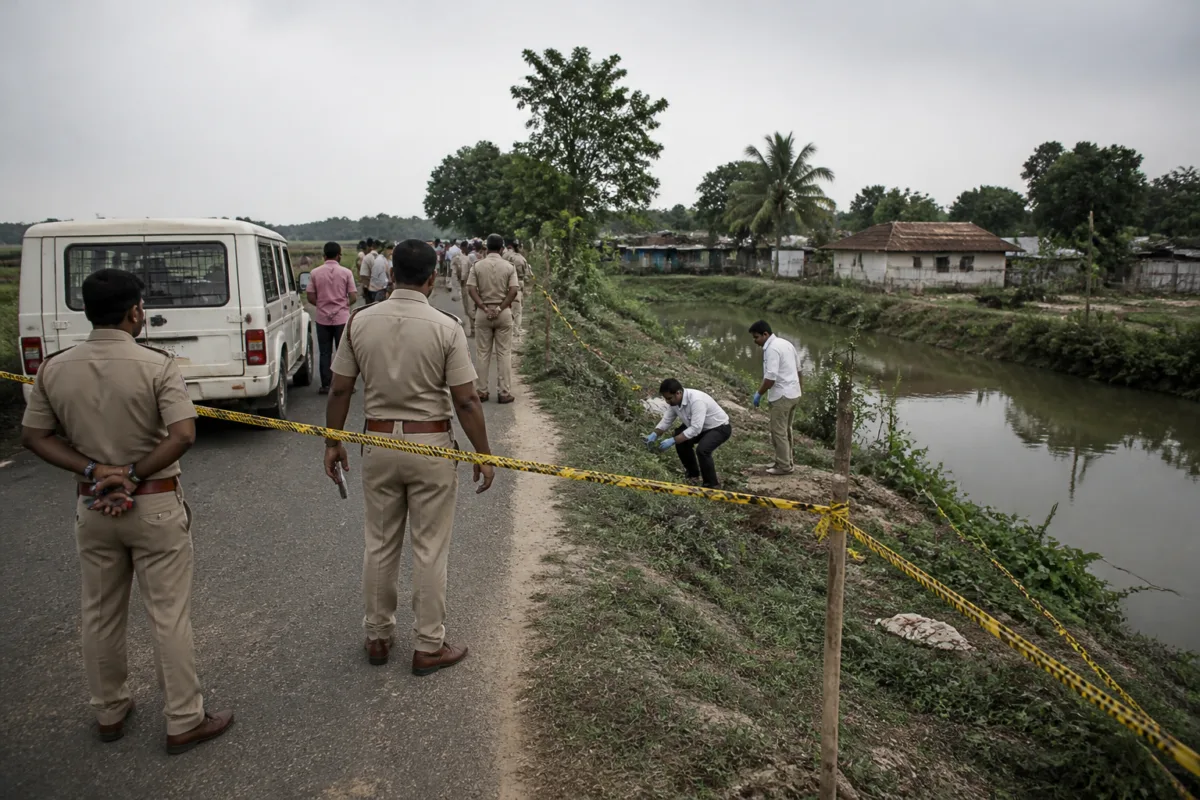
Two men accused in separate serious crimes were shot dead by police in Bengal on the same day after officers said each had attempted to seize a firearm during a crime-scene reconstruction. The incidents in Gaighata and Shamsherganj are being presented by the police as encounters, but their strikingly similar circumstances place the focus on a larger urban governance question: how the state manages dangerous accused persons while preserving a credible and accountable criminal investigation process.
The first death occurred at about 2.30am in Gaighata, North 24 Parganas. Police said Prahlad Das, 23, who had been arrested in the rape and murder of a 17-year-old student, snatched a sub-inspector’s revolver while being taken to reconstruct the crime. According to the account cited in the report, Das fired three rounds while attempting to flee. One policeman was injured, and the sub-inspector whose weapon had allegedly been taken jumped into a roadside canal to escape the firing. Police then fired four rounds, three of which struck Das in the chest, abdomen and right thigh. He was taken to Chandpara Rural Hospital, where doctors declared him dead.
Around 250 kilometres away, at approximately 2.30pm, CID personnel shot dead Samiul Sheikh, 46, in Murshidabad’s Shamsherganj. Sheikh was accused of killing BJP worker Sujit Mondal. The police account was materially similar: during a reconstruction of the crime, Sheikh allegedly tried to snatch a firearm and escape. He was taken to Anupnagar BPHC and declared dead.
The common feature is not merely that both men died in police firing. Both incidents took place during a procedure intended to reconstruct an earlier crime, and in both cases the authorities said the accused suddenly became capable of obtaining a police firearm. That makes the management of reconstruction exercises central to the story. The source report does not provide details about the number of officers present, the restraints used, the precise security protocol, whether independent witnesses were present, or how the weapons were handled before and after the shootings. Those omissions do not establish wrongdoing, but they leave important operational questions unanswered.
Crime-scene reconstruction can help investigators establish sequence, location and method. It also places an accused person, investigators and evidence in the same physical setting. In these two cases, the exercise became the setting for fatal violence. The deaths therefore raise questions about whether such procedures were being conducted with adequate safeguards, how accused persons were transported and positioned, and what internal review follows when a person in custody is killed during an investigation. The supplied report records the police version but does not establish whether an independent inquiry, forensic examination or judicial review has been completed.
The Gaighata case began after a Class XI student went missing on a Saturday night following a musical programme near her home. Police said she left the venue around 11.30pm after receiving a phone call. Her naked and battered body was found the next day behind Das’s house, and he was arrested on charges of rape and murder. During the reconstruction, police said he asked to stop near Baidyabati, about four kilometres from the India-Bangladesh border, to relieve himself before allegedly taking the sub-inspector’s revolver. The site was cordoned off the following morning. A shoe was found there, although the report said it was unclear to whom it belonged.
The details matter because they illustrate how a custody incident can rapidly become the final chapter of a case before the underlying allegations are tested through the regular legal process. Das had been accused of a grave crime, but the encounter account and the original rape-murder case are separate evidentiary questions. The first concerns the circumstances in which he allegedly obtained and fired a police weapon. The second concerns the evidence linking him to the death of the student. His death removes the possibility of a trial against him, making the credibility and documentation of the police action particularly important.
The Shamsherganj case reveals a different institutional pathway. Mondal, 46, a BJP worker from ward 13 of Dhulian Municipality, had been missing since August 28. His wife, Sumana, filed a missing-person complaint and told police she feared he could be in danger because he had been pressing a friend in Farakka to repay a debt. Body parts were recovered from a river on September 4. Police questioned Sheikh, Tajkira Bibi and Johny Sheikh, while CID sources said Sheikh initially denied involvement and later admitted that he had lured Mondal to an isolated location, strangled him, cut up the body and disposed of the remains near the Ballalpur bridge.
The report says a financial dispute was the suspected motive. It also says that, after an order from CM Suvendu Adhikari, the CID took over the murder investigation on September 7. Three officers of Shamsherganj police station and the officer in charge of the Dhulian police outpost were suspended, the station inspector was placed under watch, the Farakka SDPO was transferred and the Jangipur SP was warned over alleged negligence. These administrative actions indicate that the killing was not treated only as an isolated criminal act. The response also involved scrutiny of local policing and alleged failures before the CID assumed control.
That contrast is important. In Shamsherganj, the state response included disciplinary action and a transfer before the fatal reconstruction. In Gaighata, the source report records the police account and the subsequent cordoning of the site, but it does not identify comparable administrative action. The two cases therefore expose two different accountability tracks: one dealing with alleged investigative negligence around the original murder, and another dealing with the circumstances of the accused person’s death during police action.
The chief minister’s public position adds another layer. Speaking outside Bengal police headquarters at Bhavani Bhawan, Adhikari said he had given the police a free hand in combating drug abuse, narcotics trafficking and crimes against women. On Gaighata, he said police had retaliated after being attacked and that the police had explained the matter in detail, while declining to comment further. On Shamsherganj, he rejected the suggestion that the political affiliation of the murdered person should determine how the case was viewed. He said police could not remain passive when someone took the law into his own hands and that those who did so would face action through due legal process.
The phrase “due legal process” sits at the centre of the institutional tension revealed by the two deaths. The administration is seeking to project firmness against crimes that generate intense public anger, particularly sexual violence and politically linked murder. At the same time, the state’s authority depends on procedures that remain reliable when the accused is unpopular or suspected of a particularly brutal offence. A policy of giving police operational freedom may reassure victims and communities in the short term, but it also makes documentation, supervision and independent scrutiny more important whenever police firing results in death.
The timing has added to the significance of the events. The report describes the double encounter as probably unprecedented in Bengal since the Naxalite turbulence of the late 1960s and early 1970s. It also notes that the two deaths came three months after police shot dead a rape-murder accused in Baruipur, South 24 Parganas. The supplied material does not establish whether the cases were formally connected or whether policing protocols changed after the Baruipur incident. It does, however, show that the latest incidents are not being viewed in isolation. They form part of a recent pattern of lethal police action involving accused persons in serious crimes.
For cities and towns, the issue is not confined to the locations where the shootings occurred. Police stations, rural hospitals, roads, border-adjacent settlements and municipal areas are part of the same public-safety system. The quality of that system is measured not only by arrests or the speed with which suspects are located, but also by the integrity of custody, investigation and evidence collection. When an accused dies before trial, residents lose the possibility of a judicial determination in that individual case, while investigators inherit the responsibility of proving what happened through records, forensic material and transparent review.
The evidence available in the report confirms that two accused men died during separate reconstruction exercises, that police attributed both deaths to attempts to seize firearms, and that the state government publicly backed firm action against serious crime. It does not establish the full sequence of events independently, the findings of any forensic or judicial inquiry, or whether the alleged weapon seizures and firing were corroborated by evidence beyond police accounts. Those are the developments that will determine whether the incidents remain contested encounter narratives or become fully documented cases of police action subject to institutional scrutiny.

