


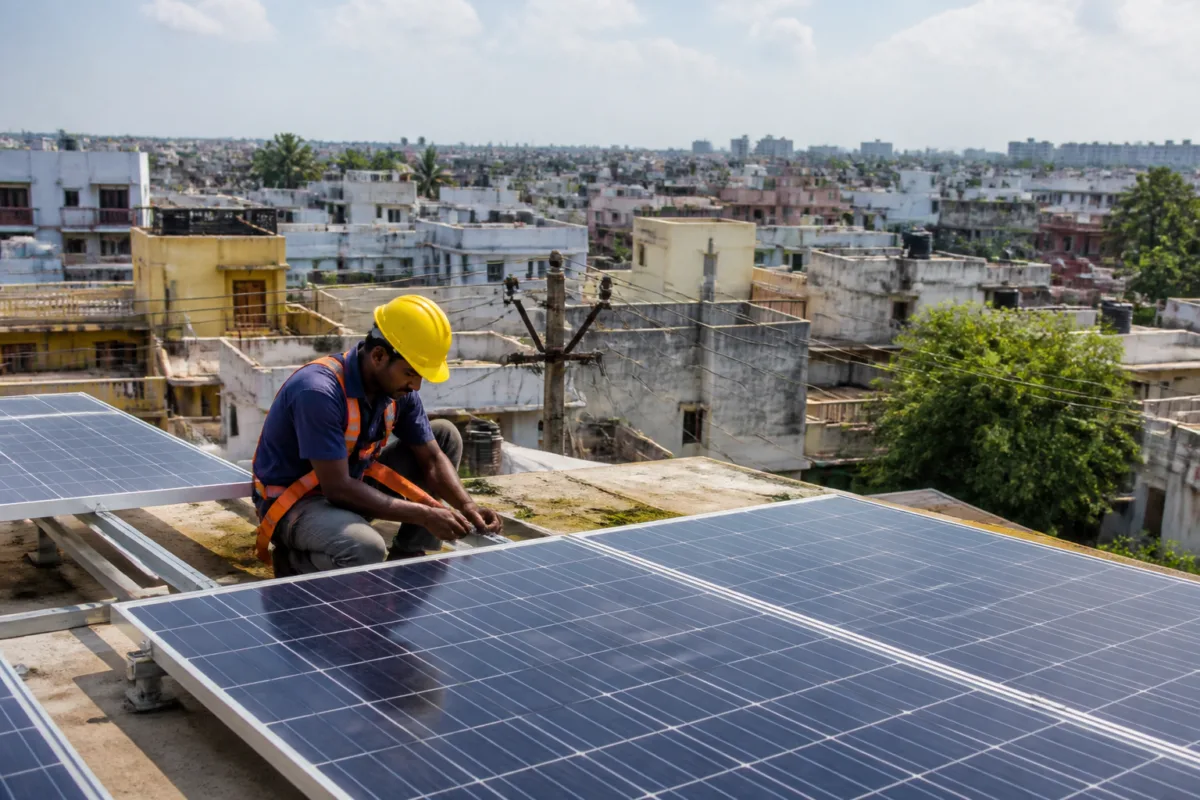
Tamil Nadu’s rooftop solar scheme has received 30,000 applications in about three weeks after the state introduced a single-window portal, but the larger significance of the announcement lies in whether administrative reform can convert public interest into functioning systems on homes and businesses. The portal is intended to address the procedural bottlenecks that previously slowed applications, subsidy payments and net-meter installations.
Energy Resources and Law Minister C T R Nirmal Kumar said the state had recorded 87,000 applications by April and received another 30,000 in the three-and-a-half weeks after the new system was introduced. He said the state was confident of reaching one lakh applications by December and set out a longer-term ambition of reaching one crore installations or beneficiaries by 2031. The report does not specify whether all applications will result in commissioned rooftop systems, making implementation the central measure of the programme’s progress.
The immediate policy change is administrative rather than technological. The single-window portal brings the Union government’s rooftop solar scheme and the state’s application process together in one place, according to the minister. Applications are automatically routed to one of about 1,500 registered vendors in Tamil Nadu. The stated objective is to remove confusion over where residents should apply and reduce the number of separate steps required to access the programme.
That design responds to a familiar problem in public infrastructure delivery: the gap between announcing a benefit and making it usable. A rooftop solar system requires more than a subsidy promise. Applicants must find a vendor, complete the application process, receive approval, have the system installed and secure a net meter where applicable. If any one of these stages is delayed, the programme’s headline application figure may not translate into additional generation capacity or lower electricity costs for households.
The minister said earlier delays had included uncertainty about the application point, slow subsidy processing and long waits for net-meter installation. He put the previous net-meter timeline at between six months and one-and-a-half years. The new portal therefore represents an attempt to make the delivery chain visible and digitally coordinated, rather than leaving applicants to navigate separate institutional processes.
The most important test will be whether the system can reduce delays after an application is submitted. The report says applications will be allocated automatically to registered vendors and that vendor-related issues are being addressed through end-to-end digitisation and zonal consultations. It also says the state has simplified procedures in coordination with its finance department so that, after the Union subsidy is received, the state subsidy can reach beneficiaries within two days. That system reportedly came into effect on Monday.
The two-day payment timeline could improve confidence in the scheme, but it applies after the Union subsidy is received. The supplied report does not establish how long the earlier stages—application scrutiny, approval, installation, inspection or net-metering—will take under the new portal. Those stages will determine whether applicants experience the reform as a genuine reduction in transaction time or simply as a more convenient front door to the same institutional queues.
The difference between applications and completed installations is especially important because the state’s targets are expressed in very large numbers. The minister said the government wanted to cover one lakh houses by March, while also saying the one-lakh target could be achieved by January because of the stronger public response. He separately referred to achieving one lakh by December. These timelines are not fully consistent in the supplied account, but they show the political and administrative pressure to convert the recent surge into a measurable programme outcome.
### Tamil Nadu rooftop solar scheme and the delivery chain
The scheme’s geography also offers a useful indication of changing demand. The minister said Coimbatore had earlier recorded more applications, but Chennai had moved ahead. The report does not provide city-wise figures or explain the reasons for the shift. It does, however, show that demand is not confined to one industrial or regional cluster and that the state is attempting to build a common application and vendor-allocation system across Tamil Nadu.
The proposed expansion to micro, small and medium enterprises is another significant feature. The minister urged MSMEs to participate, while saying that tariff-related representations from MSMEs and large industries would be examined in phases. Rooftop solar for businesses operates within a different financial and operational context from household adoption, but the supplied material does not provide separate targets, subsidy terms or installation data for commercial and industrial consumers.
That distinction matters for public administration. A household applicant may primarily face difficulties related to awareness, documentation, subsidy timing and net-metering. An MSME may additionally be concerned about electricity tariffs, operating schedules and the reliability of power supply. The state’s decision to examine tariff representations in phases suggests that rooftop generation is being considered alongside the broader cost and supply concerns of electricity consumers, although the report does not state what changes, if any, will follow.
The government is also using newspapers, television and camps organised by Tamil Nadu Power Distribution Corporation Limited to increase awareness. These campaigns are intended to bring more residents into the portal, but awareness alone cannot establish whether the programme is functioning effectively. The relevant administrative indicators would include the time taken from application to installation, the number of applications rejected or withdrawn, the number of systems connected to the grid, subsidy-payment delays and the distribution of benefits across districts. None of those figures is provided in the report.
The dependence on around 1,500 registered vendors creates both capacity and coordination questions. Automatic work allocation may reduce the burden on applicants, but the success of the model will depend on whether vendors can complete installations at the pace implied by the new application numbers. The minister’s reference to zonal consultations indicates that the government is engaging with vendors on implementation issues. The supplied account does not identify the specific problems vendors have raised or the performance standards being used to assess them.
### From rooftop adoption to power-system planning
The rooftop programme is also being linked to Tamil Nadu’s wider electricity planning. The minister said the government had begun steps to procure at least 8,000 MW of additional power through medium-term five-year and long-term contracts, taking into account the expiry of existing agreements by 2028-29. This indicates that the state is treating rooftop solar as part of a broader electricity-supply challenge rather than as a standalone subsidy programme.
The report does not explain how much of the proposed additional procurement is connected to rooftop solar demand, nor does it provide the state’s present rooftop capacity or expected contribution from the one-lakh and one-crore targets. The relationship between distributed generation and contracted power will therefore require closer monitoring. Rooftop systems can alter when consumers draw electricity from the grid, while the state must continue planning for supply when solar generation is unavailable.
The proposed battery storage policy is presented as a response to the management of surplus solar power. The minister said the policy would be introduced soon. No draft, capacity target, financing model or implementation timetable is included in the supplied material. At this stage, the announcement establishes the government’s intention to address storage, but not the design of the policy or its likely effect on rooftop consumers.
This is the institutional challenge behind the application surge. Solar adoption is often measured through installations, but the public system must coordinate subsidies, vendors, distribution infrastructure, metering, consumer awareness, power procurement and storage. The single-window portal addresses one part of that chain: access and routing. The subsidy-processing change addresses another: payment after the Union subsidy is received. Net-metering timelines, installation completion and grid management remain equally important to the programme’s performance.
The long-term target of one crore by 2031 makes this distinction more consequential. A programme operating at that scale would require sustained administrative capacity across districts, a dependable vendor network and a transparent way to track applications through completion. The source report confirms the target but does not provide an implementation roadmap, annual milestones or district-level allocation. Those details will be necessary to judge whether the target represents a measured expansion plan or primarily an ambition.
For citizens, the immediate question is whether the new portal shortens the time and uncertainty associated with adopting rooftop solar. For the state, the question is whether a digitally integrated process can maintain service quality as demand grows. For the electricity system, the question is how rooftop generation, net metering, contracted supply and future storage will be managed together.
The available evidence confirms a sharp increase in applications after the portal’s launch and a set of administrative changes aimed at reducing procedural friction. It does not yet establish how many systems have been installed, how quickly net meters are being provided or how many applicants have received subsidies. The next meaningful markers will be installation and connection data, the consistency of the two-day state subsidy process, the announced battery storage policy and progress towards the state’s one-lakh and longer-term one-crore targets.

