


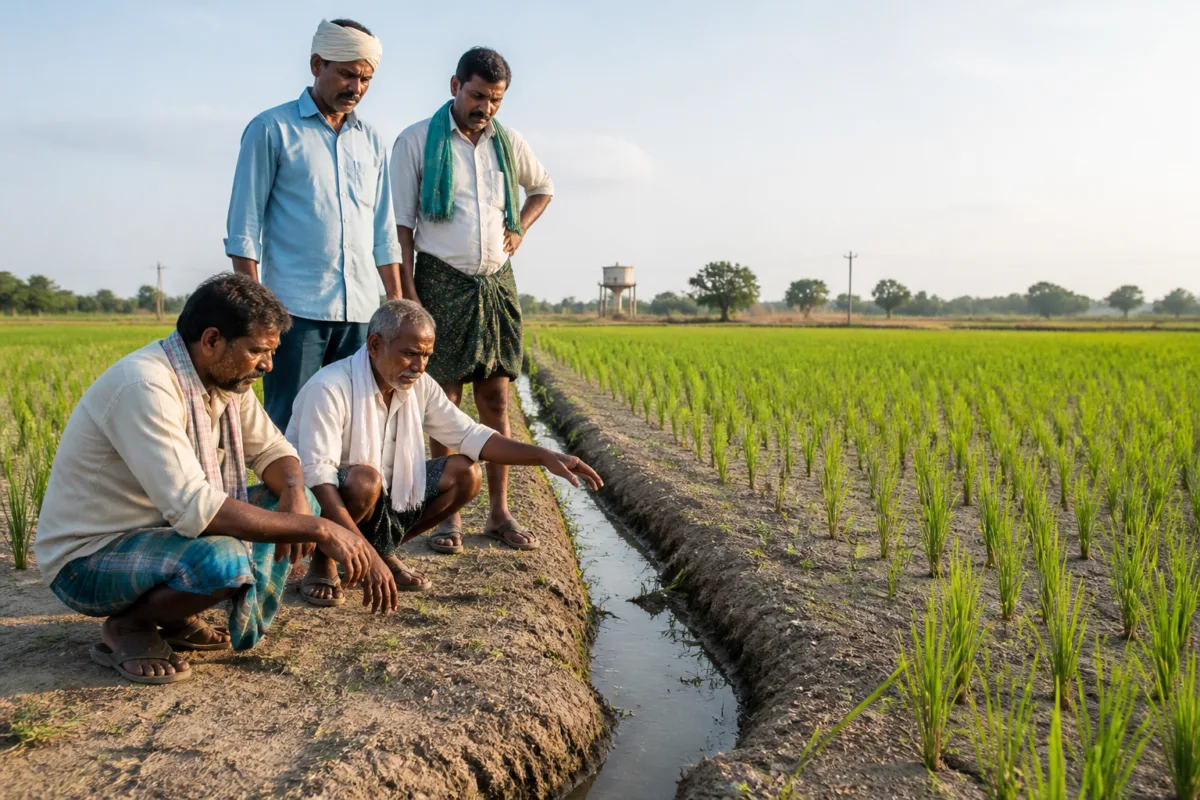
Telangana’s appeal to farmers to avoid paddy cultivation during the upcoming Yasangi season has become more than a crop advisory. It has exposed a recurring governance problem: water scarcity is being addressed through seasonal warnings, while the larger system linking irrigation, crop planning, farmer incomes and administrative preparedness remains contested.
The immediate dispute is political. The Congress government says farmers must gradually move away from water-intensive paddy because water availability is shrinking. The BRS and BJP have questioned whether the government planned adequately for emerging constraints, while farmer organisations say the controversy reflects a longer failure to build resilience against droughts, floods and other weather-related disruptions. The argument is therefore not only about what farmers should plant in one season. It is about whether governments can align agricultural decisions with water realities before a crisis becomes visible.
The distinction matters because a paddy advisory transfers a substantial part of the adjustment burden to farmers. A change in crop choice can affect seed purchases, cultivation costs, expected yields, market access and household income. The supplied report records concerns that alternative crops may not generate adequate returns and that farmers need meaningful support during the transition. Without those conditions, an advisory can appear less like a planned shift and more like an emergency response to a problem that has already reached the farm gate.
That is why the political debate has acquired significance beyond the immediate agricultural announcement. Political analyst S Ramakrishna said the advisory could become a liability for Congress if farmers interpret it as evidence of poor preparation. He also said a credible explanation, effective water management and sustained support could help the government defend its position. His assessment places the controversy in the space between policy design and public perception: the same restriction can be presented as responsible resource management or as proof that the administration failed to prepare.
The report draws on political scientist Paul Richard Brass’s study of the 1966-67 Bihar famine to explain this process. Brass’s framework focused not only on the causes of a crisis but also on how governments responded, how the public judged that response and how political rivals assigned responsibility. Applied cautiously to Telangana, the parallel suggests that the consequences of water stress will be shaped by institutional action and political communication as much as by the immediate shortage itself. The comparison does not make present conditions identical to the Bihar famine; it highlights how crises become contests over competence and accountability.
Telangana’s water debate also has an important institutional dimension. The BRS has accused the Congress government of failing to use available waters from the Godavari and Krishna rivers, alleging that significant quantities flowed downstream without being utilised. Congress has responded by pointing to shortcomings in irrigation infrastructure inherited from the previous BRS government. These competing claims place river management, storage, irrigation capacity and inter-governmental responsibility at the centre of the dispute, although the supplied report does not provide figures to independently measure the quantities involved or establish which explanation is correct.
The absence of a shared account of water availability is itself significant. For farmers deciding what to sow, the relevant question is not simply whether rivers contain water in aggregate. It is whether water can be delivered at the required time, through functioning irrigation systems, at a cost and with enough reliability to support a crop cycle. A seasonal advisory cannot resolve that gap on its own. It needs to be connected to credible information about storage, releases, local irrigation access and the expected economics of alternative crops. The report does not establish that such an integrated framework is currently in place.
Farmer organisations argue that the problem predates the current government. Ravi Kanneganti of Rythu Swarajya Vedika said neither BRS nor Congress had developed a systematic strategy for recurring droughts, floods and weather-related disruptions. His central criticism was that governments should plan during normal years rather than respond only when a crisis emerges. This shifts the focus from the timing of the present advisory to the institutional continuity of water and crop planning across administrations.
The recurrence of the issue reinforces that concern. Kanneganti noted that the previous BRS government had also advised farmers against paddy cultivation during Yasangi in 2021. A repeated appeal to avoid the same water-intensive crop can indicate that the underlying challenge has not been resolved, even when the political circumstances have changed. It raises questions about whether crop diversification is being treated as a long-term agricultural strategy or as a periodic administrative instruction issued when water conditions deteriorate.
Congress leader and Rythu Commission member S Anvesh Reddy rejected the allegation that the government acted late. He said farmers had been informed from the beginning of the year about the need to shift to alternative crops and that seeds had already been supplied to support the transition. This is the government’s strongest answer to the charge of inadequate preparation: the advisory, according to this account, is part of an earlier communication and input-supply process rather than a last-minute reaction.
That claim, however, moves the accountability question to the next stage. Early communication and seed distribution are necessary parts of crop diversification, but farmers must also know whether alternative crops have dependable buyers, viable prices and adequate technical support. Ch Chaitanya, a political observer quoted in the report, said the political outcome may depend on whether alternative crops are remunerative and whether support systems are available. The concern is practical rather than partisan. Farmers cannot be expected to absorb the risk of a water-management transition if the market and institutional arrangements remain uncertain.
This is where the water issue becomes an urban and governance story as well as an agricultural one. Telangana’s cities depend on decisions made across the wider regional water system. Irrigation demand, river utilisation, storage, drought response and rural livelihoods are linked to the state’s overall allocation and management choices. The supplied report does not quantify the connection between the advisory and urban water supply, but it shows how a dispute over agricultural water can become a broader test of state capacity.
The controversy may also affect the political environment around local body and GHMC elections, according to Ramakrishna. That possibility is presented as an assessment, not an established electoral outcome. The more immediate measure of government credibility will be whether farmers experience the advisory as a supported transition or as a restriction without adequate compensation, markets or implementation assistance.
The evidence supplied establishes three facts about the present dispute. The Telangana government has advised farmers to avoid paddy during the upcoming Yasangi season; opposition parties have challenged the government’s water management and preparedness; and farmer organisations have identified the absence of a durable crop-planning strategy as the deeper problem. It does not establish the volume of water available, the precise scale of the proposed crop shift, the financial support attached to it or the likely returns from alternative crops.
Those unanswered questions are central to judging whether the advisory represents responsible water governance. The next test will not be the political argument alone, but the government’s ability to demonstrate how water conditions were assessed, how farmers were informed, what alternatives were supplied and how incomes will be protected during the transition. Until those links are clear, Telangana’s paddy advisory will continue to function as both a water-management measure and a measure of administrative credibility.

