


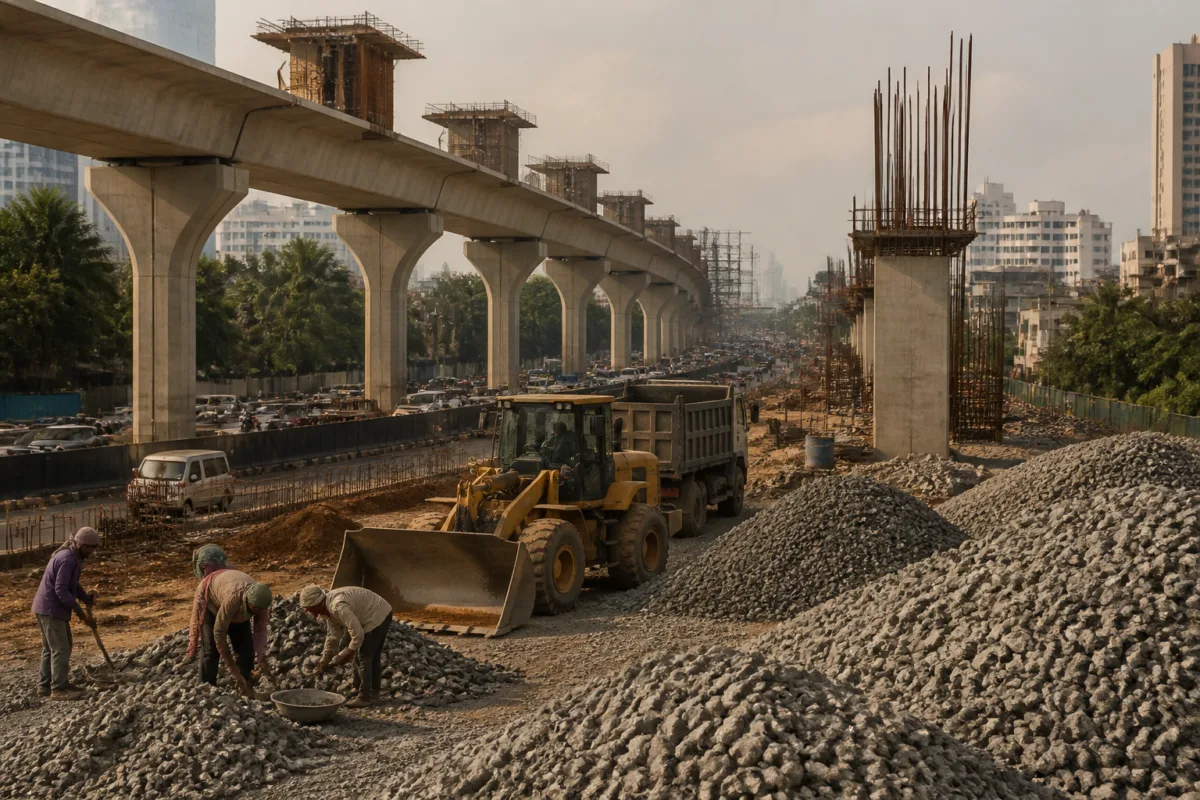
Tamil Nadu’s continued restrictions on transporting stone and construction aggregates to other states are putting pressure on Bengaluru’s 58-km Namma Metro Blue Line, revealing how dependent large urban infrastructure projects are on supply chains that operate beyond the city’s administrative boundaries.
According to a report by The Times of India, contractors working on the corridor from Silk Board to Kempegowda International Airport are facing shortages of quarry dust, crushed stone, aggregates and railway ballast. A senior Bangalore Metro Rail Corporation Limited (BMRCL) official said the disruption had affected concreting, architectural finishing, depot construction and other activities. The shortage comes when opening timelines for Namma Metro are already facing delays.
The immediate problem is not a lack of construction activity in Bengaluru. Work is continuing across several sections of the Blue Line, including the elevated corridor between Silk Board and KR Pura, the KR Pura–KIA stretch and construction sites along the Outer Ring Road. The constraint is the availability and cost of the materials needed to keep those activities moving.
The episode illustrates a central weakness in the construction of urban infrastructure: project schedules are often planned around the engineering sequence of works, but their performance also depends on quarry permissions, crusher capacity, inter-state transport rules, freight availability and the ability of contractors to shift suppliers quickly. A metro corridor may be located in one city, but its physical inputs can come from a much wider regional production network.
### A metro project tied to a regional materials network
Before the restrictions, contractors reportedly expected to source 30 to 40 per cent of their construction materials from crushers in Tamil Nadu’s Krishnagiri district. The district’s proximity to Bengaluru had made it a significant supply point for projects in the city. The report says contractors had earlier procured aggregates from Hosur, where around 14 quarry-crusher units supplied materials.
Following the restrictions, vendors shifted procurement to four or five crusher units in Bidadi, Karnataka, according to an engineer with a construction company working on the Outer Ring Road stretch. This is not simply a change in supplier. It represents a sharp reduction in the number of available production points, leaving contractors with fewer options when demand rises or supply is interrupted.
The impact is visible in prices. The engineer said aggregate prices had risen from around Rs 800 per tonne to more than double that level. The report does not provide a revised per-tonne price, but the increase has added to the financial pressure on contractors executing major projects.
For infrastructure contracts, such cost changes can affect the economics of work already awarded. Contractors may have priced bids based on expected material availability and transport distances. When supply shifts to a smaller number of quarries, both the material price and the logistics cost can change. The immediate result is pressure on project finances; the operational result is the possibility of activities being rescheduled around material availability.
### The disruption reaches beyond the viaduct
The Blue Line’s most visible work is the construction of its elevated corridor, but the shortage affects several layers of the project. The BMRCL official cited impacts on concreting and architectural finishing. These activities require materials at different stages and in different quantities, meaning a disruption can affect more than one work package at a time.
Depot construction has also been affected, particularly because railway ballast is required for track laying. A depot is not an ancillary space that can be completed independently of operations. It is part of the infrastructure needed to stable, maintain and deploy trains. When ballast availability delays depot track work, the effect is connected to the operational readiness of the corridor, even though the material itself is not part of the elevated viaduct.
Along the Outer Ring Road stretch, contractors are working on entry and exit structures and travelators in addition to the main corridor. These components show why metro construction cannot be measured only in kilometres of viaduct completed. Stations, access facilities, depots, track systems and passenger circulation infrastructure all have to progress together for a line to become usable.
The report does not establish that the material shortage alone will determine the Blue Line’s final opening date. It does establish that the disruption has affected construction activity over the past three months and that contractors are facing procurement and cost difficulties. The precise effect on each contract package and on the overall commissioning schedule is not specified in the supplied material.
### Why Tamil Nadu imposed the restrictions
Tamil Nadu imposed the restrictions citing rising domestic demand, inadequate supplies and escalating prices of construction materials. The move was also intended to curb illegal mining and unauthorised transportation of stone materials. The restrictions came into effect on July 27 for an initial three-month period but have continued, according to the report.
This creates a governance tension between local resource management and regional infrastructure demand. Tamil Nadu’s stated concerns relate to the availability and regulation of materials within its jurisdiction. Bengaluru’s construction programme, meanwhile, depends on access to those materials for public infrastructure projects. Neither concern is confined to a single project: quarrying has environmental and regulatory consequences, while material shortages can affect multiple infrastructure works simultaneously.
The episode also shows why inter-state dependencies need to be visible in project planning. A metropolitan transport authority may control the corridor design, contracts and construction supervision, but it does not necessarily control the quarries, crusher units or state-level movement restrictions that determine whether essential inputs arrive at site.
The available account does not indicate that BMRCL or the Karnataka government has announced a specific replacement supply arrangement, exemption or revised procurement policy. It also does not state whether Tamil Nadu’s restrictions have been modified or when normal movement will resume. Those unresolved administrative questions are important because contractors can respond to a short disruption differently from a prolonged one.
### Bengaluru’s wider infrastructure exposure
The effects are not limited to the Blue Line. GR Shanmugappa, president of the Karnataka Truck Owners’ and Agents’ Association, said the restrictions had affected several infrastructure projects in Bengaluru. He estimated that more than 40,000 tonnes of stone had been transported to the city before the ban and that 600 to 700 truck owners had been affected.
These figures, as reported by The Times of India, indicate the scale of the logistics network that supported Bengaluru’s construction economy. The movement of stone involves more than the project contractor and the quarry. It also includes crusher operators, truck owners, agents, drivers and vendors. When movement stops, the impact travels through this chain, while receiving projects face higher prices and fewer procurement choices.
The reported shift from approximately 14 quarry-crusher units in Hosur to four or five units in Bidadi further illustrates the importance of redundancy. A large city’s infrastructure programme may require substantial material volumes, but the resilience of the supply chain depends on whether there are enough geographically distributed suppliers and transport routes to absorb a disruption.
At the same time, the figures should not be read as proof that every Bengaluru construction project has experienced the same degree of disruption. The supplied report specifically connects the shortage to the Blue Line and refers more broadly to several infrastructure projects. It does not provide a project-by-project assessment, a citywide inventory of material stocks or an independent estimate of the total financial impact.
### The institutional question behind the delay
The Blue Line’s material shortage is therefore an institutional coordination issue as much as a construction problem. BMRCL and its contractors are responsible for delivering the metro corridor, but the supply of aggregates is shaped by decisions taken by quarrying authorities, transport regulators, state governments and private suppliers across state borders.
This fragmented responsibility can make accountability difficult. If materials become unavailable, the project authority may be able to seek alternate suppliers, but alternate suppliers may not have the capacity, permissions or transport economics to replace the original network. Contractors may absorb some costs, yet a prolonged increase can put pressure on contract performance and work sequencing.
The report does not establish whether the Blue Line’s contracts contain specific provisions for such a supply disruption, whether costs can be revised, or whether BMRCL has formally altered construction schedules. Those details would be necessary to assess the contractual and fiscal consequences. What the reported facts show is that physical infrastructure delivery is vulnerable to decisions made outside the project boundary.
For Bengaluru, the larger lesson is that metro expansion requires more than land, financing and engineering capacity. It also requires dependable regional access to basic construction materials. The city’s future transport network is being built through a supply system that extends into neighbouring districts and states, making freight regulation and quarry governance part of the practical infrastructure agenda.
The immediate developments to watch are the duration of Tamil Nadu’s restrictions, the availability of replacement sources in Karnataka, the movement of aggregate prices and the effect on depot track laying and other Blue Line work packages. Until those factors are clarified, the report confirms a significant supply disruption but does not establish a revised opening date or quantify the final delay to the corridor.

