


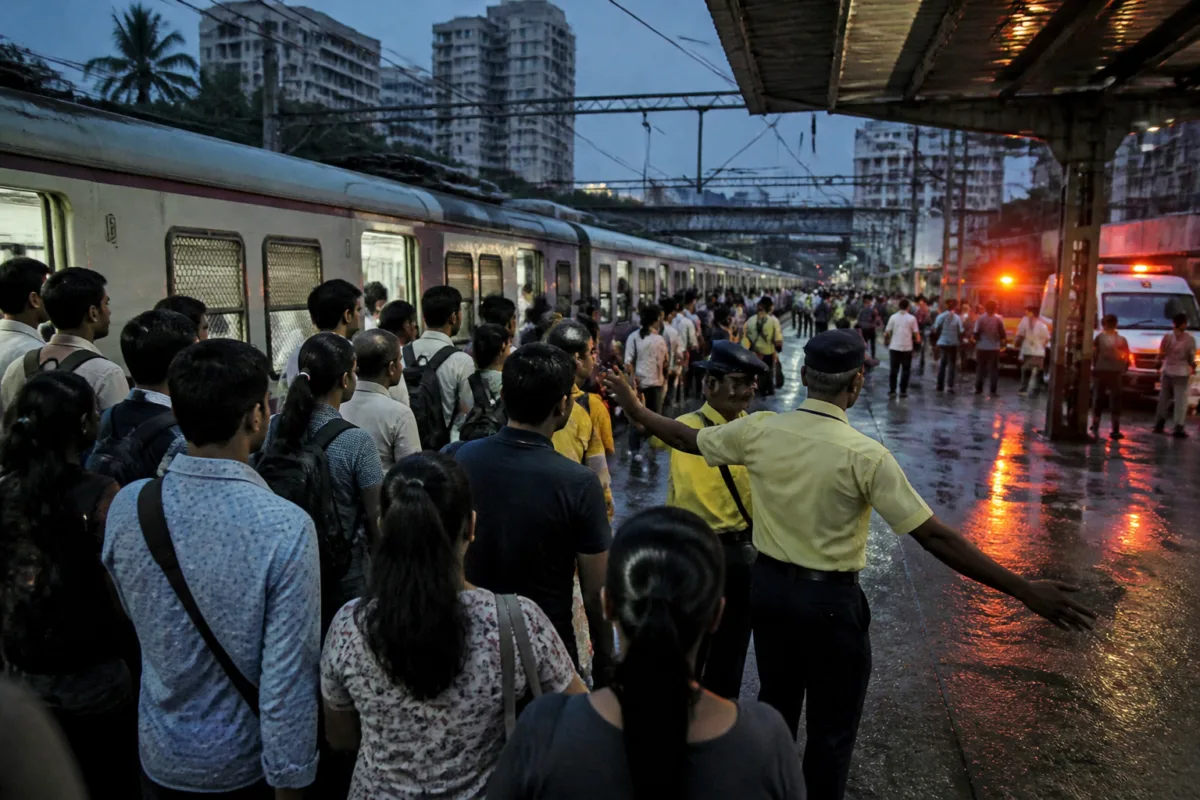
The deaths of three commuters during a nine-hour Central Railway disruption in Mumbai have exposed a difficult question for the suburban rail system: what happens when passengers are trapped in stalled or severely delayed trains, and how safely can they leave the railway premises? The police investigation has not yet established the full sequence of events, but accounts from relatives and officials point to a breakdown in the link between service disruption, passenger communication and track safety.
Two men, Rahul Rajbhar, 22, and Kharbhan Rajbhar, 35, were killed after being hit by a Kalyan-CSMT local between Ghatkopar and Vikhroli at about 7.55 pm. In a separate incident, Sahil Thete, 21, died after being hit by a train at Bhandup station. All three deaths occurred on a day when a fire in a relay room near Kanjurmarg brought the signalling system to a halt and disrupted Central Railway suburban services across the corridor.
The immediate event was a signalling failure. The wider issue is how a railway designed to move large volumes of passengers responds when its operating model is interrupted. Central Railway services were disrupted for around nine hours, while trains continued to run 30 to 40 minutes late until late in the evening even after operations were restored on affected routes. Thousands of commuters were reportedly stranded in stationary trains for 70 to 90 minutes. Some passengers walked along the tracks as services operated intermittently on adjoining lines.
That context matters because the railway’s safety rules and a commuter’s practical choices can diverge sharply during a prolonged disruption. Railway tracks are controlled operational spaces, and passengers entering them face an obvious risk from moving trains. But when a train remains stationary for an extended period, passengers may not know whether the service will resume, whether they can safely disembark, or how to reach an alternative route. The available account does not establish what Rahul and Kharbhan did before they were hit, but it shows why the circumstances require more than a simple conclusion that they were illegally crossing the tracks.
Relatives told The Times of India that a long-stalled train may have led the two men to alight and walk along the tracks. Police said the men were believed to have boarded a train in the eastern suburbs after finishing work and were travelling towards Thane. A police officer cited in the report said there was a possibility that the disruption prompted them to alight and try to leave the railway premises to continue their journey by road. Police also said a motorman alerted them to the bodies and that the motorman’s statement and witness accounts would be recorded.
The distinction between an established fact and a possible explanation is central to the case. The police have recorded separate accidental-death cases and are investigating the sequence of events. Relatives, meanwhile, are seeking CCTV footage and relevant reports to challenge what they described as the initial official account that the men were crossing the tracks. At this stage, the supplied evidence does not establish whether they left a train voluntarily, fell from one, entered the tracks while trying to exit a station area, or were crossing for another reason.
The family circumstances also reveal the human cost behind a disruption measured operationally in minutes and delays. Rahul and Kharbhan had moved to Mumbai from Mau in Uttar Pradesh about three years ago and worked as stack-parking welders, along with several other members of their families. Kharbhan leaves behind a widow and four children in his hometown. His relatives said they were collecting documents to file a compensation claim and wanted access to CCTV footage and other records.
The third death adds another dimension to the same public-safety question. Sahil, a final-year BCom student, had attended a coaching class in Thane and usually travelled by train to his home in Kanjurmarg. A relative said that because the timetable was disrupted, Sahil could only alight at Bhandup and may have been trying to exit the station when he was killed. Police said he was crossing from platform number 4 to platform number 2 on the tracks when a fast train hit him on platform number 3.
Here too, the available information contains two layers. The police account describes movement across tracks, while the family links the fatal incident to the disruption and the difficulty of completing a routine journey. The investigation must determine how Sahil reached the tracks, what information was available to passengers at Bhandup, and whether crowd movement or altered train operations contributed to the circumstances. The source does not provide enough evidence to determine those questions.
The relay-room fire is therefore not only an equipment failure in the reported sequence. It was the initiating event in a chain that included the loss of signalling, prolonged passenger delays, altered travel decisions and three fatal incidents. The precise responsibility for each link remains to be established. The evidence does, however, show that railway disruption management extends beyond restoring train movement. It also involves communicating with passengers inside stalled trains, controlling movement around platforms and tracks, providing safe exit routes and ensuring that alternative travel information reaches commuters quickly.
The operational details reported from the disruption indicate how quickly a signalling problem can spread through a high-density suburban network. Services were affected for around nine hours, and delays continued even after operations were restored. Passengers were not simply facing a short wait at a station; some were confined in stationary trains for between 70 and 90 minutes. In such conditions, a system’s ability to provide clear instructions becomes part of its safety performance.
The source does not specify what announcements were made, whether staff were deployed at the relevant locations, how passengers were advised to remain inside trains, or what procedures governed the release of commuters from stalled services. Those omissions are important investigative questions, not evidence that the railway failed in each of these areas. They are also the details that would be needed to assess whether the deaths resulted solely from individual decisions or whether the disruption response created avoidable risks.
Compensation is another unresolved institutional issue. The families are seeking compensation, but the source does not state whether any claim has been accepted, what legal provisions may apply, or whether the railway has announced assistance. The relatives’ demand for CCTV footage and reports is directed at establishing the facts before such claims are pursued. Access to records can be especially important in railway fatalities, where the difference between trespass, accidental disembarkation, a fall from a train or an emergency attempt to leave a station can affect both accountability and compensation.
For Mumbai’s suburban railway, the larger urban question is how to make system resilience visible at passenger level. Signalling systems, relay rooms and train-control procedures are technical infrastructure, but their failure is experienced through immobilised trains, missed connections, confusion and risky movement. A disruption plan that measures only the time taken to restore services may not capture the safety consequences that occur while trains are stopped or schedules are unreliable.
The available evidence confirms that a fire near Kanjurmarg triggered a major Central Railway disruption and that three people died in separate train-related incidents during that period. It also confirms that families dispute or question the initial explanations and are seeking documentary and video evidence. What remains uncertain is the exact sequence of events involving each victim, the instructions given to commuters, the role of railway personnel at the relevant locations and the basis for any compensation claim.
The next important developments are the police recording of the motorman’s statement, the identification of witnesses, the examination of CCTV and other railway records, and the outcome of the accidental-death investigations. Until those steps are completed, the deaths should not be reduced either to a simple case of passenger trespass or to an established finding that the disruption directly caused each fatality. The facts will depend on the evidence collected about what happened on the tracks, inside the trains and at the stations that evening.

