


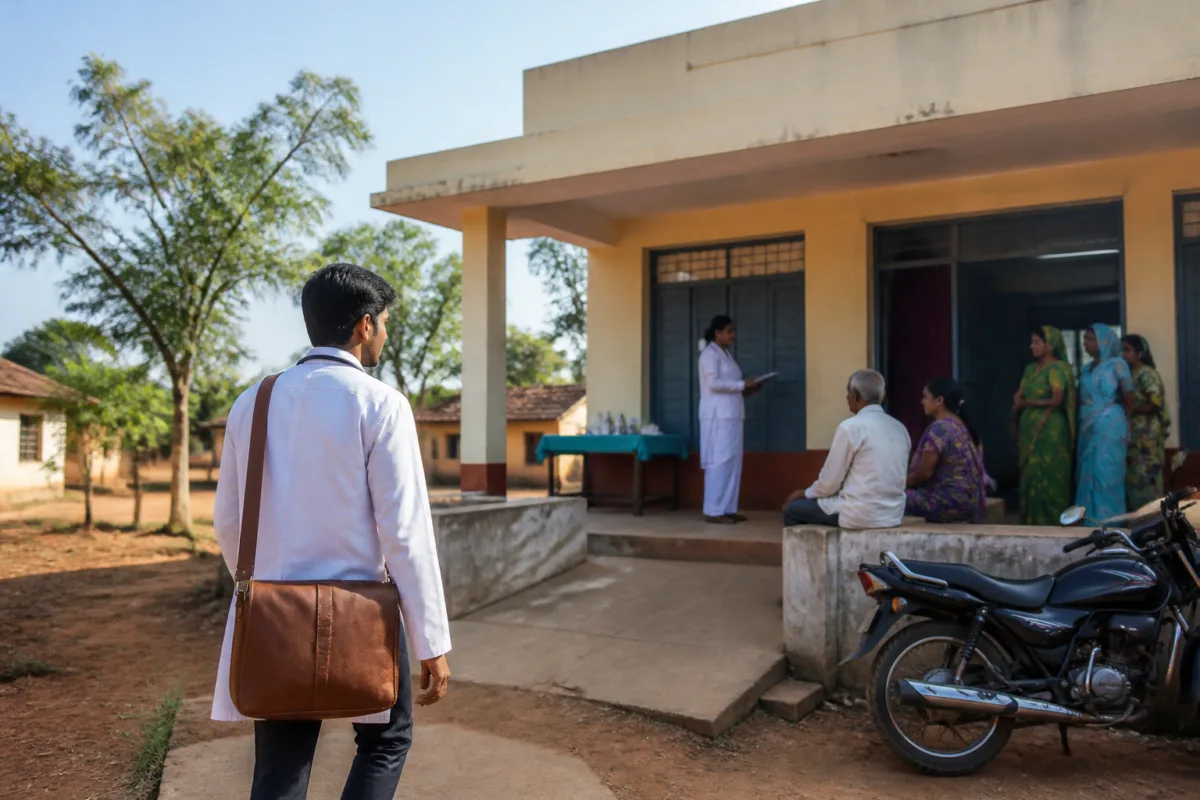
The Supreme Court’s consideration of guidelines for compulsory rural service by medical graduates has brought an unresolved question in India’s health system into sharper focus: whether sending doctors to rural facilities should be treated as a national public-health obligation, a state-level contractual condition, or both. The court has asked the Union government to clarify whether it intends to formulate a nationwide policy and how it would consult the states and other stakeholders.
The case concerns Karnataka’s attempt to make rural service a condition for medical graduates who receive seats through the government medical quota. Under a law enacted by the state in 2012, such graduates must serve for at least one year at health centres in rural areas before registering with the Karnataka Medical Council. Karnataka later issued a notification on July 28, 2023, extending compulsory rural service to students admitted through the private quota. That notification has been challenged before the Supreme Court by Ashish Reddy.
The immediate dispute is therefore about the legality and operation of a state-level requirement. But the proceedings have widened the question. The bench of Justices P.S. Narasimha and Alok Aradhe has indicated that the country may require constitutional guidelines on compulsory rural service, particularly because the Union government’s position has not been clearly established in the material before the court.
That uncertainty matters because the policy sits at the intersection of medical education, professional registration, public employment and the division of powers between the Union and the states. The report by Prajavani records that the court was told health is a subject in the State List and that several states have introduced bonds for compulsory service. At the same time, the court has been considering whether a uniform national approach is needed for a question that affects the future availability of medical care across India.
The Karnataka model illustrates the difference between a policy objective and an enforceable mechanism. The objective is to place qualified doctors in rural health centres, where access to medical professionals is a persistent public-system concern. The mechanism is a bond or rule linked to medical admission and registration. Whether that mechanism is legally sound, proportionate and administratively workable is the issue now before the court.
The proceedings also show that the policy debate has not yet reached a settled institutional position. During an earlier hearing, the bench had expressed the need for a uniform national policy on compulsory rural service. The Solicitor General, according to the report, said the Union government would obtain instructions and file an affidavit on a policy applicable across the country. During the latest hearing, Additional Solicitor General Aishwarya Bhati said that the Union could begin a consultative process.
The distinction between postgraduate and undergraduate medical education has also entered the discussion. Bhati told the court that postgraduate students need compulsory service on a rotational basis, while no such system currently exists at the undergraduate level. The statement indicates that compulsory service is not a single policy category. Different rules may be required depending on the stage of training, the doctor’s qualification, the nature of the facility and the relationship between the student and the public system.
That distinction is important for implementation. A requirement attached to a publicly funded medical seat may be designed differently from one imposed on a student admitted through a private quota. A rule affecting registration with a medical council also operates differently from a service bond enforced by a government department. The material available in the case report does not establish what a final national framework would contain, but it makes clear that the court is examining these institutional differences rather than treating rural service as a simple posting arrangement.
The constitutional dimension has been raised by senior advocate Raju Ramachandran, who is assisting the court as amicus curiae. He suggested that guidelines could be framed under Article 21 of the Constitution to address legislative gaps. The court’s reported remarks similarly focused on the absence of clarity at the level of first principles: policymakers must first decide whether doctors serving in rural areas is necessary for improving the health system and national health, and only then determine whether the obligation should be implemented through a bond or regulations.
This sequencing is central to the dispute. A bond can provide an administrative route to secure service, but it does not by itself answer questions about the purpose, coverage or fairness of the policy. Nor does a registration condition establish whether rural health facilities have the staffing, housing, equipment and supervision needed to make the placement meaningful. The supplied report does not provide data on compliance, vacancies, retention, enforcement or the performance of Karnataka’s existing system. Those gaps limit what can be concluded about the policy’s results.
What the case does establish is that compulsory rural service has developed unevenly across states. Some states have used bonds, while the Union government has not yet presented a clearly articulated national position in the proceedings described by Prajavani. This creates a fragmented policy environment in which a medical graduate’s obligations may depend on the state, the admission quota and the applicable registration rules.
The administrative consequences extend beyond the courts. If a national framework is proposed, the Union government would have to determine how it interacts with state health departments, medical councils, medical colleges and rural health facilities. It would also have to clarify who identifies service locations, who supervises doctors, how postings are allocated, what happens when facilities lack basic capacity, and which authority deals with non-compliance. None of these operational details has been settled in the material supplied.
The case also places medical colleges and state governments within the same policy chain. Admission rules create the initial obligation; state health systems provide the service location; professional regulators control registration; and courts may be asked to decide whether the framework is constitutionally valid. A policy that does not coordinate these institutions could create disputes at every stage, even if its stated aim is to improve rural access to doctors.
The court’s intervention reflects this unresolved chain of responsibility. Justice Narasimha reportedly said the government must discuss the issue with health department secretaries and take serious action. The court has directed the Union government to clarify whether it intends to formulate a policy and with whom it would consult. The hearing has been adjourned to the following week.
The broader urban question is not limited to villages. India’s healthcare system is organised around a strong concentration of training, specialist care and professional opportunity in cities. A rural service requirement is one attempt to redistribute medical personnel through a legal or administrative obligation. Its success, however, cannot be assessed only by counting how many doctors are posted outside urban centres. It also depends on whether the facilities receiving them are part of a functioning system with referral links, staff support and continuity of care. The supplied material does not provide evidence on these conditions, so their impact remains to be examined rather than assumed.
The Supreme Court proceedings therefore expose a policy gap rather than resolve one. The need for rural medical services is being treated as a question of national health, but the legal and administrative framework remains divided between state laws, admission conditions, professional registration and possible central guidelines. The next significant development will be the Union government’s clarification on whether it plans a national policy and how it proposes to consult the states and other stakeholders.

