


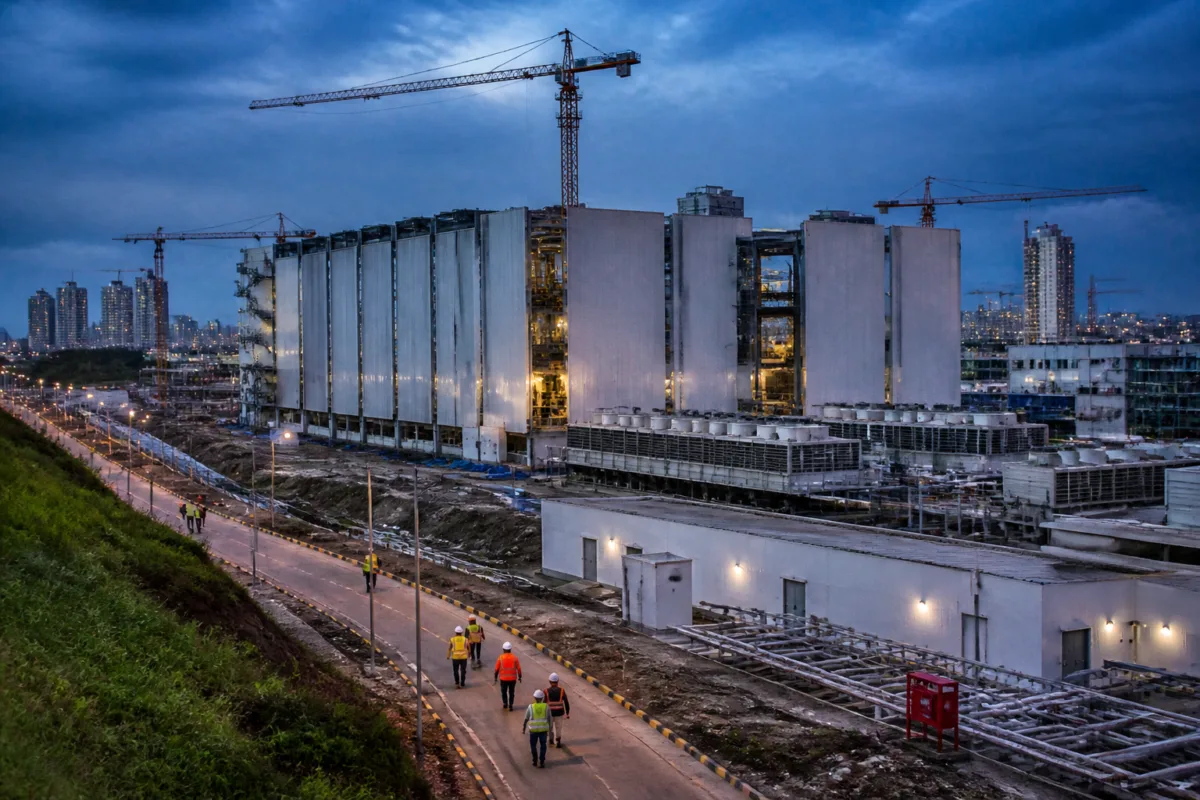
The debate over an AI bubble is increasingly becoming a debate about the physical infrastructure behind it. Specialist cloud providers, or neoclouds, are borrowing heavily to buy advanced graphics processing units (GPUs), build data centres and lease computing capacity to AI developers. Their current stress suggests that the next phase of the AI boom will be shaped not only by demand for computing, but by whether the revenue generated by that demand can support the cost of constructing and financing the infrastructure.
Elon Musk has warned that more than 200 neocloud companies could face significant difficulties, including failures and consolidation. His comments came as shares of companies including CoreWeave, Nebius and IREN fell, while credit-market concerns increased. At the same time, Nvidia chief executive Jensen Huang has described demand for computing capacity as extremely strong. The apparent contradiction is central to the story: AI demand can remain high even while individual infrastructure companies struggle to earn adequate returns.
That distinction matters because data centres are not ordinary software businesses. They require large upfront commitments to land, buildings, power systems, cooling equipment, networking infrastructure and specialised processors. A neocloud generally incurs these costs before it has fully earned the revenue expected to repay them. When interest rates and borrowing costs rise, the financial structure becomes more fragile even if customers continue to seek additional computing capacity.
The immediate pressure therefore appears concentrated in the relationship between infrastructure finance and infrastructure demand. A company can have customers and still face a liquidity problem if its debt must be refinanced at much higher rates, if its equipment loses value faster than expected or if new capacity takes longer to generate revenue. In the data-centre sector, the timing gap between spending and monetisation is particularly important because the assets are expensive and technology cycles are rapid.
The market reaction around CoreWeave illustrates this tension. Its bonds due in 2032 subsequently traded below 80 cents on the dollar, a level that signals investor concern about credit risk. The report also cited a rise in the cost of insuring debt against default for companies including CoreWeave and Oracle, alongside higher US Treasury yields. These indicators do not establish that the AI infrastructure market is collapsing, but they show that lenders and investors are scrutinising the assumptions behind its expansion more closely.
That scrutiny is significant for cities because data centres are increasingly part of the urban infrastructure economy. They occupy large sites, require substantial electricity and network connections, and depend on construction and equipment supply chains. Their financial health can influence whether planned facilities are completed, expanded or consolidated. A change in the credit environment can therefore affect not just technology valuations, but the pace at which physical computing capacity is built.
Research firm Gartner’s forecast places the scale of the challenge in sharper relief. It expects AI providers to spend nearly $1 trillion on infrastructure in 2026, followed by another $6 trillion between 2027 and 2030. Gartner estimates that data-centre owners would need $8.5 trillion in cumulative revenue through 2030 to cover announced investment, financing costs and a 12% return on invested capital. Revenue attributable to AI data centres, however, is forecast to reach no more than $3.6 trillion over the same period.
On that basis, Gartner warns that more than $3.5 trillion in AI infrastructure spending could be exposed to impairment by the end of 2030. It also expects more than 80% of neocloud providers to cease independent operations by then. The forecast includes companies that are acquired or consolidated, not only those that become insolvent. This distinction is important: a reduction in the number of independent providers would represent a major restructuring of the market, but not necessarily the disappearance of AI computing demand.
Gartner’s numbers point to a basic infrastructure problem. Announced investment is not the same as economically sustainable investment. Developers may be able to secure land, equipment and debt for a facility, but the project still requires enough paying demand over time to cover capital costs, financing and returns. If the revenue pool is smaller than the infrastructure commitments made by the industry, some assets will be underused, repriced or transferred to stronger owners.
Technology change adds another layer of risk. The report notes that more efficient AI models and rapidly improving chips could make existing equipment less competitive before its cost has been recovered. This creates an unusual form of infrastructure risk. A building may remain physically usable, but the computing equipment inside it may no longer produce the expected revenue. The financial life of the asset can therefore be shorter than the physical life of the facility.
Specialist providers are particularly exposed because they have fewer revenue streams than large technology companies. Microsoft, Amazon and Alphabet can support AI investment through established cloud, software and other businesses. Their balance sheets and customer relationships give them more room to absorb a period in which infrastructure spending grows faster than returns. Neoclouds, by contrast, are more dependent on the utilisation and pricing of a narrower set of AI assets.
The larger companies are not insulated from the underlying question. The report cites Reuters data showing that Amazon, Microsoft and Alphabet together had nearly $1.7 trillion in contracted revenue yet to be recognised, much of it linked to their cloud businesses. It also says the three companies could spend as much as $600 billion in 2026. The key issue is whether future cloud revenue will justify that level of capital expenditure, not simply whether these companies can raise the money.
This creates two possible channels for the market adjustment described in the report. In the first, tighter credit affects weaker specialist providers while the largest platforms continue investing. Under this scenario, distressed companies sell assets, seek buyers or stop expanding, while AI adoption and data-centre construction continue under fewer owners. The result would be consolidation and a financial correction rather than a broad infrastructure collapse.
In the second, the pressure reaches major customers. If hyperscalers reduce or delay projects because monetisation does not match spending, neoclouds could lose expected demand while continuing to carry large debt burdens. That could affect chip suppliers, data-centre developers and technology investors more broadly. The report presents this as a risk rather than an established outcome, and the available evidence does not establish that such a chain reaction has begun.
The difference between these scenarios will depend on the strength and duration of demand, the cost of refinancing and the ability of providers to convert computing capacity into stable revenue. It will also depend on the pace of technical change. Strong demand alone cannot protect a company whose financing costs, equipment costs and customer pricing are misaligned. Conversely, a highly leveraged provider may still survive if it can secure long-term customers, improve utilisation or transfer assets to a better-capitalised owner.
For the built environment, the central lesson is that data-centre expansion cannot be assessed only through announced capacity or headline investment totals. A facility is part of a wider system involving capital markets, power availability, construction schedules, hardware depreciation and customer contracts. If any part of that system weakens, the project’s commercial viability can change even when the underlying need for digital services remains.
The neocloud episode also exposes the institutional gap between planning physical capacity and evaluating financial durability. Data-centre projects are often discussed as symbols of technological progress and economic investment. Yet their long-term performance depends on less visible questions: who carries the debt, how quickly revenue is realised, how equipment is replaced and whether demand is concentrated among a small number of customers. The report does not provide a city-level assessment of these factors, but its financial evidence shows why they matter to infrastructure planning.
The evidence currently supports a narrower conclusion than either a full AI boom or a complete bubble-collapse narrative. Credit conditions are putting pressure on debt-heavy neoclouds, and Gartner’s forecast indicates a large gap between projected infrastructure spending and the revenue required to support it. At the same time, demand for computing remains strong and major technology companies continue to invest. The immediate story is therefore one of financial discipline entering a rapidly expanding infrastructure market.
What deserves monitoring is whether consolidation remains limited to weaker specialist providers or begins to change investment plans among the largest cloud companies. Bond pricing, refinancing conditions, data-centre utilisation, equipment replacement cycles and recognised cloud revenue will provide more useful signals than announcements of capacity alone. These indicators will show whether the sector is simply becoming more concentrated or whether the financial model supporting the next generation of urban digital infrastructure is being fundamentally revised.

