


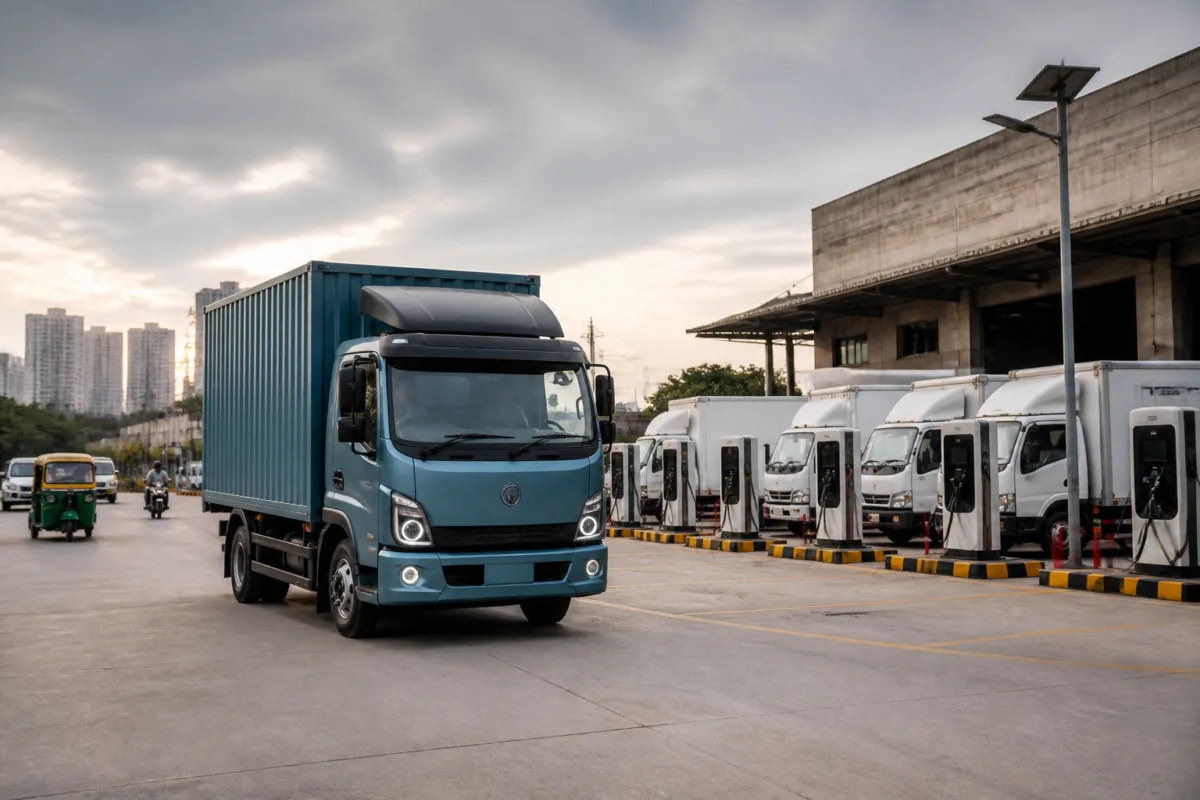
Amazon and Tata Motors have announced plans to deploy 3,000 electric trucks across Amazon’s transportation network in India, beginning in Delhi and later expanding to major national highways. The companies said the initiative would be the largest electric-truck deployment by an e-commerce company in the country and would extend fleet electrification beyond last-mile delivery.
The first batch of Tata electric trucks was flagged off in Delhi by H D Kumaraswamy, Union Minister of Heavy Industries and Steel, on Tuesday. The vehicles will move customer shipments between facilities, across cities and along national freight corridors as part of Amazon’s middle-mile logistics operations.
Under the arrangement, Tata Motors will supply the electric trucks, while Amazon’s carrier partners will own and operate them. The initial deployment will involve light- and medium-duty vehicles and is scheduled to begin during the festive season, when freight volumes across e-commerce and retail supply chains typically increase.
The next phase will focus on major national highways, with the companies targeting electrification of the 2,800-km Delhi-Bengaluru-Chennai freight corridor along NH48. The route passes through seven states and connects six of India’s largest e-commerce regions. Charging infrastructure, including hubs being developed with charging infrastructure provider Yahhvi, is expected to support the expansion.
The collaboration brings Amazon’s logistics network and freight demand together with Tata Motors’ vehicle engineering, manufacturing and service capabilities. The companies said the arrangement would address some of the operational barriers to electric-truck adoption and demonstrate how zero-tailpipe-emission commercial vehicles can be used at scale.
Kumaraswamy said the partnership reflected sustained demand from a nationwide logistics network being met by electric trucks manufactured in India. He added that government schemes, including PM E-DRIVE, PLI Auto and PLI ACC, would continue to support the transition to electric mobility.
The rollout follows Delhi’s 2026 EV Policy. Under the policy, the first 1,000 privately owned medium-duty electric trucks registered within three months of its launch will be permitted to enter the city at any time of day for 10 years, bypassing the usual “No Entry” restrictions. The provision is relevant to freight operators because restrictions on the timing of commercial vehicle movement can affect delivery schedules and fleet utilisation.
Tata Motors said its support would extend beyond supplying vehicles to include charging infrastructure, servicing and operational assistance. Rajesh Kaul, vice-president and business head–Trucks at Tata Motors, said the collaboration would demonstrate how electric trucks could be integrated into large-scale logistics operations and potentially reduce transportation-related emissions.
Amazon said the truck programme was part of its goal of achieving net-zero carbon emissions by 2040. Abhinav Singh, vice-president, Operations, Amazon, APAC, West Asia, Africa and Turkey, said the company already had more than 15,000 electric vehicles operating across more than 500 cities in India. He said the company was also supporting infrastructure and solutions intended to make electric-vehicle adoption easier for carrier partners and drivers.
The planned deployment places charging availability, vehicle servicing and route operations at the centre of India’s freight-electrification effort. The companies’ next steps involve beginning the Delhi rollout, building supporting charging hubs and expanding operations towards the targeted national corridor.

