


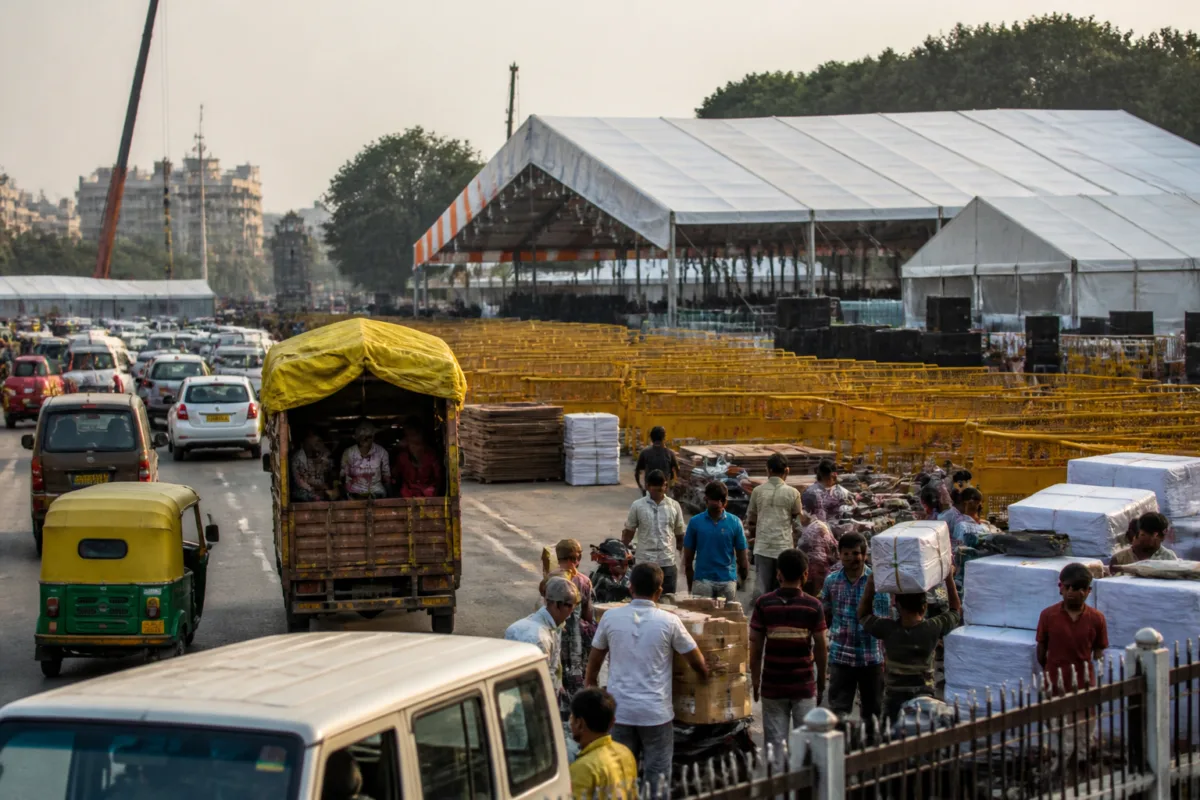
The proposed INDIA bloc rally at Delhi’s Ramlila Maidan on November 1 has become more than a political event. A warning from the Chamber of Trade and Industry (CTI) that the gathering could cause losses of up to ₹10,000 crore for surrounding markets has exposed a recurring urban governance problem: how Delhi manages large public events in districts where political venues, wholesale markets, transport routes and dense commercial activity overlap.
CTI chairman Brijesh Goyal has written to Congress leader Rahul Gandhi asking that the rally be postponed until after Diwali. The traders’ body has also sent a copy of the letter to Congress president Mallikarjun Kharge. Its request is based on the expected effect of barricading, road closures and traffic restrictions around Ramlila Maidan during a period when markets are still handling festive-season business.
The rally is being organised by the INDIA bloc over allegations related to vote theft, the Special Intensive Revision process and Chief Election Commissioner Gyanesh Kumar. The political organisers have projected an attendance of about 10 lakh people. CTI estimates that 15,000 to 20,000 buses and other vehicles could arrive in Delhi, affecting movement around 20 major wholesale and retail markets.
Those figures are estimates by the traders’ body, not independently established loss or attendance data in the supplied report. That distinction is important. The central urban question is not whether ₹10,000 crore will certainly be lost, but how a city should calculate and manage the economic cost of restricting access to a major commercial district for a mass gathering.
Ramlila Maidan sits within a dense commercial network that includes Chandni Chowk, Bhagirath Palace, Khari Baoli, Sadar Bazaar, Chawri Bazaar, Kashmere Gate, Nabi Karim and Karol Bagh. These are not isolated shopping destinations. They are linked by roads used by customers, delivery vehicles, traders, workers and public transport users. A restriction near one venue can therefore affect movement well beyond the event boundary.
That relationship between public venues and markets makes central Delhi different from a purpose-built rally ground located away from major trading clusters. When access roads are closed or heavily controlled, the immediate effect is not limited to inconvenience for spectators. It can alter delivery schedules, customer footfall and the movement of goods through wholesale markets. The supplied report does not provide an official traffic-diversion plan or a market-wise assessment, so the precise effect remains unclear.
CTI has pointed to an earlier incident as a reference for its concern. It said that a protest at Jantar Mantar on October 10, attended by about 3,000 to 4,000 people, resulted in the closure of central Delhi and caused traders losses of ₹2,000 crore. This figure is also an estimate attributed to CTI. It is being used by the traders’ organisation to argue that a much larger event during the festive trading period could produce a substantially wider disruption.
The comparison, however, also shows why event planning needs more than a headline attendance figure. The impact of a gathering depends on its location, duration, road closures, security perimeter, public transport arrangements, parking controls and the timing of restrictions. The supplied material confirms that preparations are under way at Ramlila Maidan and that Delhi Police has made security arrangements for the event during the Diwali period. It does not establish the final number of barricades, closed roads, diverted bus routes or metro restrictions.
This gap between projected disruption and published operational detail is central to the dispute. Traders are being asked to prepare for a potential event involving hundreds of thousands of people, but the report does not identify a publicly released, detailed access plan for the surrounding markets. Without such information, businesses cannot easily distinguish between roads that will be fully closed, roads that will remain accessible with restrictions, and routes reserved for emergency or commercial movement.
CTI has suggested November 10 or a later date for the rally. It has also proposed shifting the event to Burari Ground or Jawaharlal Nehru Stadium, arguing that these locations would reduce the effect on markets. The alternatives reflect two different approaches to public-event governance. Postponement would avoid the peak period identified by traders, while relocation would attempt to separate a mass political gathering from a high-intensity commercial district.
Neither option is presented in the supplied report as an accepted government decision. The issue therefore remains a request from the traders’ body to the political organisers. The report also does not say whether the police, transport authorities, municipal agencies or venue managers have formally assessed the proposed alternatives.
The political dispute behind the rally adds another layer. Rahul Gandhi has responded to traders by saying that the government shut the metro, sealed roads and locked down the capital, and that the protest would stop if the Prime Minister removed Gyanesh Kumar. These are political statements and allegations made in the context of the wider campaign; they do not establish the operational facts of the November 1 event. A CPI MP, P. Sandosh Kumar, has argued that electoral reform is more important than business concerns and questioned decisions linked to the Special Intensive Revision process and changes to Form 6. The Election Commission’s position, as referenced in the report, is that allegations of unilateral decisions by the Chief Election Commissioner were rejected.
The competing claims illustrate the difficulty of managing politically important gatherings in a city whose commercial geography is concentrated in old and densely connected districts. For organisers, the location offers visibility and symbolic value. For traders, the same location represents an economic network that cannot be easily shut down without consequences. For the administration, the task is to protect public safety and the right to assemble while maintaining access to markets and essential movement.
The immediate evidence supports three conclusions. First, the potential economic loss figures are estimates from CTI and should not be treated as audited outcomes. Second, the risk is geographically broad because Ramlila Maidan is surrounded by multiple major markets and transport corridors. Third, the dispute is unfolding before the final operational arrangements are clear, leaving businesses dependent on information about access, security and traffic diversions.
The next significant development will be whether the organisers agree to postpone or relocate the rally, and what plan Delhi’s authorities publish for traffic, public transport, emergency access and market connectivity if it remains at Ramlila Maidan on November 1. Those details will determine whether the event becomes a temporary inconvenience for nearby businesses or a wider disruption across central Delhi’s commercial system.

