


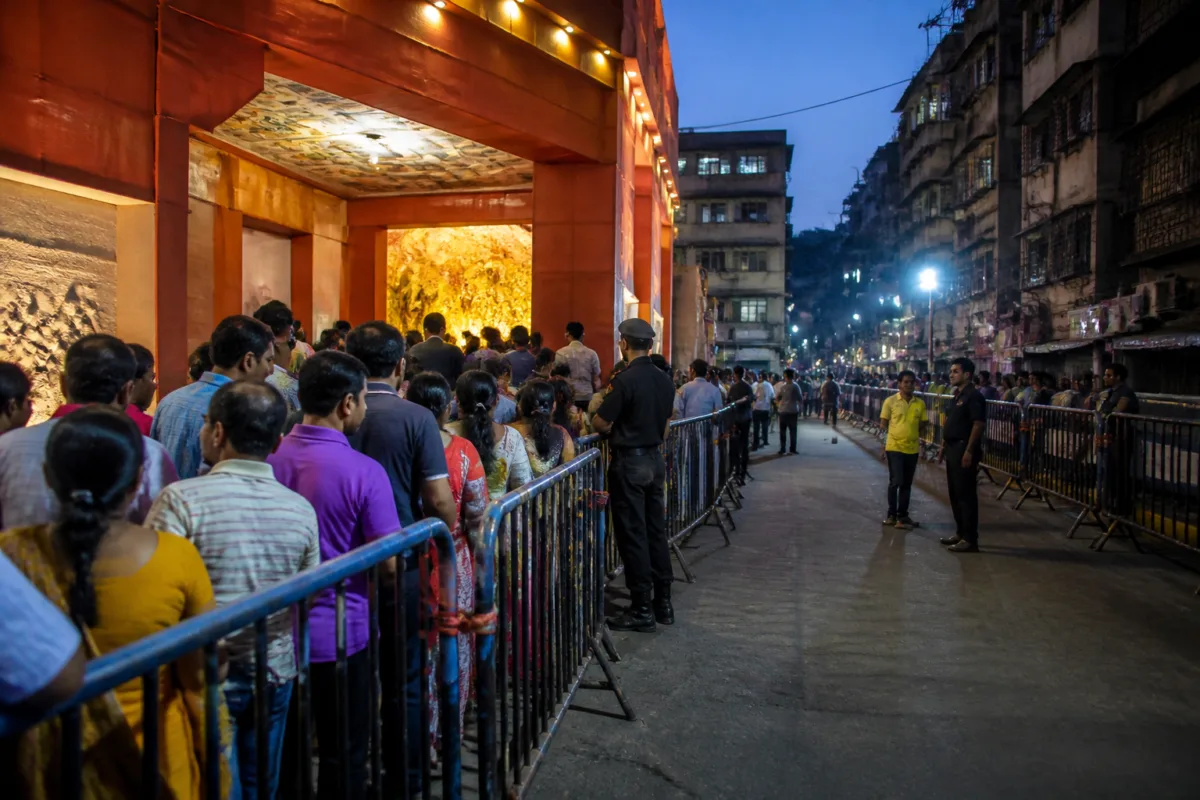
The Chorebagan Durga Puja stampede, in which 19 visitors were killed and at least 25 injured, has exposed a safety problem that extends beyond one crowded pandal: the difficulty of managing temporary public spaces that attract large, concentrated crowds without the same operational systems expected at permanent venues. The state government has described the incident as the result of “human error”, while announcing safety guidelines for major puja organisers and backing an independent inquiry into what went wrong.
The tragedy took place at the Chorebagan pandal on October 17. Speaking about the incident, chief minister Suvendu Adhikari said it was “not a minor incident” and that those responsible for the error must be identified. The government, he said, would not shield anyone. His remarks place individual accountability at the centre of the initial public response, but the proposed inquiry is also expected to examine broader questions involving pandal design, construction, visitor movement and crowd management.
That distinction matters because large Durga Puja celebrations function as temporary urban infrastructure. For several days, a neighbourhood space can become a high-footfall public destination, with visitors moving through narrow approaches, queues, entry gates, exhibition areas and exit routes. The built environment is often assembled for a limited period, but the risks created by its layout and operating arrangements can be immediate and substantial.
The Chorebagan incident therefore cannot be understood only as a failure by one person or one committee. The available account does not establish precisely what happened inside or around the pandal, nor does it identify the specific human error referred to by the chief minister. Those questions have been left to an independent committee headed by a retired judge, appointed with the assistance of Calcutta High Court. Its findings are expected to establish what went wrong and recommend precautions for large puja pandals.
The government’s decision to stay out of the independent inquiry is significant. According to the chief minister, Chorebagan was a government-approved Durga Puja, but the state would not control the examination of the incident. This separates the inquiry from the immediate administrative response and creates the possibility of an assessment that looks beyond the government’s own approval process. The supplied account does not specify the committee’s terms of reference, its deadline or the extent of its access to records and witnesses.
The proposed inquiry also raises a basic governance question: what does approval mean when a temporary public venue is expected to accommodate very large numbers of visitors? Government approval may confirm that an organiser has met specified requirements, but it does not by itself guarantee that conditions remain safe throughout the festival. Visitor volumes, queue lengths, emergency access, staff deployment and the functioning of entry and exit routes can change rapidly during peak periods.
The source reports that around 66,000 Durga Pujas were organised across the state this year and that the celebrations were largely disciplined, with Chorebagan described as a tragic exception. That figure illustrates the scale of the administrative challenge. Safety oversight is not limited to a small number of permanent venues. It must operate across thousands of temporary sites, each with different street conditions, structures, access points and crowd patterns.
At the same time, the number of pujas alone does not explain the risk at any individual site. The relevant question for safety planning is how many people a particular pandal can safely receive at a given time, how quickly they can enter and leave, and whether emergency services can reach the site if movement breaks down. The supplied report does not provide the Chorebagan pandal’s approved capacity, visitor numbers at the time of the stampede, gate configuration, route width or details of emergency access. These are among the factual gaps the independent inquiry will need to address.
The government plans to meet prominent puja committees in about three months and distribute a brochure outlining recommended safety measures. The chief minister said the recommendations of the retired-judge committee would guide precautions for major Durga Pujas and help organisers identify risks in pandal design, construction and crowd management before the next Durga Puja season.
A brochure can help communicate rules, but the Chorebagan case indicates that communication is only one part of the safety chain. The system also requires clear responsibility for checking designs, assessing crowd capacity, monitoring construction and verifying whether safety arrangements remain in place during the event. The source does not state which agency currently performs each of these functions, how inspections are documented or what penalties apply when approved conditions are breached.
This is especially important because pandals are temporary structures assembled in dense urban settings. Their design may shape how people queue, where they pause, how quickly they can change direction and whether congestion spreads from one section to another. Construction choices can also affect the available space for movement and the ability of organisers or emergency personnel to intervene. The government’s reference to pandal design and construction suggests that the forthcoming guidelines will need to consider the physical environment alongside crowd-control procedures.
The institutional structure is similarly important. A public festival may involve organisers, local authorities, police, emergency services, medical facilities and government departments. The source confirms that the injured received treatment at private hospitals and that the government provided assistance to affected families. It does not, however, explain how medical readiness was planned at the venue, who coordinated the response or whether emergency arrangements were adequate before the incident.
The treatment of the injured and assistance to families address the consequences of the tragedy, but prevention depends on what happens before visitors arrive. A safety system must identify potential points of failure in advance, assign responsibility for each control and ensure that organisers can respond when conditions change. The independent committee’s recommendations could clarify whether the breakdown at Chorebagan was primarily a design problem, an operational failure, an approval failure or a combination of these factors.
The government’s decision to scale down several large celebrations planned after Durga Puja shows that the incident affected the administration’s approach to public gatherings in the short term. The chief minister said the tragedy had deeply affected the state. That response indicates that authorities treated the event as a wider warning for large celebrations, rather than as an isolated matter confined to one puja committee.
Yet the longer-term test will be whether the proposed safety measures become enforceable operating requirements rather than general advice. The source says the government hopes the recommendations will help identify risks before the next Durga Puja season. It does not establish whether the new framework will include mandatory crowd-flow plans, maximum occupancy limits, independent structural checks, live monitoring, emergency drills or publicly available compliance records. These details will determine how the lessons of Chorebagan are translated into administration.
The tragedy also highlights the limits of counting successful events as evidence of a safe system. The government’s statement that most of the roughly 66,000 pujas were disciplined establishes the broad scale of the celebrations, but it cannot determine whether risk controls were consistently applied. A system can function without incident many times and still contain weaknesses that become fatal when several conditions coincide at one location.
For Kolkata and other cities, the central urban question is how temporary cultural spaces are governed when they become more crowded than many permanent public facilities. Festivals contribute to the city’s economy, identity and public life, but their success also depends on streets, structures and services being able to absorb sudden demand. That makes festival safety part of urban governance, not merely an internal matter for event organisers.
The Chorebagan inquiry is expected to provide the factual foundation for the next stage. It will need to establish what happened, identify the responsibilities of the people and institutions involved, and recommend precautions that can be checked before the next festival season. Until those findings are available, the central fact is clear: a temporary public venue became the site of a deadly crowd disaster, and the state’s proposed response now has to address both individual accountability and the systems that allowed the risk to develop.

