


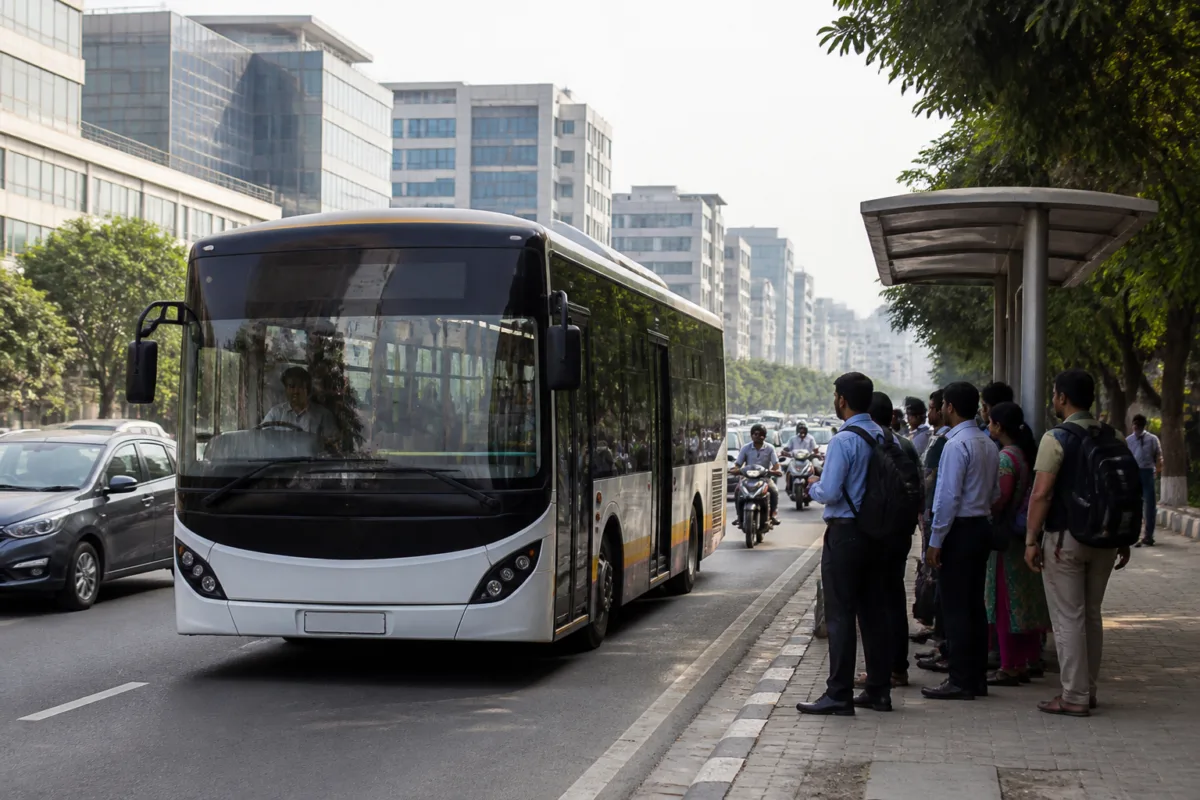
A survey of Sarjapur Road commuters has found that 73.1% of respondents would pay more for an air-conditioned BMTC service with a high probability of getting a seat, Wi-Fi, fixed schedules, real-time tracking and pre-booking. The finding is not merely a case for premium buses. It is evidence of a larger problem in south-east Bengaluru: many commuters are willing to pay for public transport, but only when the system reduces the uncertainty built into an ordinary bus journey.
The survey was conducted by the Bangalore Metropolitan Transport Corporation (BMTC) and Save Our Sarjapur, and its findings were released in October. The SORT Bengaluru–BMTC Sarjapur Mobility Survey covered 400 respondents and was designed to understand why commuters in one of Bengaluru’s most congested employment corridors do not use BMTC more extensively. The report comes as construction of the Sarjapur Road Metro line is likely to begin within a year, a development that could add to congestion during the construction period.
That timing matters because the survey captures a corridor that is already organised around intense daily travel between residential neighbourhoods, the Outer Ring Road, technology parks and other employment centres. Hosa Road and Kasavanahalli accounted for 37.6% of respondents’ journey origins, followed by Haralur Road at 25.6%. Sarjapur Road near Iblur accounted for 10.2%, while the Chandapura–Dommasandra and Dommasandra–Sarjapur corridors together represented another 14.7%.
The destinations show how dispersed the travel market is. The largest share, 29.8%, travelled along the Outer Ring Road between Iblur and Marathahalli, while 18.5% travelled beyond Marathahalli. Others headed towards the central business district and Koramangala, Whitefield, Electronics City and the Banashankari–HSR area. Respondents also identified technology parks including Prestige Tech Park, Ecospace, Bagmane Tech Park, Embassy Tech Village and Manyata Tech Park.
This is important for bus planning because the corridor does not serve a single destination or a simple home-to-office route. It connects residential areas to a network of employment clusters, often requiring transfers and short walks through roads that were not designed as integrated public transport environments. The survey identified access to Eco World as a particular gap and said that internal access to other technology parks could widen the coverage of bus services.
The willingness to pay a premium should therefore be read alongside the reasons commuters currently hesitate to use buses. The report lists an application that does not track buses, missing frequency, unreliable services and a lack of air-conditioned buses among the problems reported by commuters. It also identifies a missing transfer between the Bellandur–Iblur junction on the Outer Ring Road and Bellandur Gate on Sarjapur Road. That gap forces passengers to walk about one kilometre.
On Haralur Road, respondents reported confusion over bus stops. These details show that reliability is not only a question of whether a bus exists on a route. It also depends on whether a passenger can locate the stop, know when the bus will arrive, transfer without an excessive penalty and reach the final destination without an unsafe or inconvenient walk.
Frequency received the highest number of rank-one votes among the factors that could persuade respondents to shift to buses. Other important factors included air-conditioned buses, bus-app tracking, fewer connections and easier ticketing. A stop within 300 metres, easy transfers, ergonomic shelters and skywalks also appeared in the list of measures that could improve adoption.
The survey’s travel pattern reinforces the need for a service designed around predictable peak demand. Forty-three per cent of respondents said they travelled five days a week, while 30.2% travelled three days a week and 15.3% travelled four days a week. In the morning, 36.3% began their journeys between 8 am and 9 am and another 30.5% between 7 am and 8 am. In the evening, the largest groups left between 4 pm and 5 pm and between 5 pm and 6 pm, each accounting for 22.9%.
These figures describe a substantial office commute, but they do not automatically establish that a premium service will replace private vehicles. They do show that the target market has a recurring travel pattern and may value a bus service that makes arrival and seating more predictable. The survey itself identifies a high probability of getting a seat as a factor that could tip the scale.
BMTC and Save Our Sarjapur have proposed four pilot routes with a high probability of a seat. The recommendations include flat fares of Rs 100, Rs 150 and Rs 200 based on distance, as well as high-frequency air-conditioned buses to Iblur. For airport travel, the report recommends pre-booking and beginning with one KIA bus. Among 382 respondents, 91.9% said they would consider a premium KIA bus to the airport, while 82.2% said they would consider one from the airport to the corridor.
The proposed fare structure is a significant departure from the idea that a bus service should be judged only by its lowest ticket price. The survey proposes fares of Rs 100 for journeys under 10 km, Rs 150 for journeys between 10 km and 20 km, and Rs 200 for journeys above 20 km. It also recommends payment by the kilometre. These figures remain recommendations in the supplied material, not an announced BMTC fare decision.
That distinction is central to the institutional question raised by the survey. BMTC would have to decide how a premium service fits within its existing network, how it would allocate buses, how routes would be monitored and how the service would be integrated with ordinary buses and future metro stations. The survey points towards a more demand-responsive model, but it does not establish that BMTC has approved the pilots or committed to a launch date.
Mukund Kumar of Save Our Sarjapura said the group had presented the survey summary to senior BMTC officials, who had been receptive and expressed interest in working with the organisation. Joy VR, co-founder of the Sarjapura Residents Welfare Association, said real-time tracking towards Sarjapur was currently unavailable and that maintaining proper intervals between buses and introducing tracking would help commuters.
The proposed premium model also raises a question about what public transport users are actually paying for. Air-conditioning and Wi-Fi are visible amenities, but the survey places frequency, tracking, fixed timings, pre-booking and the probability of a seat at the centre of the proposition. In other words, the premium is linked as much to certainty as to comfort. A passenger may accept a higher fare when the service reduces the risk of waiting without information, missing a connection or standing through a long journey.
Sarjapur Road’s coming Metro construction makes that question more urgent, although the survey does not quantify the expected congestion or establish a construction schedule. The report says the work is likely to begin within a year and could worsen congestion. In that setting, bus pilots could become a way to test whether better operations can attract commuters before a major rail project is completed. But the evidence supplied does not show whether the proposed routes, fares or KIA service have received final approval.
The survey’s larger message is that improving bus adoption in Bengaluru may require more than adding vehicles to busy roads. It requires treating information, transfers, stop design, internal technology-park access and booking as part of the transport service itself. The reported one-kilometre gap between Bellandur–Iblur and Bellandur Gate illustrates how a missing connection can weaken an otherwise useful corridor.
For BMTC, the immediate test will be whether the survey can be converted into an operational pilot with measurable service commitments. The proposed routes, fare bands, tracking systems, booking features and seating guarantees will determine whether the premium concept addresses the reported problems or simply adds a higher-priced layer to an unreliable network. The next developments to watch are BMTC’s decisions on the pilot routes, the proposed one-bus airport trial and the timeline for Sarjapur Road Metro construction.

