


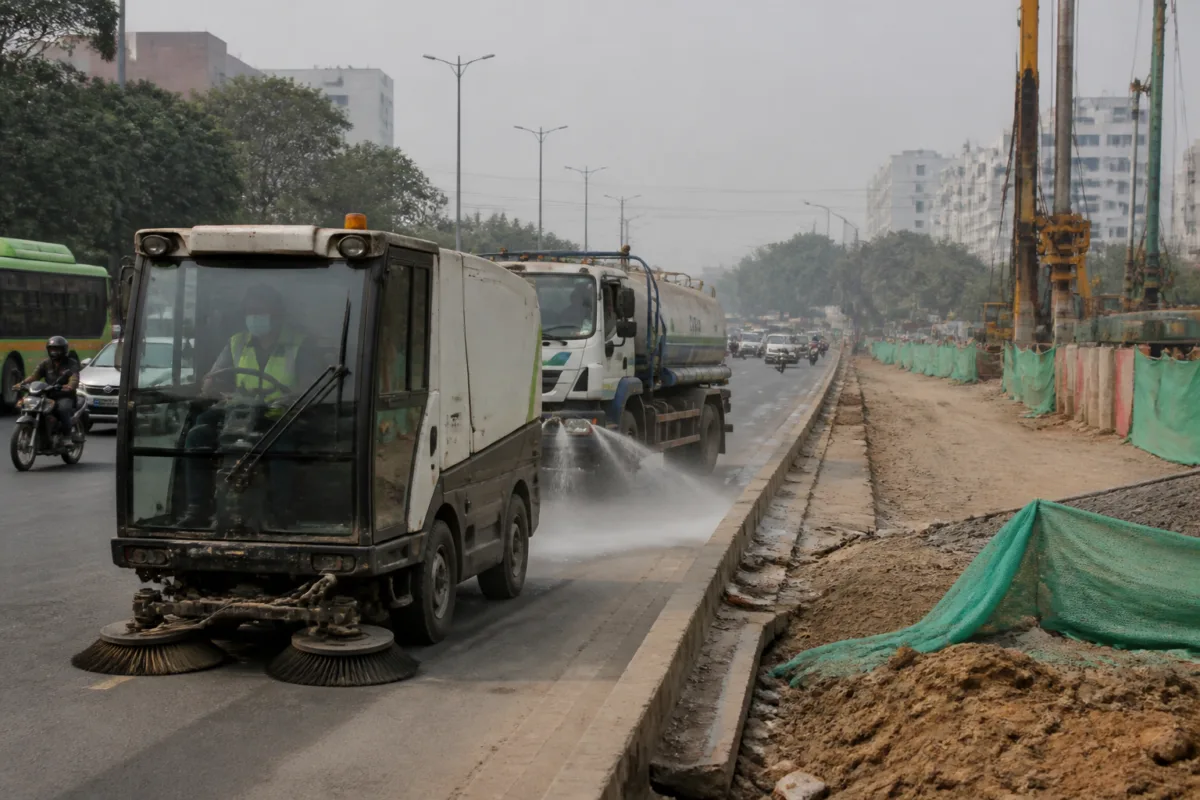
Delhi’s dust pollution campaign is expanding across roads, construction sites and identified hotspots, but the evidence assembled by the Times of India points to a deeper administrative problem: the city is measuring equipment and interventions more easily than it is measuring whether dust sources have been eliminated. Water sprinklers, anti-smog guns and mechanical sweepers can suppress visible dust, yet damaged roads, exposed soil, uncovered construction material, illegal dumping and incomplete road coverage continue to recreate the problem.
That distinction matters because Delhi’s dust challenge is not located at one road or one construction site. Road traffic can lift accumulated silt, construction activity can release particles from uncovered surfaces, and waste dumping can leave loose material close to neighbourhoods and arterial roads. The city’s response is therefore moving towards a source-based approach, but the available evidence shows that implementation remains uneven across agencies and locations.
The most significant shift is the Public Works Department’s plan to examine dust sources within a 3-km radius of 47 pollution hotspots. The approach recognises that cleaning a road at the centre of a hotspot may have limited value if nearby excavation, exposed soil, construction material or unpaved surfaces continue to generate dust. The department also planned to deploy around 200 anti-smog guns.
The hotspot framework places responsibility beyond a single road segment. Locations identified in the reported exercise include Anand Vihar, ITO, DTU, Dwarka, Bawana, Pusa, the area around IGI Airport, IIT Delhi, parts of the Jawaharlal Nehru University area, Burari Crossing, North Campus and Alipur. Earlier hotspot assessments mentioned in the report included Anand Vihar, Bawana, Mundka, Wazirpur, Rohini, RK Puram, Okhla, Jahangirpuri, Punjabi Bagh, Ashok Vihar and Dwarka.
This wider geography reflects how urban dust is produced. A designated hotspot may be where poor air quality becomes visible in monitoring data, but the source can sit on an adjoining road, at a construction site, beside an open plot or along a corridor where traffic repeatedly disturbs loose material. A hotspot strategy can identify these relationships, but its effectiveness depends on whether the responsible road-owning, municipal and construction-enforcement agencies act beyond their individual boundaries.
The scale of the unresolved task is visible in the Commission for Air Quality Management’s hotspot exercise cited in the report. An assessment had identified 65 major pollution sources across 13 hotspots. Of these, 16 were reported resolved, 43 remained under monitoring and six were pending. Authorities had also identified 4,555 minor sources, including road dust, garbage and construction-waste dumping, potholes, unpaved roads, traffic congestion and open waste burning. Nearly half of these minor problems had been addressed at the time of the review.
These figures show that identification is not the same as resolution. A source can be recorded, inspected and placed under monitoring without the physical condition that creates the dust being permanently corrected. A pothole may remain after an inspection. Waste may be removed from one location and appear elsewhere. A road may be swept while its edges, medians or adjoining unpaved areas continue to accumulate silt. For the public, the relevant outcome is not the number of sources entered into a monitoring system but whether the source stops producing dust.
## Road sweeping is a capacity and access problem
Mechanical sweeping illustrates the gap between deployment and coverage. A CAQM assessment reported in the source found that mechanical sweepers were cleaning only 35–40% of Delhi’s large and medium-sized roads on alternate days, despite a prescribed norm covering the entire road network. Delhi had nearly 100 machines against a requirement of 172, and each machine covered up to 30 km a day against a requirement of 40 km.
The shortfall is not only about procurement. Roads obstructed by encroachments or illegally parked vehicles prevent machines from reaching the full carriageway. At the same time, around 70% of Delhi’s road network consists of roads narrower than 10 metres, which are currently swept manually. This creates an operational mismatch: the city may add machines for major roads while a large share of the network remains dependent on labour-intensive cleaning.
The issue is also what happens before and after a sweeper passes. A machine that cannot reach the road edge may leave the most dust-prone material in place. If collected silt is not removed, it can return to the carriageway. The report also cites a 2023 inspection near the Red Fort, Rajghat, ITO, Pragati Power Plant, IP Estate and Millennium Park, where thick layers of dust and loose silt were found on pavements and footpaths. Mechanical sweepers were reportedly found blowing dust instead of suppressing it with water.
That episode points to the importance of operating standards, not just machine counts. Dust control requires suitable equipment, adequate coverage, unobstructed access, correct operating procedures and the removal of material after sweeping. Without all of these, mechanical cleaning can become a recurring activity that shifts dust rather than preventing it from becoming airborne.
## Construction enforcement remains the decisive test
Construction and demolition activity creates a separate enforcement challenge. Exposed soil, uncovered materials and improperly stored waste can release dust into surrounding streets. In March 2026, the Prime Minister’s Office reportedly flagged serious lapses in Delhi’s dust-mitigation measures and warned of strict action against officials for negligence. The discussions covered road dust, poor waste management and delays in grievance redressal.
The Municipal Corporation of Delhi said it was removing construction and demolition waste from roadsides and vacant plots. District authorities, however, cited limited mechanised sweeping in residential areas, shortages of capsules at fixed compactor transfer stations and difficulties in deploying heavy machinery in narrow lanes. These constraints show how a citywide pollution mandate can encounter local infrastructure and access problems.
MCD councillors had also raised concerns during a November 2025 meeting about unauthorised construction despite restrictions under Graded Response Action Plan Stage III, illegal dumping of construction waste and the burning of leaves. They alleged that sprinklers and mechanical sweepers were being deployed only in selected wards. The committee chairperson acknowledged visible potholes and said accumulated dust was not being adequately lifted after sweeping.
In October 2026, MCD introduced a stronger monitoring layer by installing 360-degree cameras at all 125 construction and demolition waste sites, with live feeds to the Delhi Pollution Control Committee. Procedures were also introduced for covering or wetting dumped material, installing dust barriers and ensuring that vehicles transporting construction waste were fully covered. Joint enforcement teams were assigned to act against dust pollution, illegal dumping and biomass burning.
The institutional significance of these measures is that they attempt to connect observation with accountability. Cameras can provide a continuing record rather than a single inspection. But monitoring alone does not establish compliance. Its value depends on whether violations are detected, whether the responsible agency acts quickly, whether penalties or corrective orders follow, and whether the same site remains compliant after enforcement teams leave.
## Why suppression cannot substitute for prevention
Delhi’s reported deployment of 167 water sprinklers and 60 anti-smog guns across roads, civic facilities and high-rise buildings reflects the city’s preference for visible, rapidly deployable interventions. MCD has also started deep cleaning identified dust-prone roads across all 12 zones. These measures have a role in localised dust suppression, particularly where airborne coarse dust is already visible.
However, the source material distinguishes between reducing visible dust temporarily and controlling the broader pollution load. Environment activist Bhavreen Malhotra said anti-smog guns could suppress coarse dust in localised construction zones but had limited overall impact on Delhi’s air quality because they could not address particulate or gaseous pollutants that rise during winter. She also said the equipment should ideally operate throughout the year.
The limitation is structural. Water sprinkling cannot repair a pothole, pave an unpaved road, remove a dumped mound of construction waste or ensure that a truck is covered. An anti-smog gun cannot replace a road-maintenance programme or consistent inspection. These devices treat the airborne symptom after material has become mobile, while source control requires action on the surface, site or activity that generates it.
This does not make sprinklers or anti-smog guns irrelevant. It changes the question against which they should be judged. Their deployment should be assessed alongside road coverage, frequency of cleaning, removal of collected material, construction-site compliance and the number of repeat violations. Counting equipment without tracking these outcomes can make administrative activity appear stronger than the underlying results.
## The larger governance question
Delhi’s dust problem exposes a coordination challenge spread across road ownership, municipal sanitation, construction regulation, waste transport, traffic management and pollution oversight. Each function can be assigned to a different agency, while the airborne dust experienced by residents remains a shared outcome. A 3-km source assessment around hotspots is an attempt to organise that complexity geographically, but it will work only if agencies act on sources that may fall outside their immediate operational responsibility.
The same applies to narrow roads and residential areas. The reported shortage of mechanised sweeping and the difficulty of moving heavy machinery through narrow lanes indicate that a single citywide intervention cannot serve every street type. Major corridors, residential lanes, construction sites, vacant plots and waste-transfer points require different operating arrangements. The evidence supplied does not establish whether Delhi has closed those operational gaps, but it shows that the gaps have been repeatedly identified.
For citizens, the distinction between suppression and prevention is experienced at street level. A road may be sprayed in the morning and still gather dust from an unpaved shoulder, a damaged surface or an uncovered waste vehicle. A construction site may display mitigation equipment while material is stored outside a barrier. A hotspot may receive intensive cleaning while surrounding roads continue to feed it with loose dust.
Delhi’s current strategy therefore offers two competing measures of progress. The first is activity: the number of sprinklers, anti-smog guns, sweepers, cameras and cleaning drives deployed. The second is control: the share of roads covered, the number of sources resolved, the recurrence of violations, the condition of road edges and the persistence of improvements at hotspots. The evidence in the reported assessments suggests that the first measure is advancing faster than the second.
What is established is that Delhi has identified thousands of dust-related sources and is adding equipment, monitoring systems and hotspot-based interventions. What remains uncertain is whether these measures will deliver consistent, durable source control across the city. The next test will be whether agencies can convert inspections into repairs, waste removal, compliant construction practices and full cleaning coverage—and whether those improvements can be demonstrated at the locations that continue to generate dust.

