


Mumbai’s system for preventing manual scavenging is showing a serious gap between what the law requires and what vigilance committees actually do. Committees for Mumbai City, Mumbai Suburban and Thane have repeatedly missed mandatory quarterly meetings, reproduced similar minutes and recorded little evidence of inspections, grievance resolution or follow-up action, according to documents reviewed by the Times of India.
The failures assume greater significance because two people died while cleaning drains, manholes or septic tanks in Mumbai between January and October 2026. Shamim Razak Gazi, 26, died on February 4 while cleaning a 25-foot-deep drain in Goregaon. Santosh Kashte, 47, died after entering a manhole at a building in Santacruz on September 28. The reported deaths raise a central question about the functioning of the safeguards created to identify hazardous sanitation work before it results in injury or death.
The Prohibition of Employment as Manual Scavengers and their Rehabilitation Act, 2013, requires district vigilance committees to meet at least once every three months under Section 24(4). Their responsibilities include monitoring implementation of the law, overseeing rehabilitation and addressing grievances. The committees are therefore not merely consultative bodies. Their meeting schedules and records are part of the institutional mechanism intended to ensure that hazardous sanitation work is detected, reported and acted upon.
The documents reviewed by the newspaper indicate that this mechanism has not operated at the required frequency. Mumbai City’s committee went 10 months and 25 days without meeting between 2025 and 2026. Its latest meeting was held in September, after meetings in May and June 2025. Mumbai Suburban’s longest recent gap was six months, between December 2025 and June 2026. Thane’s committee met in July and November 2025 and again in June 2026.
The explanations cited for the gaps also reveal how administrative processes can dilute responsibility. A source attributed Mumbai City’s delay to a low caseload, while the Mumbai Suburban committee cited the March year-end account-closing period. Neither explanation addresses the statutory requirement that meetings take place every three months, nor does it establish how potential cases, worker complaints or site-level risks were monitored during the gaps.
The issue is not limited to whether a committee met. Its minutes reportedly record almost the same discussions across meetings, with little evidence of action. A vigilance committee that repeatedly discusses the same requests without documented outcomes risks becoming a record-keeping exercise rather than an operational safeguard. The difference matters in sanitation work, where the absence of a formal complaint does not necessarily mean the absence of hazardous work.
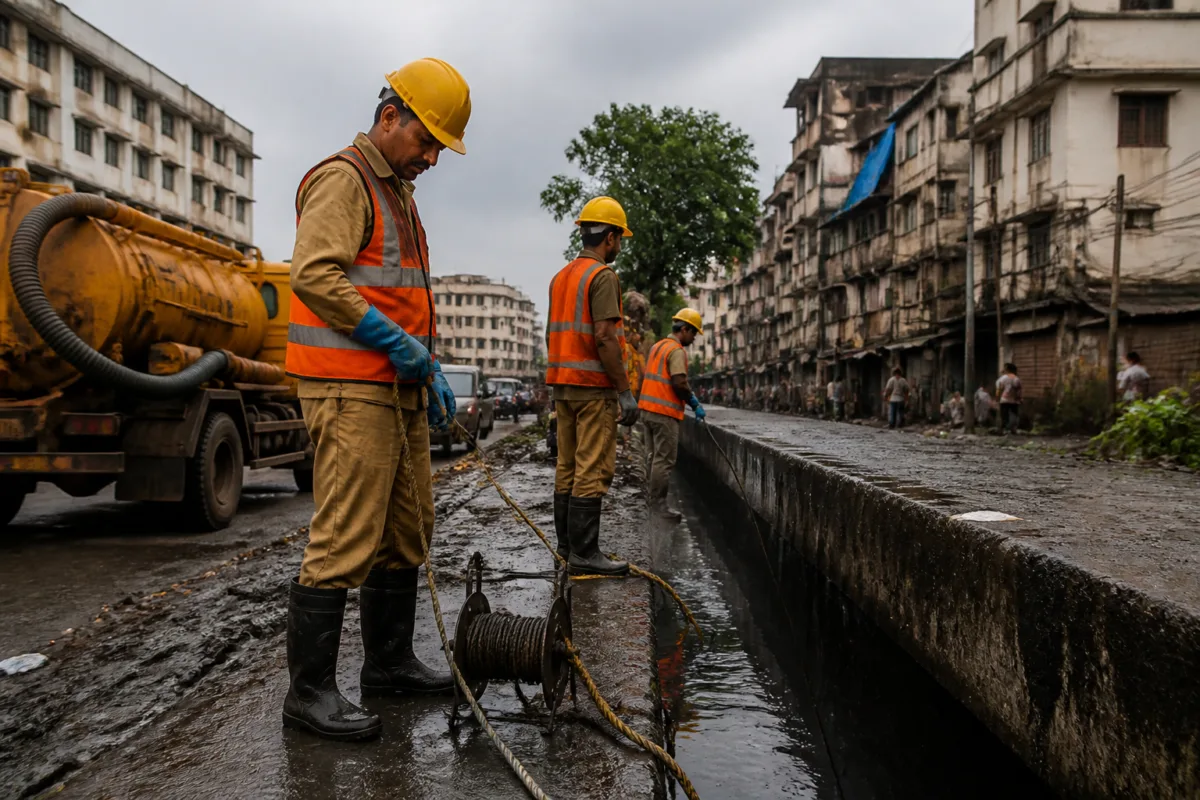
Vikramkumar Chandeliya, a non-government member of Mumbai Suburban’s committee representing the Akhil Bharatiya Safai Mazdoor Congress, said he had repeatedly raised concerns about workers clearing clogged drains without gloves or gumboots in Kurla. He said some workers told him they had been hired through BMC contracts. Civic officials, however, denied that manual scavenging was taking place. The contrasting accounts point to a basic verification problem: the system must establish what work is being performed, by whom, under which contract and with what safety equipment, rather than rely only on institutional definitions of responsibility.
The Brihanmumbai Municipal Corporation has reported zero manual scavenging deaths between 2021 and 2024. Its position, as reported, is that cases on private premises or involving informal hires fall outside its scope. That distinction may separate municipal employees from other workers in administrative records, but it does not remove the underlying safety risk from the city’s built environment. Drains, manholes and septic tanks remain connected to urban infrastructure even when the worker entering them is hired informally or through a private arrangement.
This is where the question of contracting becomes important. The report identifies Gazi as a contract worker engaged in “BMC sewerage operations”, according to the Dalit Adivasi Shakti Adhikar Manch. Chandeliya also said workers told him they were engaged through BMC contracts. The supplied material does not establish the precise contractual responsibility in each case, but it shows why fragmented hiring arrangements can make accountability difficult. If a civic body, contractor, building owner and informal intermediary each define the work as someone else’s responsibility, the worker can remain outside effective protection even while performing an essential urban service.
The committees’ difficulties also extend beyond municipal boundaries. Mumbai Suburban’s minutes record repeated requests to Central and Western Railways for information on manual scavenging at stations, tracks, depots and offices. The requests were discussed in December 2025 and June 2026, but the report says there was no documented response. Similar requests to BEST also produced no documented reply. Railway representatives, according to Chandeliya, changed from meeting to meeting and did not bring the records or documents requested earlier.
This lack of information weakens the committee’s ability to perform its statutory role. Without records from agencies operating transport infrastructure, committees cannot establish whether hazardous sanitation work has occurred, identify responsible employers or assess whether rehabilitation and safety requirements have been met. The problem is therefore not only an inactive committee; it is also a fragmented information system in which public agencies do not provide the evidence needed for oversight.
Sitaram Shelar of the Centre for Promoting Democracy described the pattern as a way of shifting responsibility and refusing to acknowledge the existence of manual scavengers. That is an assertion by an activist and should be read as such. But the documented gaps in meeting schedules, repeated requests and limited action provide a measurable basis for examining the accountability problem without relying on intent. The administrative record itself shows that meetings, requests and responses are not being converted consistently into verifiable action.
Thane committee member Jagdish Kharalia of Shramik Janta Sangh said committees were expected to visit sites, verify incidents, submit reports and recommend action, but that these functions were not being carried out properly. He also said members had repeatedly demanded action-taken reports on decisions made at meetings. According to him, members lacked the authority to intervene in cases of manual scavenging and required official powers, as well as transport or travel allowances, to conduct inspections.
These concerns identify an institutional design problem. A committee may have a legal mandate to monitor and recommend, but its effectiveness depends on access to sites, reliable records, travel capacity, technical information and a clear route for enforcement. If members cannot inspect a suspected site or compel agencies to provide documents, the committee’s formal responsibilities may remain larger than its practical powers.
Representation is another weakness. Section 24(2)(f) permits up to four social workers or community representatives on district committees, including at least two women. Mumbai Suburban has only one non-government member after another member died. The social welfare department said it would advertise for applicants with relevant field experience. Until that process is completed, the committee has reduced non-government representation in a field where community knowledge can be critical to identifying informal work and unreported hazards.
The evidence supplied in the report does not establish the full number of people engaged in hazardous sanitation work across Mumbai, nor does it provide a complete audit of committee decisions, contracts or deaths. It does, however, establish a pattern that is significant enough to warrant scrutiny: legally prescribed meetings were missed, minutes repeated earlier discussions, public agencies did not provide requested information, committee members reported limited powers, and two deaths occurred during the period under review.
The larger urban question is whether sanitation safety is being treated as an enforceable public responsibility or as a narrow compliance issue divided among municipal departments, private premises, contractors and transport agencies. The law creates a monitoring structure, but the reported functioning of that structure suggests that the city lacks a consistently documented chain from complaint to inspection, from inspection to responsibility, and from responsibility to corrective action.
The immediate developments to monitor are the filling of the vacant non-government position on the Mumbai Suburban committee, the response of Central and Western Railways and BEST to information requests, and whether the three committees resume meetings at the legally prescribed quarterly interval. Their future minutes and action-taken reports will indicate whether the system is beginning to record implementation rather than repeated discussion.

