


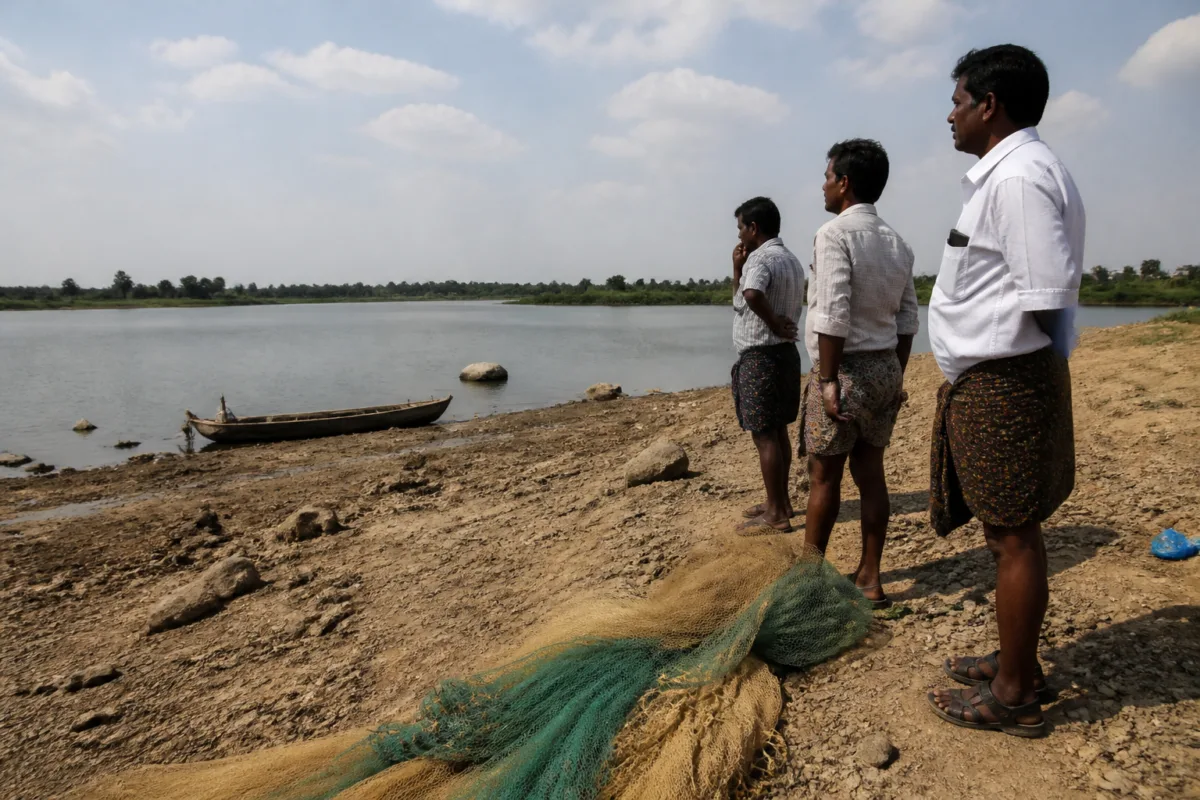
Telangana’s delayed fish seed release has exposed how a state livelihood programme can be weakened when procurement timelines, stocking decisions and water availability do not align. The Fisheries Department began this year’s release only on September 28, instead of the usual July-August period, while falling water levels across the state have raised doubts about whether stocked fish can survive and support production.
The immediate concern is not limited to the delay itself. Nearly 4.30 lakh fishermen associated with around 6,000 cooperative societies depend on water bodies for their livelihoods, according to a report by Telangana Today. Fish seed is normally released into about 26,000 water bodies across Telangana. The scale of that network means that an administrative decision taken at the procurement stage can affect production, household income and seasonal livelihood planning across a large rural economy.
The state’s free fish seed release programme was launched in 2018 by the previous BRS government. The programme was intended to increase fish production by stocking water bodies without charging fishermen for the seed. According to the report, annual production rose from about 80,000 to one lakh metric tonnes before the programme to 5.1 lakh metric tonnes in recent years. That increase made the programme an important part of Telangana’s fisheries economy, but the reported decline in production over the past couple of years has also revealed its dependence on timely and appropriate implementation.
The present disruption has two connected dimensions. The first is administrative: tenders were not finalised in time, pushing the start of the release to September 28. The second is ecological and operational: water levels in several water bodies have continued to fall because of deficient rainfall. A stocking programme designed around the July-August period therefore faces a more difficult operating environment when releases are made later and water bodies are becoming less suitable for fish growth.
This distinction matters because fish seed is not a standalone input. Its effectiveness depends on the condition of the receiving water body, the timing of release and the suitability of the species introduced. Fishermen’s representatives told Telangana Today that delayed releases, inadequate quantities and the introduction of unsuitable species have contributed to falling production. These allegations point to a broader implementation problem: measuring success by the volume of seed released may not capture whether stocking actually improves fishermen’s catch or income.
The report also raises questions about how the programme is monitored. A member of the Telangana Gangaputra Community Development Organisation alleged that contractors benefited from the existing release process by supplying lower quantities while claiming bills for higher volumes. This is an allegation attributed to the organisation and is not independently established in the supplied material. However, it identifies a specific governance risk in a programme spread across thousands of water bodies: if quantities, species, delivery dates and receiving locations are not transparently recorded, the public expenditure may not translate into reliable livelihood support.
The institutional design of the programme is equally important. Around 6,000 fishermen’s cooperative societies are already part of the sector’s organisational structure, but the TGCDO has urged the state government to involve these societies in planning measures to address the crisis. Their proposed role is significant because local cooperatives are closer to the water bodies, fishing conditions and seasonal changes experienced by communities. The demand is not simply for greater participation in implementation; it is also a request for a planning role in deciding how the programme responds to changing water conditions.
That request highlights a recurring challenge in public programmes: centralised procurement can simplify contracting, but it may not adequately reflect local variation. Telangana’s 26,000 water bodies cannot be assumed to have identical water levels, ecological conditions or fishing potential. The supplied report does not provide a district-wise breakdown or details of the tender process, so it is not possible to determine how stocking decisions are currently differentiated. It does establish, however, that the programme operates at a scale where timing and local conditions are central to its outcome.
The production figures show why the issue has consequences beyond one delayed season. Fish production reportedly increased from roughly 80,000 to one lakh metric tonnes to 5.1 lakh metric tonnes after the programme was introduced. At the same time, the report says production has declined over the past couple of years. The available information does not establish the precise annual trend, the share of the decline caused by delayed stocking, or the contribution of rainfall and water-level changes. It does show that the programme’s earlier gains have not insulated fishermen from implementation failures or environmental stress.
Water availability is therefore a critical part of the fisheries administration question. The report links deficient rainfall to falling water levels in several water bodies and says that the drying up of these water bodies could further affect fish production. In this setting, a delayed release creates a potential mismatch between the procurement calendar and the physical conditions of the water bodies. Releasing seed after the normal season may provide little benefit where water levels have already fallen substantially, according to the TGCDO representative quoted in the report.
The state’s response will also determine whether fishermen bear the full cost of a programme disruption. TGCDO honorary president G Satyanarayana has urged the government to announce compensation for fishermen, similar to assistance provided to farmers, and to help them through the coming season. The supplied report does not indicate whether the government has accepted this demand, announced a relief package or issued a formal response. That absence leaves the immediate support question unresolved for the communities affected by reduced production and uncertain stocking.
The reported threat of migration adds a livelihood dimension to the administrative delay. Satyanarayana said fishermen could be compelled to migrate to places including Tamil Nadu and Mumbai if the government does not intervene. The report does not provide figures on actual migration or establish that migration has already begun. The statement nevertheless reflects the vulnerability of fishing communities when local water bodies fail to provide adequate work and when alternative support is not available.
The episode also illustrates why fisheries should be treated as part of the wider water and rural infrastructure system rather than only as an agricultural or departmental concern. The programme depends on public procurement, departmental oversight, water-body conditions, local cooperatives and access to livelihood support. Weakness in any one of these links can reduce the value of the others. A fish seed release cannot compensate for a water body that is drying up, while adequate water may not produce the intended results if seed is released late, in insufficient quantities or without regard to species suitability.
What the supplied evidence confirms is that Telangana’s fish seed release has been delayed, stocking remains incomplete or slow in many water bodies, and fishermen are facing the combined pressure of falling water levels and declining production. It also confirms that the programme once coincided with a substantial increase in reported fish production. What remains unclear is the final quantity released this season, the number of water bodies covered, the tender value and monitoring process, the species supplied, and the government’s response to compensation and cooperative participation demands.
Those details will determine whether the current problem is treated as a one-season delay or as a sign that the programme needs stronger planning and accountability. The next developments to monitor are the completion of stocking, the condition of water bodies, any official response to fishermen’s demands and whether the state changes how cooperative societies participate in planning and oversight.

