


Information Technology Minister Ashwini Vaishnaw has set October 23, 2028, as a target for India to produce mobile phones that are designed, manufactured and branded domestically. The announcement is significant not because India is beginning to make smartphones, but because it identifies a more difficult industrial goal: retaining the design capabilities, intellectual property and consumer brand that determine where much of the value in the mobile economy is created.
India is already a major manufacturing base for smartphones sold by international companies. The country’s factories produce devices for global brands, and electronics manufacturing has expanded substantially in recent years. But assembling a product for another company is not the same as developing the product architecture, owning the underlying intellectual property, building the operating ecosystem and persuading consumers to buy it under a domestic name.
That distinction places Vaishnaw’s 2028 target in a broader policy context. India’s electronics strategy is attempting to move the country from being primarily a production location to becoming a technology and product-development base. The proposed smartphone would be a visible test of whether that transition is taking place.
The minister made the remarks at the NDTV World Summit in Delhi on October 23, 2026. He said that by October 23, 2028, India would have mobile phones designed, manufactured and branded in the country. He did not identify the proposed brand, announce a confirmed launch date, or disclose the phone’s price, specifications or production scale.
Those omissions are important. A target date establishes an administrative and industrial ambition, but it does not by itself establish that a commercially successful product will reach consumers. The evidence available so far confirms the government’s objective and describes some existing design capabilities. It does not establish the final device’s technical performance, supply chain, market position or ability to compete with Apple and Samsung.
The engineering challenge begins inside the handset. During the interview, Vaishnaw referred to the need to integrate radio-frequency communication, antennas, computing hardware, memory, cameras, display systems and power-management components within a compact body. These systems must work together while meeting constraints involving weight, battery life, heat and available internal space.
A smartphone therefore requires more than a factory capable of placing components on a board. It requires product architecture, specialised engineering, testing, software coordination and the ability to refine the device through successive design cycles. The minister’s account suggests that the government sees these capabilities as the foundation for a domestic handset programme.
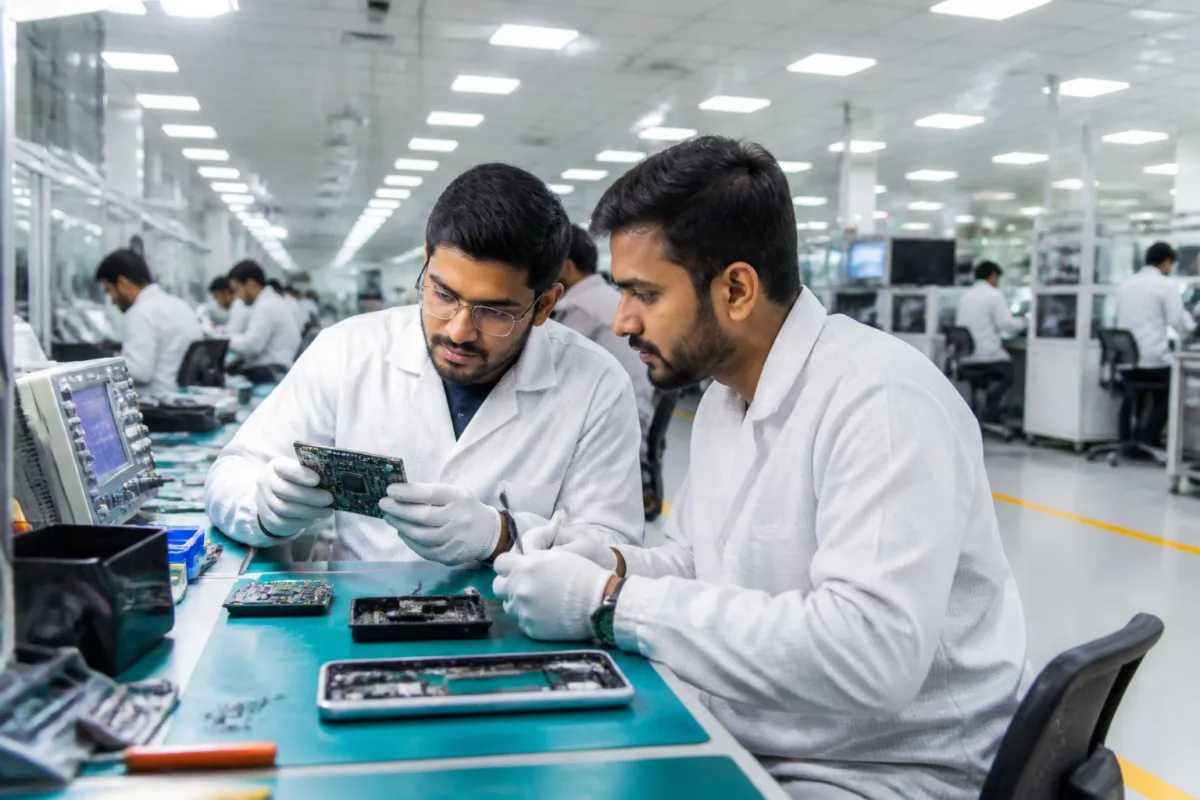
According to Vaishnaw, the groundwork began several years ago when the government challenged Indian designers to develop a mobile-phone printed circuit board. Two companies accepted the challenge, and one of them produced a design that was later selected by a major US telecommunications service provider. The minister said the company had designed and delivered a 5G-plus mobile phone for the operator, with the device manufactured and supplied to customers.
If accurately translated into a sustained domestic product programme, that experience could address one part of the value-chain problem: the ability of an Indian company to develop a functioning handset design for an international customer. However, an operator-specific device and a widely recognised consumer brand involve different commercial requirements. The latter demands product planning, software support, distribution, after-sales service and long-term customer confidence, none of which has yet been detailed for the proposed Indian phone.
The reported three-and-a-half years of experience cited by the minister are intended to show that domestic companies have begun accumulating specialised knowledge. The next stage is more demanding because a branded product must remain competitive after it leaves the design lab. Its price, reliability, performance, software experience, repairability and availability will determine whether consumers choose it over established alternatives.
This is where India’s manufacturing success encounters the limits of an assembly-led model. A factory can create employment and support exports, but ownership of product design and intellectual property determines whether domestic firms can capture value earlier in the production chain. It also affects the development of local suppliers, engineering services and component ecosystems.
The policy objective is therefore not simply to produce an Indian-labelled phone. The deeper question is how much of the technology, design and commercial capability will remain within Indian companies. A device assembled domestically but dependent on external design and intellectual property would represent a different industrial outcome from one whose core product decisions and technology are developed in India.
The government’s Make in India programme, launched in 2014, is part of the background to this effort. Vaishnaw credited the initiative with helping expand domestic production and manufacturing capabilities. He also pointed to mobile phones, drones, missiles, trains and other advanced equipment as evidence of industrial progress. The minister said electronics had become India’s third-largest export category and expected it to rise to second place in the near future.
The supplied report does not provide export values, production figures, domestic value-addition levels or a breakdown of how electronics ranks against other export categories. As a result, the wider progress described by the minister cannot be independently quantified from the available material. The statement does, however, establish the government’s preferred measure of success: moving electronics higher in the export economy while developing more advanced domestic capabilities.
That ambition also places greater demands on industrial policy. Manufacturing a competitive smartphone requires coordination across design firms, component suppliers, testing facilities, telecommunications operators, software developers and distribution networks. The minister’s remarks identify design and intellectual property as priorities, but they do not set out the institutional structure, funding mechanism or procurement framework through which the proposed handset will be developed.
The absence of those details leaves several practical questions open. It is not clear whether the phone will be developed by a private company, a consortium, an existing electronics manufacturer or a new public-private initiative. It is also not clear whether the stated October 2028 date refers to a prototype, a limited commercial launch or a product available at scale to consumers.
These distinctions matter because the mobile-phone market is shaped by ecosystems rather than hardware alone. Apple and Samsung have established global businesses, recognised brands, distribution networks and loyal customers. An Indian entrant would need to provide consumers with a credible reason to switch or adopt it, while maintaining software and service support over time. The report contains no announced pricing, feature list or retail strategy against which that challenge can yet be assessed.
For India’s urban and industrial economy, the proposed phone is a useful indicator of a wider transition. Electronics production is concentrated in manufacturing facilities, but the benefits of moving up the value chain can extend to engineering employment, supplier development, research capabilities and specialised industrial infrastructure. The scale of those benefits will depend on how much design, testing, intellectual property and high-value decision-making is located domestically.
The announcement also shows why headline manufacturing numbers need to be read carefully. A country can increase production while remaining dependent on foreign brands, technology platforms or critical components. Conversely, a domestic brand can exist without creating a deep local ecosystem if its principal technologies and suppliers remain external. The relevant measure is not only how many phones are made in India, but what capabilities Indian firms control.
Vaishnaw’s deadline is thus an industrial milestone rather than a guarantee of commercial success. The evidence currently confirms that the government is pursuing an Indian-designed and branded smartphone, that domestic companies have developed at least some handset-design capabilities, and that the target date is October 23, 2028. It does not yet confirm the identity of the brand, the product’s specifications, the amount of local technology or the scale of its intended market.
The developments to monitor are therefore concrete: the announcement of a participating company, disclosure of the product architecture and intellectual-property ownership, confirmation of manufacturing capacity, and details of pricing, software support and distribution. Those steps will show whether India’s smartphone ambition is moving from a policy declaration towards a durable domestic technology business.

