


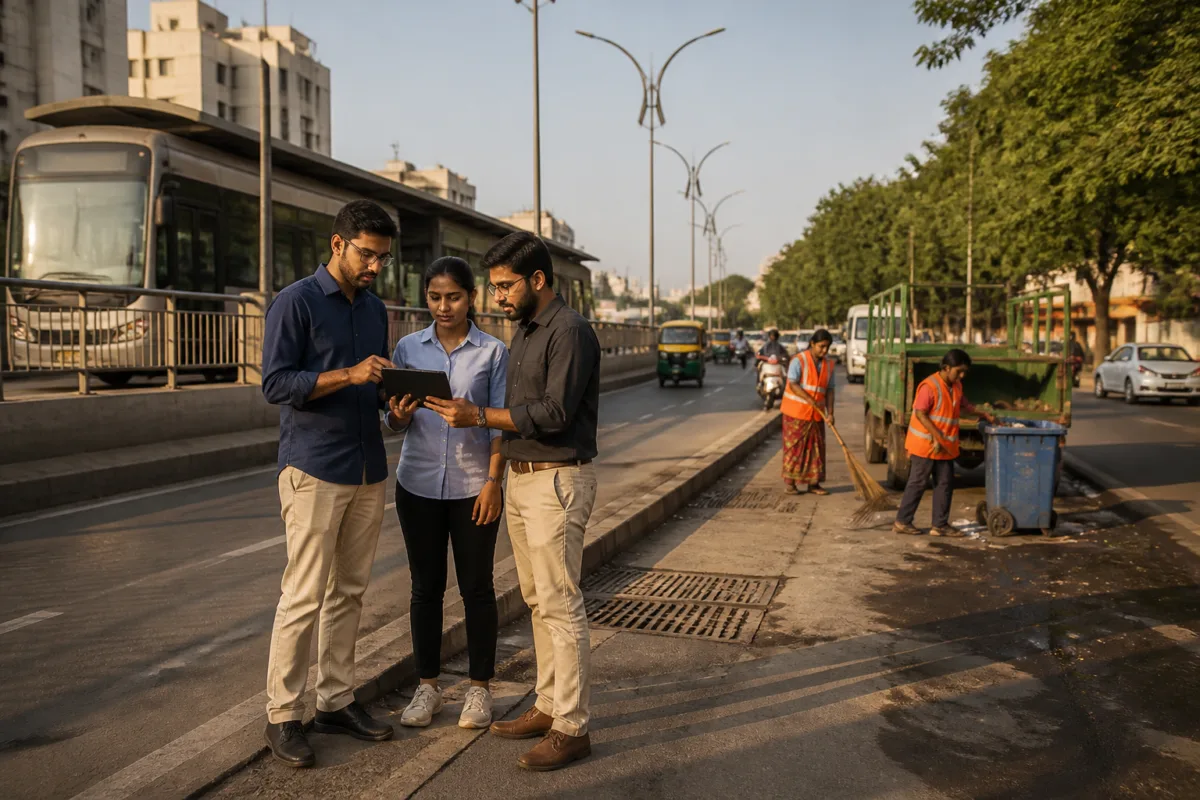
Ahmedabad’s new startup policy places a ₹250-crore question at the centre of urban governance: can technology-led experiments improve basic civic services without allowing innovation to become a substitute for routine municipal performance? The Ahmedabad Municipal Corporation (AMC), working with Smart City Ahmedabad Development Limited (SCADL), has announced the Ahmedabad Innovation and Startup Policy 2026, under which startups will be invited to develop solutions for potholes, water supply, drainage, waste management, street lighting and air pollution.
The policy proposes an innovation fund of ₹250 crore over five years, equivalent to an intended annual allocation of ₹50 crore. Selected startups may receive up to ₹35 lakh for pilot projects and proof-of-concept work. They may also be allowed to test their technologies in parts of the city’s water-supply network, waste-collection system, street-lighting network, BRTS corridors, drainage system and health centres.
That design makes the initiative more than a conventional startup-support programme. It connects a municipal corporation’s procurement and service-delivery machinery with private innovation, while placing public infrastructure in the role of a testing environment. The policy also proposes a common digital portal through which startups can identify city problems and submit solutions. Technologies that perform successfully in real-world conditions could then be considered for larger-scale implementation, according to the report.
The immediate attraction of this model is clear. Urban problems are increasingly shaped by data, network complexity and the need for rapid monitoring. A system that can detect road damage, track water distribution, improve waste collection or monitor street lighting may help civic agencies respond more quickly than conventional complaint-based processes. However, the policy’s success will depend not only on whether startups can produce new tools, but also on whether AMC can define the problem, provide usable data, evaluate results and integrate successful pilots into ordinary departmental operations.
This distinction matters because the problems listed in the policy are not new or peripheral responsibilities. Road maintenance, water supply, drainage, waste management, street lighting and public health are core municipal functions. The source report notes that these issues continue to challenge Ahmedabad despite AMC having an annual budget of more than ₹18,000 crore. The new policy therefore raises a structural question: is the corporation seeking new technology because existing systems lack technical capacity, because implementation is weak, or because some problems require capabilities that municipal departments do not currently possess?
The available information does not answer that question. It does, however, show that the policy is being presented as a new layer of intervention over existing civic departments. AMC already has officials and staff in engineering, health, solid waste management and other areas. Bringing startups into these functions could add specialised tools and new methods, but it could also create fragmented pilots if departments do not have clear responsibility for adoption, maintenance and performance monitoring.
The proposed access to civic infrastructure makes the evaluation challenge especially important. A technology tested on a water-supply network, drainage system or BRTS corridor is not operating in a controlled laboratory. Its performance may depend on existing contracts, staff practices, physical infrastructure, data quality and the behaviour of residents and service users. A pilot that works in one ward or facility may not automatically work across the city. The report does not specify the criteria that will be used to judge success, the duration of pilots, the public reporting system or the process for discontinuing unsuccessful projects.
The procurement structure outlined in the policy attempts to create different routes based on project value. A screening committee may approve pilot funding and proof-of-concept grants for projects costing up to ₹7.5 lakh. Projects between ₹7.5 lakh and ₹15 lakh may be eligible for direct purchase and work-order approval under specified conditions by the board of management. Projects above ₹15 lakh and up to ₹35 lakh would use a limited-bid challenge process, while projects exceeding ₹35 lakh would be subject to open bidding.
These thresholds indicate an effort to give smaller innovators an entry point into municipal work while retaining more formal competition for larger contracts. They also show that the programme is not limited to grants. Startups may move from an initial pilot to procurement and, potentially, to larger-scale municipal deployment. That makes the transition between experimentation and public spending a critical administrative stage. The source material does not establish how performance data, lifecycle costs, cybersecurity, maintenance obligations or citizen feedback will be incorporated into those decisions.
The policy further proposes reserving 15 per cent of work in AMC projects valued above ₹50 crore for startups. If implemented as described, this would give young companies a defined place in large municipal projects rather than confining them to small demonstration exercises. It could also change how major infrastructure contracts are structured. The report does not clarify whether the 15 per cent would apply to contract value, specific work packages, technology components or subcontracting arrangements. That detail will matter because the practical opportunity available to startups will depend on how the reservation is designed.
The intellectual-property arrangement adds another layer to the policy. Startups would retain rights over technologies they develop, while AMC would take a licence to use them. SCADL may acquire up to a 2 per cent equity stake on a case-by-case basis after a startup’s success. This model could make participation more attractive to innovators by allowing them to retain ownership, but it also means that the terms of municipal licensing will influence the cost and continuity of public use. The supplied report does not provide details on licence duration, exclusivity, transferability or what happens if a startup fails after its technology has been adopted.
The policy also includes incentives outside direct project funding. Startups working with the corporation could receive up to 50 per cent relief in property tax for offices measuring up to 250 square metres for three years. A public-private partnership model is proposed for coworking spaces, while community halls and auditoriums could be used as innovation hubs. Students, researchers, individual innovators and startups recognised by the Department for Promotion of Industry and Internal Trade would be eligible to apply.
These measures broaden the potential pool of applicants beyond established technology companies. They also shift part of the initiative towards building an innovation ecosystem within the city. Yet the urban value of that ecosystem will ultimately be measured by service outcomes rather than the number of applications, pilots, events or participating startups. A portal, a grant and a testing location can create activity without necessarily improving a road, reducing water losses, preventing flooding or making waste collection more reliable.
The ₹250-crore commitment is therefore best understood as an institutional experiment in how a large municipal corporation buys and tests solutions. The fund represents a significant planned allocation within the policy, but the available report does not state whether it is a new budgetary provision, a reallocation from existing programmes or a commitment subject to annual approvals. It also does not specify how the fund will be divided among sectors or how much will be reserved for pilots versus citywide deployment.
For residents, the practical test will be visible at street level. They will not experience the policy as an innovation fund; they will experience it through the condition of roads, the reliability of water supply, the speed of drainage after rain, the cleanliness of neighbourhoods, the functioning of street lights and the quality of public health facilities. The policy’s stated focus on these systems gives it direct relevance to daily urban life, but the source material does not yet provide evidence of any completed pilot or measurable improvement.
The initiative also creates an accountability requirement for AMC and SCADL. Before new technologies are scaled, the corporation will need to show what problem each pilot addressed, what baseline it used, how results were measured and what it cost to maintain the solution. It will also need to distinguish between a technology failure and a failure of implementation. Without that information, unsuccessful outcomes could be attributed to the startup even when the underlying issue was poor data, incomplete access to infrastructure or weak departmental coordination.
Ahmedabad’s startup policy confirms a growing administrative interest in using external innovation to address urban-service challenges. It does not yet establish whether the city’s core delivery systems will become more effective. That answer will depend on the policy’s procurement rules, the transparency of pilot results, the ability of civic departments to absorb successful tools and the disclosure of how the ₹250-crore fund is spent over five years. The next significant evidence will be the policy’s implementation framework, the launch of the common digital portal and the results of its first real-world pilots.

