


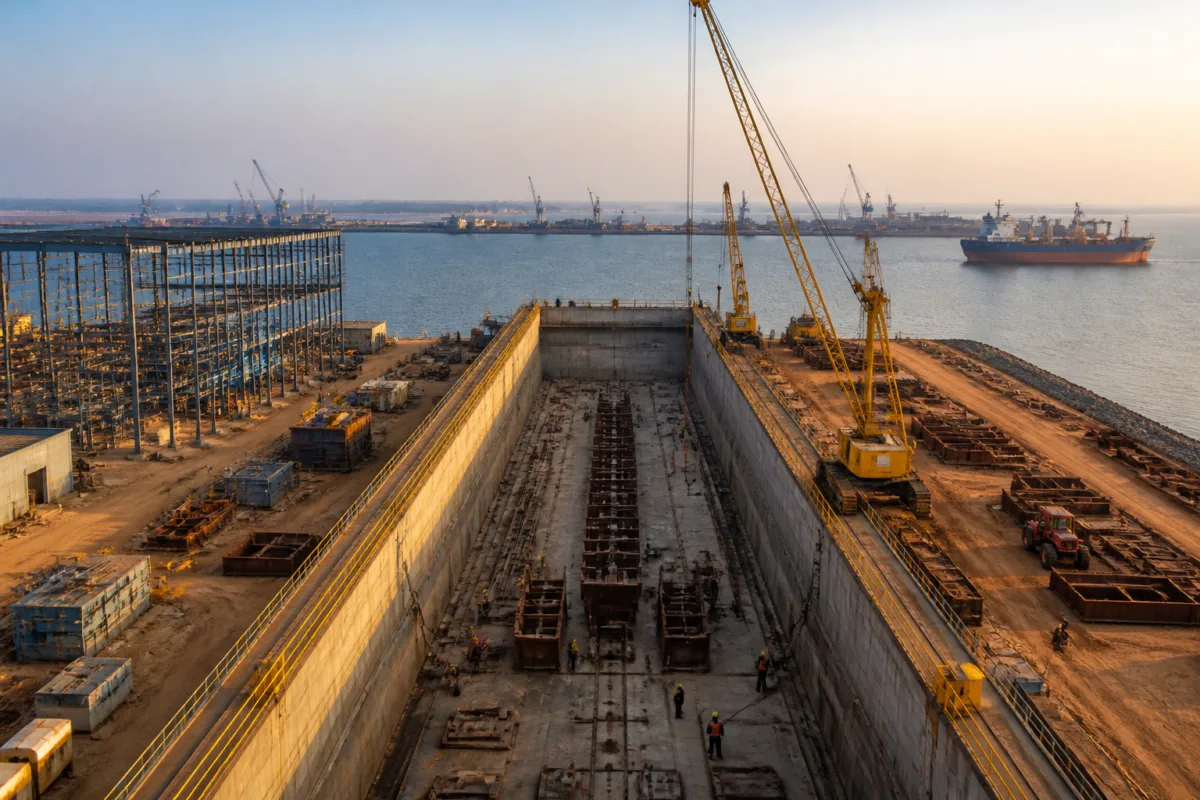
Gujarat’s Shipbuilding and Repair Policy 2026 marks an attempt to move the state’s maritime economy beyond individual ports and towards an integrated coastal manufacturing system. According to a report by Divya Bhaskar, the policy has entered official implementation and involves a proposed ₹58,953 crore investment in four greenfield shipbuilding and ship-repair parks, alongside six new greenfield ports estimated to cost ₹12,320 crore. The combined proposal would place more than ₹71,000 crore of planned maritime infrastructure at the centre of Gujarat’s next industrial expansion.
The scale of the announcement matters because shipbuilding is not only a factory activity. It requires waterfront land, deep-water access, large dry docks, fabrication capacity, marine equipment suppliers, testing facilities, research institutions, skilled labour and reliable connections to road, rail and port networks. The Gujarat Maritime Board’s stated approach, as reported by Divya Bhaskar, is to develop these functions as an ecosystem rather than treat ship construction as a standalone industrial project.
The policy is therefore best understood as a proposal to reshape how the state uses its coastline. Gujarat already has a long maritime edge and an established port economy, but the reported plan seeks to add higher-value industrial activity around that network. Ship repair, offshore fabrication, marine equipment manufacturing and research facilities could enable more stages of the maritime supply chain to be located near the coast instead of being separated across different industrial regions. The supplied report, however, does not provide the names, investment breakdowns or implementation schedules for all four proposed clusters.
The most prominent project identified in the report is a ₹27,000 crore flagship mega park at Kuchhadi, near Porbandar. The location is described as one of four strategic areas selected for shipbuilding clusters after a pre-feasibility survey. The report does not state the proposed land area, capacity, employment projections, construction timeline or the identity of a private developer. Those details will be important in determining whether the announcement represents an investment-ready project, an early-stage planning exercise or a combination of both.
Gujarat Maritime Board managing director Ajaykumar, who is also described as a senior Indian Administrative Service officer serving in the chief minister’s office, said the proposed project would include offshore fabrication, large dry docks, marine equipment manufacturing, research and development infrastructure, advanced testing facilities and skill-development centres. These components indicate an effort to address the supporting capabilities that often determine whether a shipbuilding cluster can compete beyond its initial land and port infrastructure.
The reference to supporting facilities is significant. A shipyard may attract headline investment, but its operational strength depends on the availability of specialised suppliers, engineering services, trained workers and testing systems. Repair and maintenance capacity can also create a different revenue cycle from new ship construction because repair activity is tied to vessel operations and turnaround requirements. The report does not establish projected vessel volumes or the expected balance between new construction, repair, offshore fabrication and equipment manufacturing. Those figures would be necessary to assess the commercial and infrastructure requirements of the proposed parks.
The policy’s technical preparation is reported to include mathematical modelling, as well as biometric and geotechnical surveys conducted by IIT Kharagpur. The report does not explain the precise scope of these studies or publish their findings. Geotechnical assessment is particularly relevant to large coastal facilities because dry docks, heavy fabrication yards, cranes, storage areas and transport links impose substantial engineering demands. The eventual design would also have to establish how the parks connect with existing settlements, roads, utilities and port infrastructure, although the supplied material does not provide those details.
The second major component is a plan to develop six new greenfield ports at an estimated cost of ₹12,320 crore. The report says these ports would operate as specialised gateways for different sectors, but it does not identify their locations or the commodities and industries assigned to each port. That missing information is central to understanding the plan. A port designed for project cargo, bulk materials, containers, offshore equipment or shipbuilding inputs would require different terminal layouts, storage facilities, navigation arrangements and hinterland connections.
The proposed port projects would be delivered through public-private partnerships using the build, own, operate and transfer, or BOOT, model. Concession periods are expected to range from 30 to 50 years. Under this structure, private concessionaires would finance or build the assets, operate them for the agreed period and transfer them later according to the terms of the concession. The model can help governments mobilise private capital and operating expertise, but it also makes the concession agreement a crucial instrument of public accountability. Tariffs, service obligations, land arrangements, risk allocation, maintenance standards and transfer conditions would determine how public value is protected over several decades.
The eligibility conditions reported for bidders are substantial. Companies seeking to participate must have an average annual turnover of at least ₹1,000 crore over the previous three years and a minimum net worth of ₹500 crore. These thresholds are intended to screen for financially capable participants, but they also indicate that the projects are being designed for large corporate or consortium-level bidders. The report does not say whether smaller specialist firms will participate through subcontracting, supplier networks or separate procurement packages.
This distinction matters for the wider urban and regional economy. Large maritime projects can generate demand for fabrication, logistics, engineering, maintenance, accommodation and training. They can also increase pressure on roads, housing, water supply, power systems and public services in nearby settlements. The supplied report does not provide an employment estimate or discuss the expected effect on surrounding communities. Without such information, the regional development impact cannot yet be measured beyond the proposed investment value.
The reported policy also raises a coordination question. The Gujarat Maritime Board is positioned as the key implementing institution for the shipbuilding parks and the port programme, while the proposed ecosystem would necessarily involve industrial, transport, skills, environmental and local administrative authorities. The policy’s success will therefore depend not only on capital mobilisation but also on the sequencing of approvals, land assembly, utility provision, environmental assessments, access infrastructure and private concession awards. The source material confirms the proposed institutional role of the Gujarat Maritime Board but does not set out the full governance or approval framework.
For Gujarat’s coastline, the difference between an announced industrial cluster and an operating one will be measured in physical delivery. The four parks would require waterfront sites capable of supporting heavy industry, dry docks and large-scale movement of materials. The six ports would require navigation and terminal infrastructure, while the proposed manufacturing ecosystem would need dependable links to suppliers and markets. These requirements make the projects part of a wider infrastructure system rather than isolated investments.
The financial numbers provide the clearest indication of the policy’s ambition: ₹58,953 crore for four proposed shipbuilding and repair parks, ₹27,000 crore for the Kuchhadi flagship project and ₹12,320 crore for six greenfield ports. The report does not clarify whether these figures represent total project costs, estimated private investment, public expenditure, or a combination of funding sources. It also does not state how much of the proposed investment has been committed, tendered or financially closed. That distinction will be essential as the projects move from policy announcement to implementation.
The policy’s stated objective is to increase India’s participation in the global marine and shipbuilding industry, with Gujarat positioned as a maritime hub. The available material supports the conclusion that the state is pursuing a broader industrial strategy based on coastal infrastructure and specialised manufacturing. It does not yet establish the projects’ global competitiveness, expected cargo volumes, job creation, environmental performance or delivery timelines.
The larger urban question is how coastal industrial growth will be connected to the settlements and infrastructure systems around it. A shipbuilding park and a greenfield port can be planned as special-purpose assets, but their daily operation depends on workers, freight movement, utilities and public services. The policy’s next phase will show whether those connections are treated as part of the core project or left to surrounding administrations.
The reported announcement confirms a major proposed expansion of Gujarat’s maritime infrastructure, but several implementation details remain open: the locations of the other clusters and ports, project schedules, funding commitments, concession terms, capacity, environmental processes and local economic impacts. The next significant milestones will be the release of detailed project documents, bidding conditions, approvals and implementation timelines. Until then, the ₹71,000 crore-plus figure describes the scale of the proposal, not completed infrastructure.

