


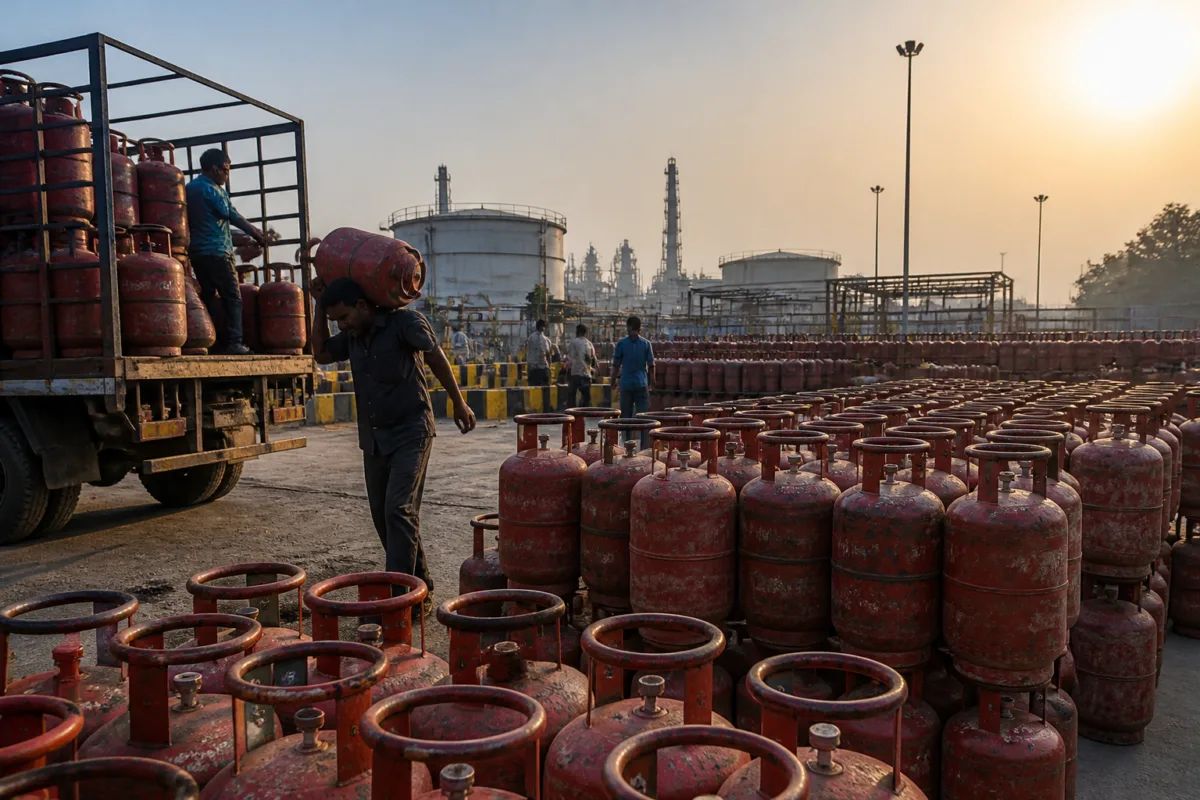
LPG under-recovery has risen sharply for India’s public-sector oil companies, highlighting the financial strain created when domestic cooking gas is sold below prevailing market-linked costs. Hindustan Petroleum Corporation (HPCL) chairman Vikas Kaushal told analysts that the company’s under-recovery increased from ₹245 per 14.2 kg cylinder in October to ₹327 in November 2026, a rise of almost 34 per cent in one month.
The figure is more than a balance-sheet disclosure. It is a measure of the gap between the cost of supplying domestic LPG and the price at which consumers receive it. When that gap widens, the immediate burden is carried by the oil-marketing companies, the government through compensation or policy support, or the companies’ wider financial position. The supplied report does not establish how the November gap will ultimately be funded, but it shows that the pressure is increasing at a time when the public-sector oil companies are also managing large capital and debt obligations.
HPCL reported total LPG under-recovery of roughly ₹18,049 crore in the second quarter of FY27. The company’s reported figures show that the pressure has moved unevenly during the year. Under-recovery across the industry was around ₹721 per cylinder in June, fell to approximately ₹500 a month later, declined to about ₹188 in August and then increased to roughly ₹210 in September. HPCL’s November figure of ₹327 indicates that the improvement seen earlier did not hold.
The industry-wide numbers point to a broader problem rather than an isolated HPCL issue. The cumulative under-recovery of Indian Oil Corporation, HPCL and Bharat Petroleum Corporation rose from approximately ₹51,000 crore in June to more than ₹62,000 crore in August 2026. These figures cover the three public-sector oil-marketing companies that distribute domestic LPG and show how quickly the cost gap can accumulate across the system.
The financial mechanics are closely connected to international supply conditions. The report says freight rates almost doubled between the first and second quarters of FY27, adding to the delivered cost of LPG imported into India. US LPG is linked to Mont Belvieu prices, which were cited at $0.68 per gallon in August 2026, equivalent to about $360 per tonne. Although this benchmark is generally lower than Saudi CP, the cost advantage can be reduced when the fuel has to travel longer distances to reach India.
Equirus Securities, cited in the report, said Houston–Asia very large gas carrier freight exceeded $200 per tonne in mid-April 2026 and rose above $300 in August as stronger eastbound demand tightened vessel availability. The significance of these freight movements is that the price paid for the commodity is only one part of the cost of supplying a cylinder. Shipping capacity, route length and vessel availability can materially alter the final import bill even when the underlying LPG benchmark is comparatively lower.
For the domestic LPG system, that creates a difficult relationship between international exposure and household price stability. Consumers receive a standard 14.2 kg domestic cylinder, while the companies procuring and transporting the fuel face costs that can change with commodity prices and shipping conditions. The report does not provide the retail price paid by consumers in November or detail the compensation mechanism for the latest under-recovery. It does, however, establish that the cost of maintaining the existing consumer price is rising for the oil companies.
This distinction matters because domestic LPG is both a household service and a large-scale distribution network. The financial gap is generated upstream, but its consequences can extend through procurement, shipping, storage, bottling and distribution. The supplied material does not quantify the effect on any one of these stages. It does show that freight has become a significant cost factor, meaning that the performance of the system is not determined only by refinery output or the international LPG benchmark.
HPCL’s disclosure also places the LPG issue alongside the company’s wider debt-management requirements. The company has refinanced the entire ₹45,000–50,000 crore loan of HPCL Rajasthan Refinery Limited, which operates the refinery at Barmer in Rajasthan. According to Kaushal, agreements were signed at the end of September and the revised financing took effect on October 3.
The restructuring is expected to provide an annual benefit of about ₹470–500 crore, with savings beginning from October 3 at the revised interest rates. Kaushal said the company was approximately 105 basis points below the original rate after refinancing. He also said HPCL expected further equity calls over the next one or two quarters and estimated that the total interest burden could eventually be reduced by about ₹1,000 crore compared with the previous year.
The contrast between the two disclosures is important. HPCL is taking steps to reduce the cost of financing a major refinery project, but its LPG business is simultaneously facing a larger per-cylinder under-recovery. Debt restructuring can improve the company’s financial position, yet it does not remove the underlying exposure to the cost of imported LPG, freight markets or the price at which domestic cylinders are sold.
The Barmer refinery is described in the report as the country’s latest refinery and has therefore become part of HPCL’s post-commissioning financial structure. Refinery debt, equity requirements and operating costs sit alongside the company’s marketing obligations. The report does not provide the refinery’s production, utilisation or profitability figures, so it is not possible from the supplied evidence to assess how the project will offset or add to the LPG-related pressure. What is clear is that HPCL is managing two different financial tasks: lowering the cost of existing debt while absorbing a rise in the cost gap on domestic LPG.
At the industry level, the data suggests that under-recovery is sensitive to more than one variable. The movement from ₹721 per cylinder in June to ₹188 in August, followed by a rise to ₹327 at HPCL in November, shows that the gap can narrow and widen quickly. The report links the latest increase to the cost of selling LPG below prevailing market rates and points specifically to higher freight expenses. It does not attribute the change to a single commodity-price movement.
That matters for how the problem is understood. A lower international benchmark does not automatically translate into a lower domestic supply cost if transport and vessel availability move in the opposite direction. Similarly, a company may improve its debt profile without resolving the cost pressures in a regulated or policy-sensitive consumer segment. The figures therefore describe a system in which financial performance depends on both market conditions and the framework governing domestic LPG prices.
The public-sector oil companies’ combined exposure also raises questions about the institutional distribution of responsibility. The supplied report identifies IOCL, HPCL and BPCL as the companies accumulating the under-recovery, but it does not specify whether the current gap is being reimbursed by the government, absorbed by the companies or managed through another mechanism. That missing detail is central to understanding the eventual fiscal and corporate impact of the November increase.
For households, the immediate issue is whether a rising cost gap remains invisible in the retail price or is eventually reflected through changes in pricing or support. The report contains no announcement of a November consumer-price revision. It therefore supports a conclusion about mounting pressure, not about a confirmed change in household bills. The distinction is especially relevant because the cylinder is a recurring household purchase and the financial consequences of any pricing decision would be distributed across consumers, public finances and the oil companies.
The evidence currently confirms three connected developments: HPCL’s LPG under-recovery increased to ₹327 per cylinder in November; cumulative under-recovery across the three public-sector oil companies had exceeded ₹62,000 crore in August; and freight costs rose sharply during the period described. HPCL is also restructuring major refinery debt to lower its interest burden. What remains unestablished in the supplied material is how the latest LPG gap will be financed, whether the November figure applies across the industry and how long freight costs will remain elevated. Those are the next facts required to assess whether the current pressure is a temporary cost shock or a deeper strain on India’s domestic fuel-supply model.

