


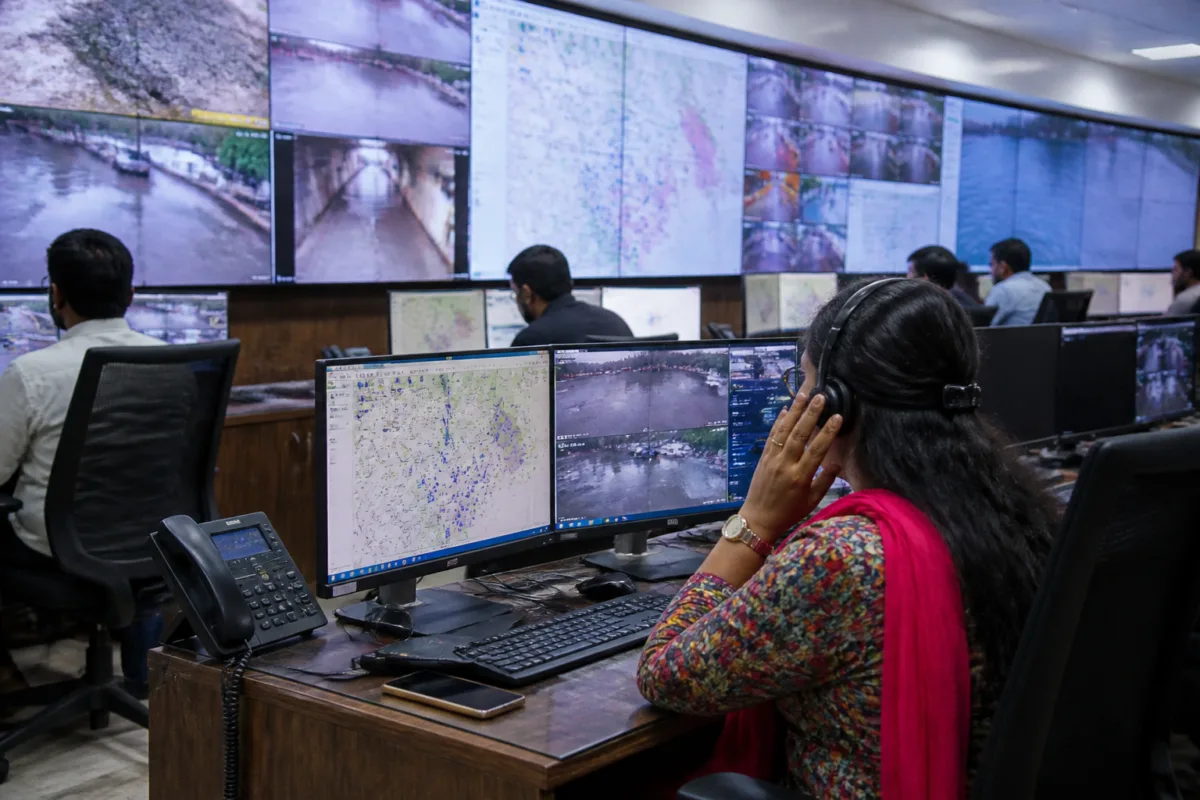
Chennai’s civic complaint system now has the architecture of a city-wide service desk: residents can call 1913, use the Namma Chennai app, submit complaints through the Greater Chennai Corporation’s website or post on social media, while an Integrated Command and Control Centre routes issues to departments and tracks the response. The harder question is not whether a complaint can be registered. It is whether the system can establish, in a credible and repeatable way, that the problem was actually fixed.
That question matters because the Greater Chennai Corporation’s ICCC is no longer only a communications room. According to a report by the Times of India, about 200 staff work at the centre, which is linked with 16 GCC departments. The facility receives an average of 2,000 calls a day through the 1913 helpline, in addition to hundreds of complaints on X, Instagram and Facebook. Its stated role combines intake, routing, monitoring and feedback.
The arrangement reflects a basic reality of municipal administration: many problems are visible to residents before they become visible to the department responsible for them. A waterlogged road may require attention from more than one agency. A fallen tree may obstruct traffic, affect drainage or damage a power line. A dysfunctional street light may fall within the corporation’s network, while complaints involving Metrowater or Tamil Nadu Generation and Distribution Corporation are passed to those agencies. The ICCC is positioned as the coordinating layer between these separate institutional responsibilities.
The centre went live in December 2020 and initially served as a Covid war room, the report said. Its current functions show how emergency-response infrastructure can be repurposed for routine urban administration. A live display at the facility carries civic data, rain forecasts and feeds from cameras covering roads, subways and canals. The same infrastructure can therefore support both complaint-based response, which begins with a resident’s report, and surveillance-based response, which begins with what staff see on a camera or dashboard.
That distinction is important. A complaint system is often judged by how easily people can submit an issue. But the administrative value of such a system lies further downstream: classification, assignment, field action, verification and closure. The information supplied in the report confirms the first three parts. Residents can use multiple channels; officials prioritise certain categories; and complaints are sent to the relevant department. The report also says the centre calls complainants for feedback. What it does not establish is how many complaints are resolved within specified time periods, how many are reopened, or how performance differs across departments.
The numbers illustrate the scale of the intake rather than the quality of the outcome. The helpline receives about 2,000 calls on an average day, while the centre also receives hundreds of complaints through social media. By Thursday noon, the ICCC had received 730 complaints and attended 1,200 calls. Additional staff had been deployed for monsoon-related complaints. These figures indicate an institution operating under a substantial flow of public requests, but they cannot by themselves show whether the city’s response is timely or effective.
That limitation is central to understanding digital civic governance. A high number of calls may indicate widespread service failures, improved public awareness of complaint channels, or both. A high number of complaints attended may mean that calls were answered or that cases were processed; it does not necessarily mean that every underlying problem was resolved. Similarly, the registration of a complaint creates an administrative record, but it does not automatically create a repaired road, cleared drain, restored street light or removed fallen tree.
The system’s prioritisation rules provide a glimpse into how the corporation manages competing demands. Water stagnation, fallen trees and non-functional street lights are prioritised, particularly during the monsoon. These categories combine immediate public safety concerns with disruptions to daily mobility and basic services. The decision to deploy additional staff for monsoon complaints also shows that the complaint system is being used as an operational tool rather than simply as a public-facing helpdesk.
Yet prioritisation also creates a question about transparency. The report does not state the service standards attached to each category. It does not say how quickly a water-stagnation complaint should be inspected, how a fallen tree is escalated, or when a street-light complaint is considered closed. Without such information, residents may know that their complaint has entered the system without knowing what response they can reasonably expect. The existence of a tracking mechanism is therefore not the same as the existence of an enforceable service commitment.
The cross-departmental structure adds another layer of complexity. GCC can route complaints related to Metrowater or TNEB to those agencies, but the report does not establish whether the ICCC can monitor the entire lifecycle of such complaints after referral. This is a familiar institutional problem in cities: responsibility for the resident’s experience is broader than responsibility for a particular asset. A citizen sees a flooded street or a dark road, while government departments divide the causes and remedies between separate jurisdictions.
A central command centre can reduce that fragmentation if it retains visibility after a case leaves the corporation’s direct control. It can also fail to solve the problem if referral becomes the endpoint of the process. The supplied report confirms that complaints meant for Metrowater or TNEB are passed on, but it does not provide data on follow-up, inter-agency response times or the proportion of referred complaints closed successfully. Those are the indicators that would show whether the ICCC is coordinating agencies or merely forwarding messages between them.
The role of cameras changes the model further. Officials told the Times of India that they monitor CCTV visuals to alert field staff about vulnerable areas. This can help the corporation identify conditions before residents report them, particularly during heavy rain. It also shifts the system from a reactive model towards anticipatory monitoring. However, the supplied evidence does not show how camera alerts are converted into work orders, whether all vulnerable areas are covered, or whether camera-led interventions are measured separately from resident complaints.
Residents’ concern about generative artificial intelligence points to another emerging governance issue: the possibility that a complaint could be marked as closed digitally without the physical defect being corrected. GCC commissioner G S Sameeran rejected that concern, saying the corporation calls complainants for feedback and that residents can raise the issue again if it remains unresolved. His response identifies citizen feedback as the main safeguard against inaccurate closure.
That safeguard is significant, but it also places part of the verification burden back on residents. A resident must notice that the problem persists, respond to the follow-up or file the complaint again. The report does not indicate whether the corporation conducts independent field verification, requires photographic evidence, records the time of repair or publishes reopened-complaint data. The commissioner’s statement establishes the corporation’s stated process, not an independently measured resolution rate.
This is where Chennai’s complaint system raises a broader question about the meaning of accountability in a digitised municipality. Digital systems make complaints more visible to administrators and can make the public’s interaction with government more traceable. But traceability is useful only when it covers the full chain from complaint to remedy. A ticket number, dashboard entry or closure notification can document administrative activity without proving a change on the street.
The information currently available supports a cautious conclusion. Chennai has built a centralised mechanism that receives complaints through multiple channels, connects the ICCC with 16 GCC departments, uses live civic and weather information, monitors selected urban locations and prioritises monsoon-related risks. The system also has a stated feedback loop through calls to complainants. These are meaningful institutional capabilities.
At the same time, the supplied report does not provide the outcome data needed to assess the system fully. It does not establish department-wise resolution times, complaint backlogs, reopening rates, referral performance or the share of cases verified independently. Nor does it show whether complaint volumes are concentrated in particular zones or linked to recurring failures in drainage, lighting, roads or tree management.
For residents, the practical lesson is that registration is the beginning of the process, not its conclusion. For the corporation, the next level of transparency would involve demonstrating what happens after registration: which department receives the case, what deadline applies, what evidence confirms completion and what happens when the complainant disputes closure. Until those measures are visible, Chennai’s ICCC can be understood as a significant coordination platform, but not yet as a complete measure of civic service performance.

