


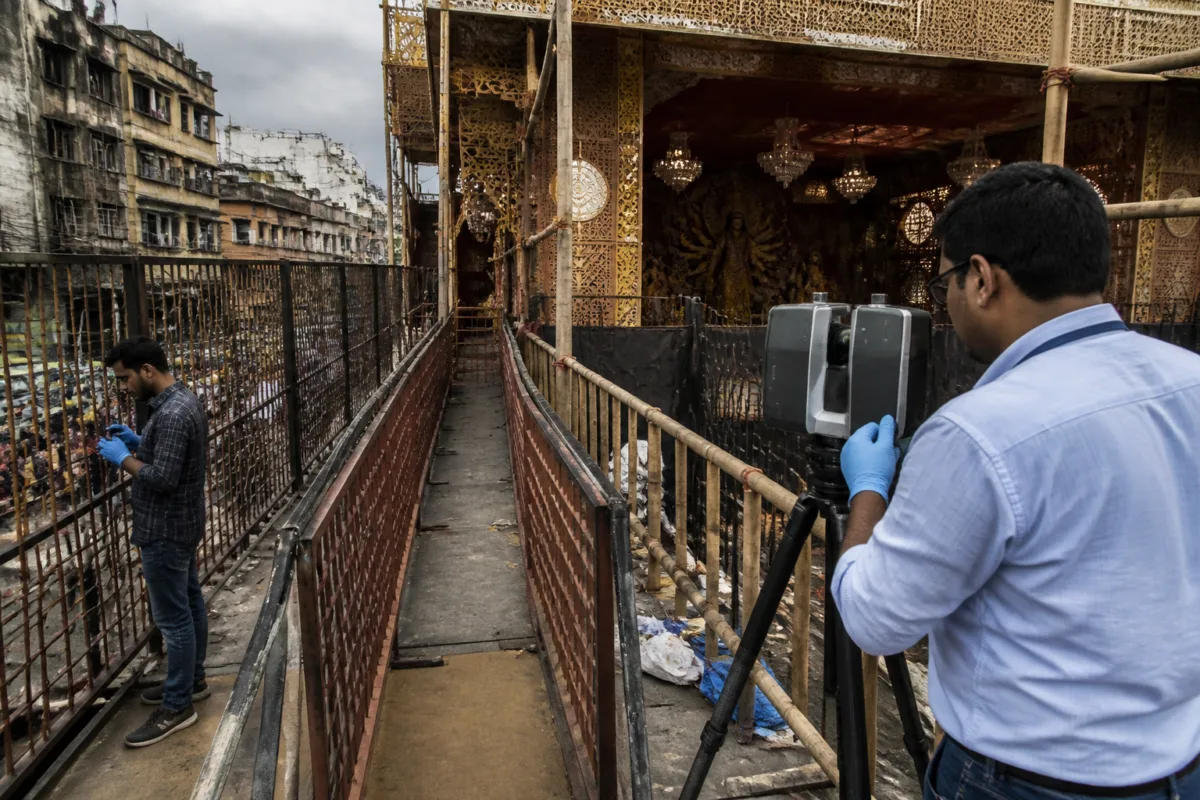
The investigation into the Chorabagan pandal incident has moved from immediate questioning to a detailed reconstruction of the site, with Kolkata Police’s six-member Special Investigation Team and forensic experts examining the structure, access routes and movement of visitors. Their work points to a central urban-safety question: whether a temporary public venue can be planned, monitored and evacuated safely when large crowds converge in a confined space.
The forensic team used a three-dimensional camera to scan the entire pandal and its surrounding area after the SIT revisited the site. Investigators are examining the design and arrangement of the pandal, the width of entry and exit routes, and the sequence of events that unfolded during the incident. The scan is intended to preserve a digital record before the structure is dismantled, allowing investigators to study the site after it is no longer physically available.
This is an important distinction in the investigation of temporary public structures. A pandal is not only a decorative installation. During peak visiting hours, it becomes a temporary public building, with defined movement paths, enclosed sections, barriers, gates, stairways or ramps, electrical systems and points where crowd density can change rapidly. The available report does not establish whether any specific rule was violated, but the investigation is focusing on precisely those physical and operational conditions that determine whether visitors can move through such a venue without becoming trapped or compressed.
The SIT, led by an officer of assistant commissioner rank from the detective department, had already visited Chorabagan before returning to the site. It reviewed closed-circuit camera footage and questioned civic volunteers and club members who were present at the venue. The questioning was aimed at reconstructing the incident as it occurred, rather than examining the structure in isolation.
That reconstruction matters because crowd incidents are rarely explained by a single physical feature. The width of a passage may be adequate under normal movement but become insufficient when visitors stop, turn around or respond suddenly to an alarm. A gate may function as an entry point at one moment and become a bottleneck when a large number of people attempt to use it as an exit. A barrier or winding pathway may guide visitors in an orderly flow, but may also restrict escape if panic changes the direction of movement.
The report says investigators are studying videos circulated on social media, while also making clear that the authenticity of those videos has not been independently verified by the source. One video appears to show several visitors becoming unwell on a rotating passage enclosed by a grille. Another appears to show people falling amid intense pushing and jostling 8 to 10 metres inside the exit gate. These visual records are being examined alongside seized CCTV footage and witness accounts, rather than treated as conclusive evidence on their own.
The investigation is also examining an announcement made during the incident. Witnesses told the source that someone announced over the public-address system that the pandal was collapsing and urged visitors to leave quickly. According to the report, the announcement created panic and intensified the rush. Investigators have indicated that the seized CCTV footage supports this sequence of events, although the full circumstances behind the announcement remain under examination.
This brings communication into the centre of the safety question. In a crowded public venue, an emergency announcement can reduce uncertainty if it is accurate, specific and coordinated with an evacuation plan. It can also increase danger if visitors receive an alarming message without clear instructions about which route to use or where to move. The available report does not establish who made the announcement, why it was made or whether an actual structural failure had been identified at that moment. Those are among the facts the investigation must determine.
The decision to conduct a three-dimensional scan before dismantling the pandal reflects another institutional challenge: the physical evidence of a temporary venue can disappear quickly. Once a structure is removed, investigators may have to rely on photographs, videos, witness accounts and records rather than the original spatial arrangement. A digital scan can preserve the relationship between the passageways, barriers, gates and surrounding areas, although the report does not specify the technology, resolution or evidentiary protocol being used.
The urban-governance implications extend beyond this individual venue. Kolkata’s major festivals rely on temporary structures assembled for a limited period but used by large numbers of people. Responsibility is therefore distributed across several actors: organisers, venue managers, civic volunteers, police personnel, municipal authorities, emergency services and visitors. The investigation is examining the actions of some of these participants through CCTV footage and questioning, while the available material does not yet provide a complete account of the approvals, inspections or crowd-capacity calculations for the pandal.
The presence of civic volunteers and police personnel also makes the question of role clarity significant. The SIT has questioned civic volunteers and club members who were present at the site, while the report refers to a police officer seen in one circulated video repeatedly trying to contact someone by phone. That image, whose video authenticity remains unverified according to the source, raises questions for investigators about communication during an emergency. It does not, by itself, establish how the police response was organised or whether a formal emergency chain of command was in operation.
The case has already produced arrests. Seven people, including two office-bearers of the puja committee, have been arrested in connection with the incident. The arrests are part of the ongoing investigation and do not, by themselves, establish criminal liability. The forensic scan, CCTV review, witness questioning and examination of videos are intended to connect specific decisions and conditions with what happened at the site.
What the supplied evidence confirms is that the investigation is treating the incident as a problem of space, movement, communication and evidence preservation. It is not limited to asking who was present. It is examining how the pandal was designed, how wide its routes were, how visitors moved through it, what information was communicated during the emergency and how the physical site can be documented before it disappears.
What remains unresolved is equally important. The available material does not establish the verified number of people affected, the precise cause of the emergency, whether the structure itself failed, the approved capacity of the venue, or whether its entry and exit arrangements complied with applicable requirements. It also does not establish the final sequence of the announcement, the identity of the person who made it or the exact relationship between the announcement and the crowd movement.
The next stage of the case will depend on how investigators combine these separate evidence streams. The three-dimensional scan may preserve the site’s layout; CCTV footage may establish movement and timing; witness accounts may explain decisions made inside the venue; and forensic examination may clarify the condition of the structure. The investigation’s conclusions will determine whether the Chorabagan incident is understood primarily as a structural, crowd-management, communication or combined safety failure.

