


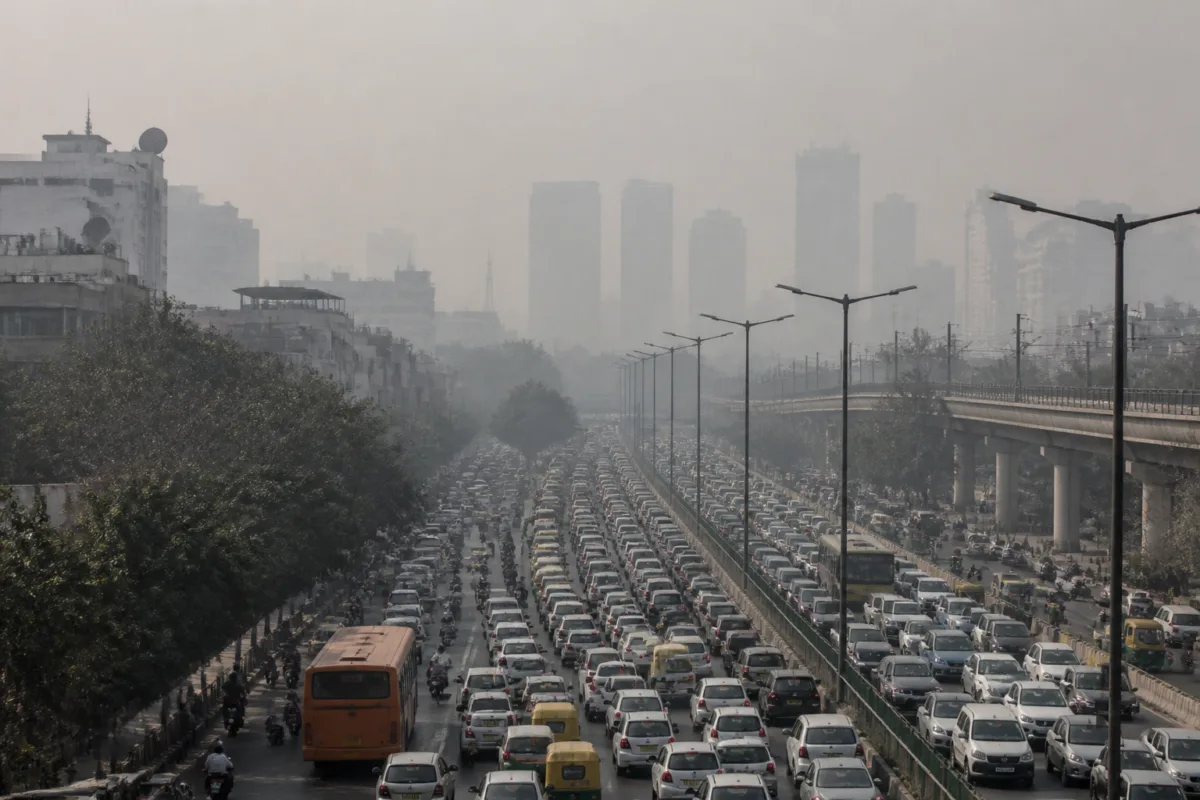
Delhi’s air quality remained in the ‘poor’ category on Thursday, a day after the Commission for Air Quality Management invoked Stage I of the Graded Response Action Plan across Delhi-NCR following a sharp rise in pollution after Dussehra celebrations.
The city’s Air Quality Index was recorded at 225 on Thursday morning, according to the report. The previous day had marked Delhi’s first ‘poor’ air quality day of the season, with the AQI rising to 238 from 179 on Tuesday afternoon, a jump of 59 points.
Several monitoring stations recorded significantly worse conditions than the citywide reading. Jahangirpuri and Vivek Vihar each recorded an AQI of 309, placing them in the ‘very poor’ category, while Chandni Chowk recorded 306. Patparganj reported 298, Rohini 291, ITO 280, Bawana 275, Alipur 273, Wazirpur 253, Anand Vihar and Akshardham 237, and Ashok Vihar 223. These readings were reported across Delhi’s 59 monitoring stations.
The Commission for Air Quality Management enforced Stage I of GRAP across Delhi-NCR on Wednesday after reviewing the region’s air quality. The first stage of the emergency response plan applies when air quality enters the ‘poor’ category and brings pollution-control measures into operation across the national capital region.
Delhi Environment Minister Manjinder Singh Sirsa said the government was taking concrete steps to control major sources of pollution. He said around 30 agencies were working under an 11-point pollution-control plan aligned with guidelines from NITI Aayog and CAQM.
The deterioration has implications for residents who spend extended periods outdoors, particularly in areas where station-level readings have entered the ‘very poor’ range. The Central Pollution Control Board classifies AQI readings between 201 and 300 as ‘poor’, a level that can cause breathing discomfort during prolonged exposure. Readings between 301 and 400 are classified as ‘very poor’.
The report also recorded Mumbai’s AQI at 106 on Thursday morning, placing the city in the ‘moderate’ category. Among Mumbai’s 26 monitoring stations, Bandra Kurla Complex-IITM recorded the highest reading at 155, also within the ‘moderate’ range. The CPCB says moderate air quality can cause discomfort to people with lung disorders, asthma and heart disease.
The air-quality readings came a day after the Bombay High Court expressed concern that Mumbai was surpassing Delhi in pollution levels. Justice Gokhale referred to reports suggesting that officials could emphasise readings from cleaner parts of the city while overlooking pollution near traffic signals and slum areas.
Under the CPCB’s classification, AQI readings from 0 to 50 are ‘good’, 51 to 100 are ‘satisfactory’, 101 to 200 are ‘moderate’, 201 to 300 are ‘poor’, 301 to 400 are ‘very poor’ and 401 to 500 are ‘severe’. The 11-point pollution-control plan and GRAP-I measures remain the stated administrative response as Delhi-NCR’s air quality stays above the ‘poor’ threshold.

