


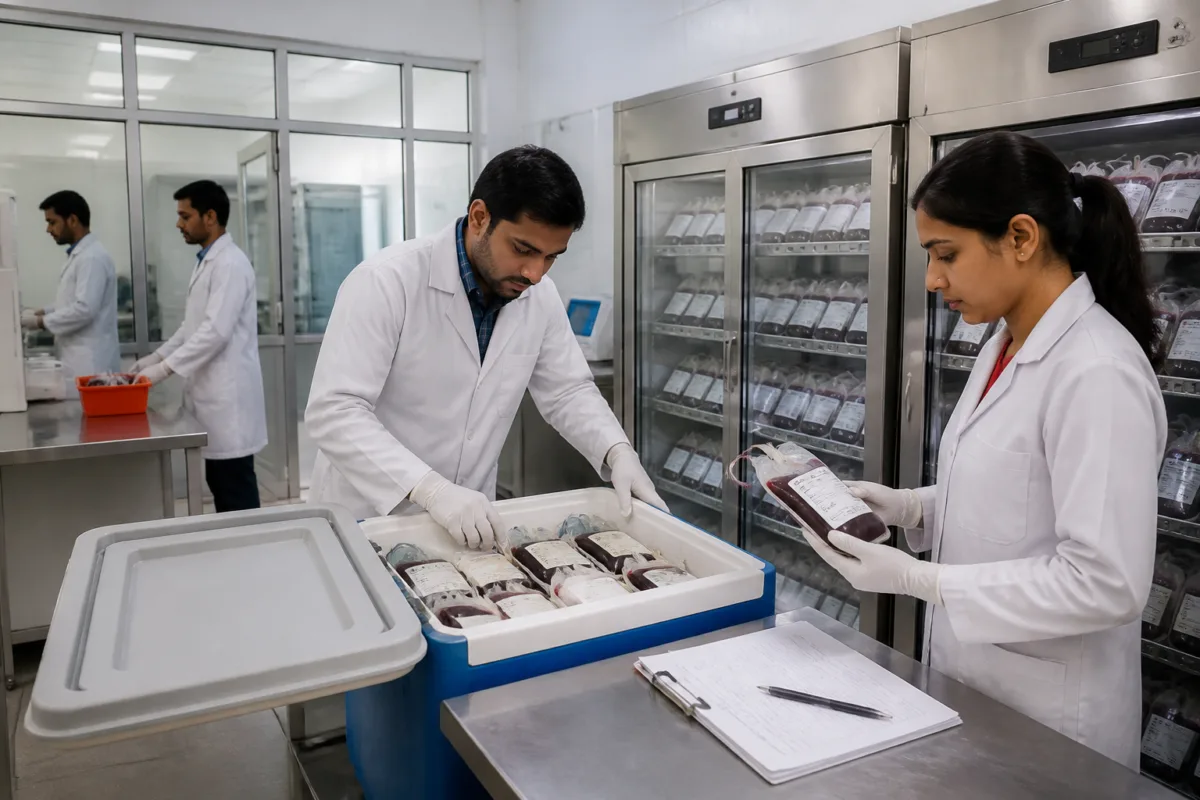
Uttar Pradesh’s proposal to make recipient centres re-test blood units received through bulk transfers is more than a new compliance measure. It exposes a weak point in the country’s blood-supply chain: safety checks are largely concentrated at the centre that supplies blood, while the institution receiving and storing it may have limited ability to verify the full chain of testing, transport and documentation.
The Uttar Pradesh Food Safety and Drug Administration has asked the National Blood Transfusion Council to mandate additional screening of bulk-transferred blood units at the recipient centre. The proposal recommends testing at least 1% of every consignment, or a minimum of one unit, whichever is higher. The testing would be conducted at a government centre in the presence of a drug inspector.
The immediate trigger was a state-wide inspection drive carried out in March 2026 across 208 blood centres. According to the report, authorities found irregularities in infection-testing practices, records related to temperature-controlled storage, the availability of trained technical staff, hygiene conditions and documentation. They also identified shortcomings in paperwork linked to large consignments of Packed Red Blood Cells procured from other states. The inspections resulted in the cancellation of 55 centre licences.
These findings make the proposed re-testing requirement significant because bulk transfer is not simply a movement of sealed medical inventory from one building to another. It is a chain involving collection, testing, storage, packaging, transport, receipt and final issue to patients. Each stage creates a record and a potential point of failure. If documentation is incomplete, the receiving centre may not be able to establish whether the blood was tested correctly, whether it remained within the required temperature conditions, or whether the consignment corresponds to the records supplied by the originating centre.
## The weak link is accountability between centres
At present, infection testing is primarily the responsibility of the supplier blood centre. That division is administratively straightforward: the centre that collects or processes the blood performs the prescribed tests before the unit is transferred. But the Uttar Pradesh agency has argued that gaps in documentation make it difficult to confirm whether out-of-state suppliers are consistently following the rules for collection and testing.
The proposal therefore shifts part of the assurance process to the receiving centre. A sample-based check would not replace the supplier’s responsibility, but it would create an additional point at which an irregularity could be detected. The recommended threshold—1% of each consignment or one unit, whichever is higher—also attempts to create a minimum floor for oversight when consignments are small.
The presence of a drug inspector at the proposed testing stage is equally important. It links the technical act of screening to regulatory supervision. Without an accountable official and a clear record of what was tested, when it was tested and what the result was, additional testing could become another informal practice rather than an enforceable safeguard.
The proposal also asks that every blood unit in a bulk transfer carry the words “Bulk Transferred Unit” and include the name, address and licence numbers of both the supplier and recipient centres. This is a basic traceability measure, but it addresses a central problem in distributed healthcare systems: responsibility can become unclear when an item crosses institutional and state boundaries.
## Why transport records matter as much as test reports
Blood safety is not determined only by whether a unit was tested before dispatch. The condition of the blood bag, the integrity of the attached pilot tube, the time taken in transit and the temperature maintained during transport are also part of the safety chain. The inspection findings cited in the report indicate that these operational records were not consistently reliable.
UPFSDA has proposed that at least two pilot tube segments accompany each unit. It has also called for a standard operating procedure and checklist for every consignment. The checklist would cover the condition of the blood bag and pilot tubes, test reports, the identities and licence details of both centres, transfer time limits and temperature logs during transport.
This approach treats the transfer as a controlled logistics operation rather than an informal exchange between blood banks. That distinction matters because bulk procurement can make hospitals and blood centres dependent on suppliers located outside the state. Once a consignment travels across state borders, the receiving institution may have less direct knowledge of the originating centre’s equipment, staffing, testing workflow and storage practices.
The proposal that recipient centres inform the local drug inspector before accepting a bulk transfer would add a notification point before the blood enters the receiving facility’s stock. It would allow the regulator to know that a transfer is taking place and, in principle, to examine the relevant records at the time of receipt rather than after a problem has emerged.
## The inspection findings point to a wider capacity problem
The March inspection drive did not identify only one technical failure. The reported irregularities extended across testing, documentation, storage, staffing and hygiene. That spread is important because it suggests that blood safety depends on the operating capacity of the entire centre, not on a single laboratory test.
A centre may have the equipment to conduct infection screening but still face problems if trained technical staff are unavailable, temperature records are incomplete, hygiene systems are inadequate or the paperwork cannot connect a test result to a specific unit. In such a system, formal compliance and real-world traceability can diverge.
The cancellation of 55 licences demonstrates the regulatory consequences reported by the state authority. It also indicates the scale of the compliance challenge: more than one in four of the 208 inspected centres faced licence cancellation, based on the figures in the report. The available material does not establish why each licence was cancelled or whether the action was temporary or permanent, so the significance of the enforcement must be read alongside those unresolved details.
The inspection exercise also raises a question about the consistency of oversight before the March drive. The report does not state how frequently such inspections had previously taken place, whether all blood centres in the state were inspected, or how many bulk consignments were reviewed. Those details would be necessary to determine whether the irregularities were concentrated in a small group of facilities or reflected a broader pattern.
## A regulatory proposal that needs a clear operating framework
The National Blood Transfusion Council will have to determine whether the Uttar Pradesh recommendations should become a broader requirement. That decision would involve more than approving a sampling percentage. It would require defining which government centres can conduct the additional tests, how results should be recorded, what happens when a sample fails, and whether an entire consignment must be quarantined while the matter is investigated.
The proposal also leaves practical questions about implementation. The report does not specify the testing turnaround time, the resources available at government centres, or how recipient facilities would manage urgent demand when a consignment is held for verification. Nor does it state whether the additional testing would apply to every type of blood component or specifically to bulk-transferred units such as Packed Red Blood Cells.
These details matter because a safety rule that is clear in principle can become inconsistent in practice if centres interpret it differently. A national SOP and checklist could reduce that variation, but the system would still need trained staff, functioning cold-chain equipment, reliable records and a regulator capable of checking compliance across locations.
The proposed labels and dual-centre identification could help create a more visible chain of responsibility. Yet labelling alone cannot resolve gaps in source testing, transport conditions or receipt procedures. Traceability works only when each institution records the same information in a consistent format and makes that information available to the regulator when required.
## The larger urban infrastructure question
Blood banks are part of the healthcare infrastructure that allows cities and states to absorb emergencies, conduct surgeries and treat patients who require transfusion. Their effectiveness depends not only on medical expertise but also on logistics, procurement, cold-chain management, staffing and regulatory coordination. The Uttar Pradesh proposal makes that infrastructure visible by focusing on what happens between two blood centres.
The issue also shows how inter-state healthcare dependence can complicate accountability. A receiving centre may need supplies from outside the state, but the regulatory systems of the supplier and recipient may not operate with the same visibility or administrative rhythm. A common documentation and inspection framework is therefore central to making bulk transfer safe and auditable.
The evidence currently confirms that Uttar Pradesh found serious irregularities during inspections and that the state agency has proposed additional controls to the national regulator. It does not yet establish whether the proposed re-testing system will be adopted, how it will be funded or whether it will become a national standard. The next important developments are the National Blood Transfusion Council’s response, the final SOP and checklist, and details of how failed tests, temperature breaches and incomplete documentation will be handled.

