


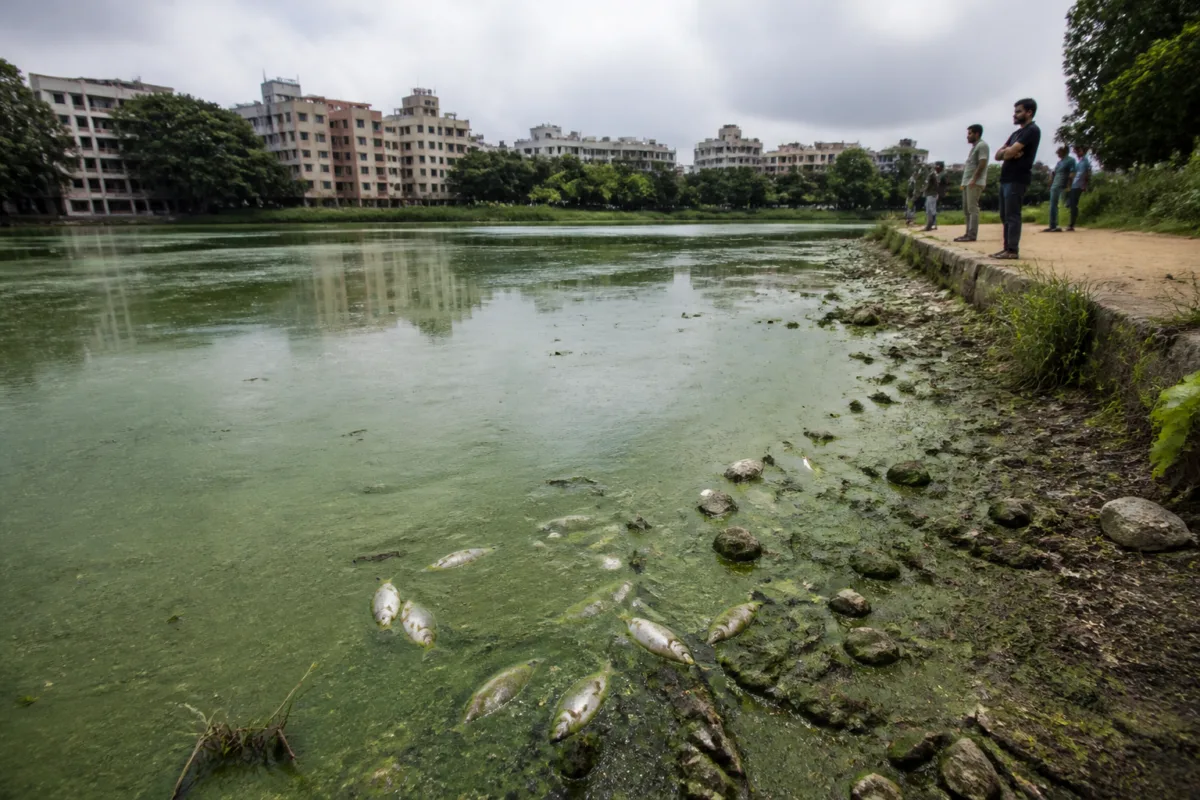
Siddapura Lake in Bengaluru has turned green after extensive algal growth, with hundreds of dead fish found floating on the water and residents alleging that sewage from nearby neighbourhoods is entering the lake. The incident has triggered demands for immediate water-quality testing, pollution-source identification and intervention by the Greater Bengaluru Authority (GBA) and Karnataka State Pollution Control Board (KSPCB).
Residents who recently visited the lake reported seeing dead fish scattered across the waterbody. They also described a strong stench, increasing pollution and mosquito breeding around the lake. Sathyam, a resident, told Bangalore Mirror that the lake had earlier been polluted on only one side, but that the condition had worsened after recent rains, with the entire waterbody now appearing affected.
“This lake is slowly dying,” Sathyam said, adding that residents were concerned about further fish deaths if authorities did not act. He called for a water-quality analysis to determine the cause of the deterioration and for a permanent solution to protect the lake. The lake, residents said, was intended to serve as a public relaxation space but had become a source of concern for people living nearby.
The extensive green colour has been linked in the report to algal growth. Experts cited by Bangalore Mirror said sewage entering a lake can increase its nutrient load and trigger excessive algal growth. When algae die and decompose, the process can consume dissolved oxygen in the water, potentially leaving fish and other aquatic organisms unable to survive.
However, the exact cause of the fish deaths at Siddapura Lake has not yet been established. Scientific testing will be required to determine whether sewage inflow, oxygen depletion, toxic contamination or another factor is responsible for the incident.
Madhuri Subbarao, co-founder of Friends of Lakes, said the fish deaths could indicate severe eutrophication, oxygen depletion and an imbalance in the lake ecosystem. She urged the GBA not to introduce aquatic life into lakes until scientific assessments confirm that water quality is suitable for their survival.
Subbarao also called on the KSPCB to ensure mandatory quarterly water-quality monitoring of all lakes, with corrective action taken before deterioration reaches the stage of visible ecological damage. She said Bengaluru’s lakes were losing ecological health, biodiversity and groundwater recharge potential despite years of citizen-led conservation efforts.
According to Subbarao, Siddapura Kere had been in better condition more than 15 years ago, when local communities were organically involved in its care. Recent citizen-led greening efforts had offered some hope of revival, she said, but lake conservation would require scientific oversight, administrative accountability and meaningful public participation.
The immediate demands are for the authorities to test Siddapura Lake’s water, identify any sewage inflow, assess the impact on aquatic life and initiate measures to prevent further deterioration. The report does not establish whether the GBA or KSPCB has announced a testing schedule or identified a confirmed pollution source.

