


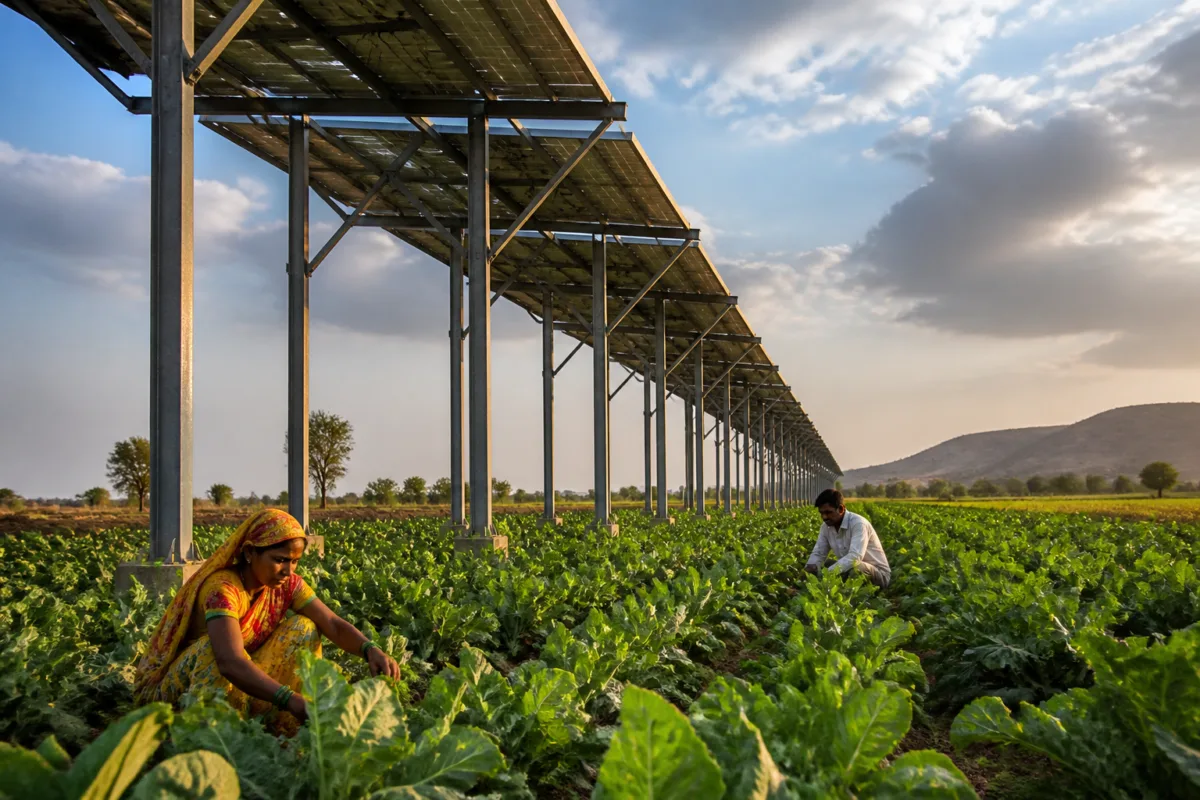
India is preparing a policy to expand agrivoltaics, a model that combines crop cultivation with solar power generation on the same land, with the government targeting an initial capacity of 5 GW over the next few years. The policy could open a new route for renewable energy expansion while allowing farmers to continue agricultural activity on land used for solar installations.
Union Minister for New and Renewable Energy Pralhad Joshi said on Wednesday that about 30 per cent of India’s 160 million hectares of cropland has potential for non-fossil fuel-based projects. He was speaking at the Agrivoltaics World Conference 2026, titled ‘Powering the Global South’, in New Delhi.
Agrivoltaic systems typically place solar panels above crops on elevated structures. This allows electricity generation without removing the land entirely from agricultural use. Joshi said the model could help address land availability constraints while enhancing farmers’ incomes through energy generation.
The minister said four acres of land are required to install 1 MW of solar capacity. However, he noted that around 85 per cent of India’s farmers are small and marginal farmers who cannot spare land by stopping agricultural activity. Agrivoltaics, he said, could help address that constraint by combining farming and solar generation.
Maharashtra, Rajasthan, Andhra Pradesh, Madhya Pradesh, Karnataka and Uttar Pradesh together account for nearly 50 per cent of India’s estimated agrivoltaic potential, according to the figures cited by the minister. The distribution of potential across these states means that implementation will require coordination between the Union government, state administrations, power agencies and agricultural institutions.
MNRE Secretary Santosh Kumar Sarangi later said the draft policy would be placed in the public domain. States and other stakeholders will be invited to submit suggestions, after which the draft will be modified, he said. The government is initially targeting 5 GW of agrivoltaic capacity and will assess the response from states, Sarangi said.
A dedicated 10-GW agri-PV component is also expected to be included in the proposed PM KUSUM 2.0 scheme. The component would promote the co-location of solar panels with crops and could support the deployment of panels mounted on stilts above standing agricultural fields. An official also indicated that a central scheme may be developed to help states deploy agrivoltaic projects.
The model faces a cost disadvantage compared with conventional ground-mounted solar power. Joshi said agrivoltaic plants currently cost 25 to 30 per cent more because they require elevated tilted structures and additional infrastructure. Electricity from mounted photovoltaic systems was estimated at Rs 3.20 per unit, compared with Rs 2.60 per unit for ground-mounted solar projects. The difference, he said, would have to be addressed to make agrivoltaics commercially viable.
The global agrivoltaic market has crossed 18.4 GW of installed capacity, according to the minister. Germany has offered support for joint research in India, with German Ambassador to India and Bhutan Jasper Wieck saying pilot sites would test whether agriculture and solar power generation can be combined economically and sustainably on the same land.
The proposed policy will now move towards stakeholder consultation. Its final design will determine how land is identified, how farmers participate, how the additional cost is supported and how states integrate agrivoltaics into agricultural and energy programmes.

