


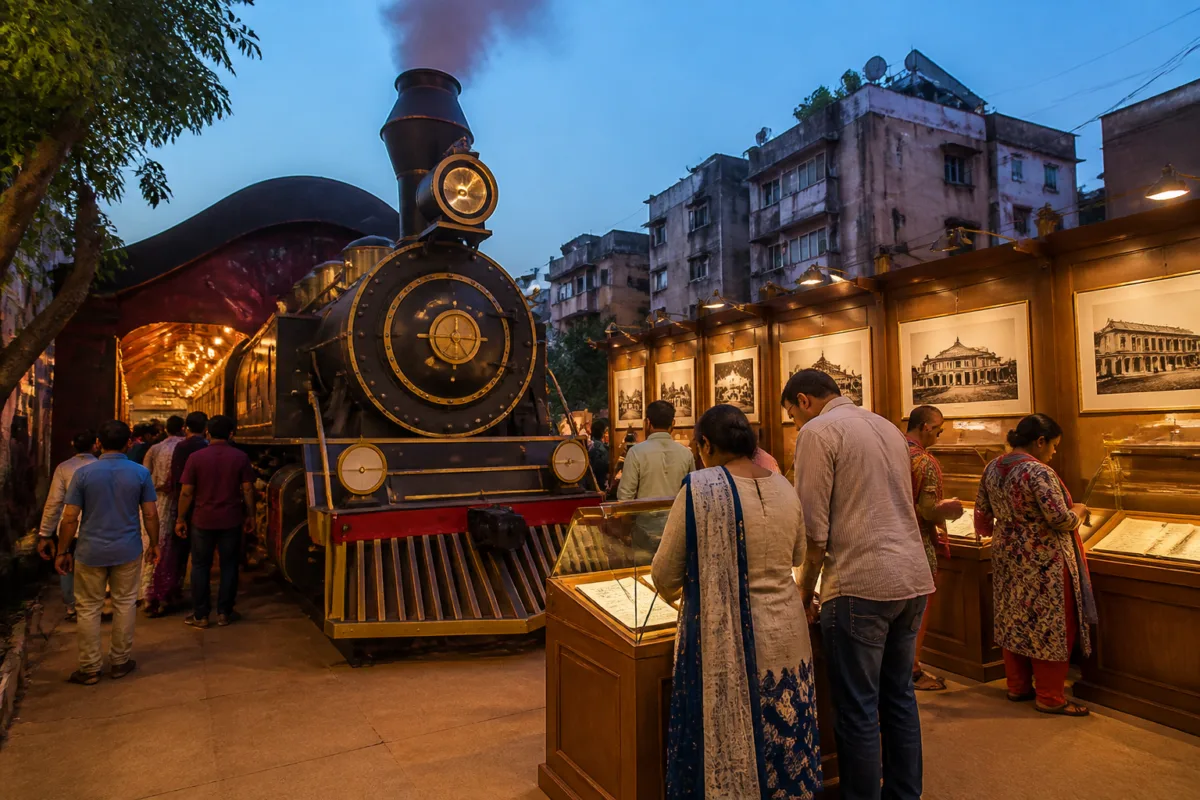
Timarpur’s 113-year-old Durga Puja is doing more than marking an annual religious festival. Its latest presentation, “Dillir Buke Bangla”, uses railway routes, recreated documents and community archives to examine how Bengali migration helped shape Delhi after the British shifted the capital from Calcutta in 1911.
The exhibition focuses on Bengali families who came to Delhi between roughly 1908 and 1920, a period when the city was being reorganised around its new status as the capital of British India. The story is presented through the experience of Timarpur, identified by the organisers as the city’s second-oldest Durga Puja and one of the first locations where many of these migrants settled in north Delhi.
That framing matters because migration is often narrated through population numbers or landmark neighbourhoods. The Timarpur presentation instead approaches it through the practical details of arrival: how families travelled, where they lived, how they maintained links with relatives left behind and how they adapted to a city with a different climate, language and social environment.
The entrance to the Puja pandal is designed as a giant steam engine carrying the insignia of the East Indian Railway, which operated the Calcutta-Delhi train route at the time. The railway is not merely a visual motif. In the account assembled by the organisers, it represents the infrastructure that made movement between the two cities possible and connected migration to the administrative transformation of the capital.
Bengalis had been arriving in Delhi in smaller numbers from the time the rail link from Calcutta became operational in 1864. The volume increased around the period of the capital shift, according to the presentation. The precise size and composition of that migration are not established in the supplied material, but the timeline places the movement within a larger transition in which Delhi was acquiring new institutions, government functions and populations.
Timarpur’s role in that transition is central to the exhibition. The organisers describe it as the city’s first government colony, established after Delhi was declared the capital. Families arriving there were initially housed in temporary quarters. That detail points to an important feature of early urban growth: migration was not only a social process but also an administrative and housing question. New residents needed accommodation, transport connections and places where community life could take root.
The organisers have reconstructed this experience through six imaginary families. They have been explicit that these are representations rather than documented biographies. “We did not want to overcomplicate the narrative. We have no records of the people who shifted during that migration. So, we created a representation of six families,” Kamal Banerjea, a member of the seven-person curation team, told The Times of India.
That admission is important for understanding what the exhibition can and cannot establish. It does not provide a complete census of Bengali migrants or a definitive account of every settlement. Instead, it creates a public interpretation of a period for which the organisers say direct records of individual migrants are limited. The distinction between archival evidence and imaginative reconstruction is therefore part of the story itself.
The curation team spent six months assembling material. It filed Right to Information applications with different departments, searched digital archives in Delhi and used old wedding invitations and receipts preserved by community members. It also examined railway companies and routes connecting Calcutta and Delhi, looking for tickets and other evidence of the journey.
The process shows how urban history can survive outside formal planning records. Receipts, invitations and personal papers may appear ordinary, but together they can reveal how families moved, communicated and established themselves. In this case, community-held documents supplement government and railway archives, allowing the organisers to connect a major administrative decision—the transfer of the capital—with the everyday experiences of families who responded to it.
The exhibition’s physical reconstruction also makes the archive accessible to visitors. Old documents and letters were reproduced using illustration software, treated with tea water to create an aged appearance and printed using offset printing rather than digital printing. Banerjea said artificial intelligence was used in the process, while most of the creative work came from the team.
This mixture of technology and handmade reconstruction reflects a wider challenge in preserving urban memory. Historical material may be fragmented, damaged or held privately, while public audiences often encounter the past through curated displays rather than original records. The Timarpur team’s method attempts to bridge those conditions, although the resulting exhibits remain an interpretation and not a substitute for a complete archive.
The story also complicates the idea of a single Bengali settlement in Delhi. Banerjea said communities established in Kashmere Gate and Chandni Chowk, and later in Karol Bagh, Minto Road and areas around Kali Bari, were all part of the broader migration story. Timarpur is therefore one entry point into a wider urban geography rather than the sole centre of Bengali life in the capital.
That geography helps explain how migrant communities become part of a city. An initial settlement can provide housing and social support, while later movement spreads institutions, cultural practices and community networks across different neighbourhoods. The supplied account does not quantify that expansion, but it identifies several locations through which Bengali presence became embedded in Delhi’s changing urban fabric.
The institutional setting is equally significant. The migration occurred alongside the creation of a new capital and the establishment of government housing. The account does not provide details of the colony’s tenure rules, departmental structure or long-term housing policy, so those aspects remain unestablished. What it does show is that early migration was closely linked to the capital’s administrative expansion and to the availability of temporary accommodation.
The evidence also reveals the limits of community memory. The curators relied on RTI applications, digital archives, railway research and private documents, yet they still said they could not identify the people who migrated during the period in question. This gap is not unusual in urban history: institutions may preserve decisions and infrastructure records, while the lives of residents survive through scattered family material.
For Delhi, the larger urban question is how the city records the communities that helped build it. The capital’s physical transformation is often associated with roads, government buildings and planned districts. The Timarpur presentation adds another layer by showing that the city was also shaped by people who travelled along new railway links, entered temporary housing and created durable social institutions.
The Durga Puja itself is evidence of that continuity. The annual tradition has endured since 1914, while the latest theme looks back to the migration that preceded and accompanied its early years. Its survival links a present-day cultural gathering with the period when Delhi was being remade as the imperial capital.
What the exhibition confirms is not a complete history of Bengali migration, but a documented community effort to recover one part of Delhi’s urban formation. Its strongest contribution lies in bringing together infrastructure, housing, migration and memory. What remains uncertain is the precise scale of the migration, the identities of individual families and the extent to which Timarpur’s experience represented other Bengali settlements. Those questions point to the value of further archival work as Delhi continues to interpret the histories embedded in its neighbourhoods.

