


Varmora Granito’s first results since its September 29 listing show a sharp improvement in profitability, but the more significant story is how a Morbi-based tile manufacturer is attempting to make its business less dependent on commodity products and more resilient to energy and logistics shocks. Net profit rose 498% year on year to Rs 53.7 crore in the first half of FY27, while revenue from operations grew 3.3% to Rs 714.2 crore.
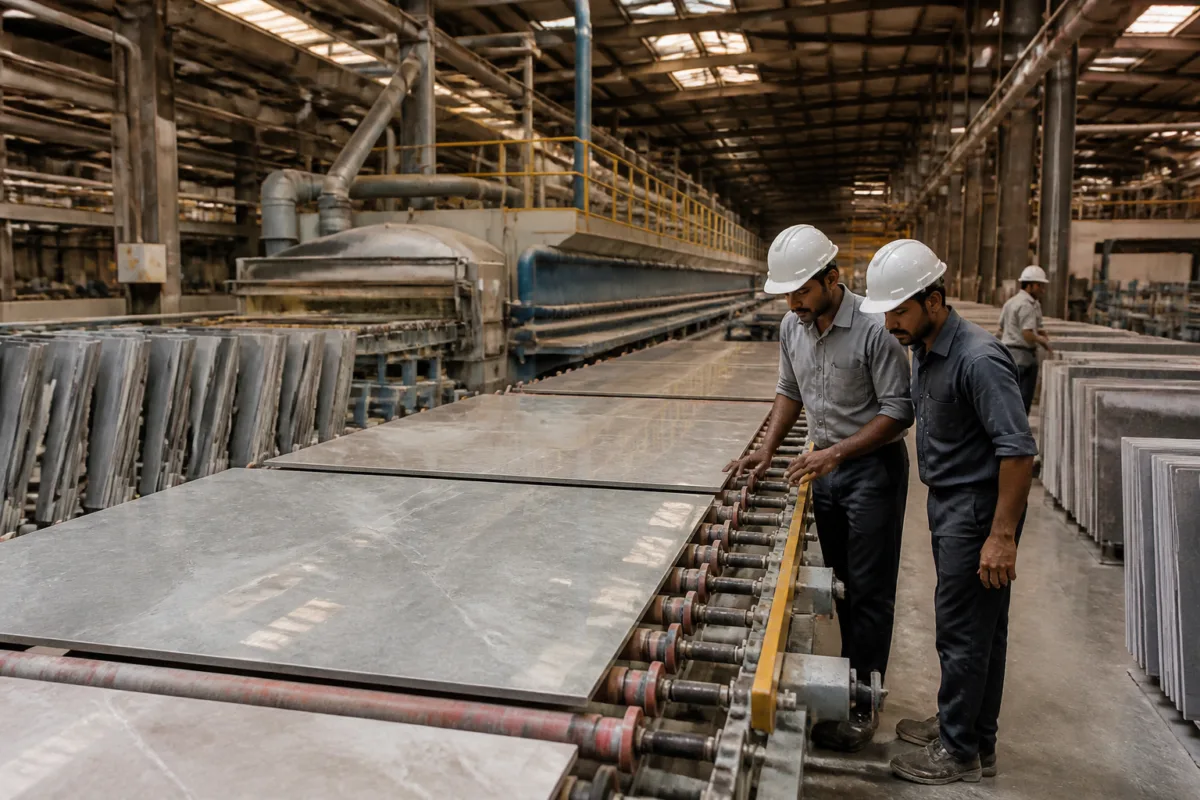
The numbers point to a change in the economics of tile manufacturing. Varmora said glazed vitrified tiles (GVT), technical products including integrated stone technology (IST), and slabs accounted for 87% of revenue in H1 FY27, compared with 83% a year earlier. The company has been moving away from ceramic and polished vitrified tiles (PVT) towards these higher-value categories over the past two years.
That shift matters because tile production is not only a question of selling more square metres. It also depends on the value generated from each product, the energy required to manufacture it, the price that distributors and consumers will accept, and the manufacturer’s ability to protect margins when fuel and logistics costs rise. Varmora’s results suggest that product mix, rather than volume growth alone, was central to its recovery.
### Varmora Granito and the economics of premium tiles
The company’s revenue growth remained modest in the first half, but its profit growth was much faster. Bhavesh Varmora, chairman and managing director, attributed the improvement in incremental margins to the greater contribution of GVT, technical products and higher-value surfaces. The company also launched 508 new designs during the period, indicating that product differentiation is being used alongside pricing and distribution to support the premiumisation strategy.
The second quarter illustrates the difference between sales volume and financial performance. Revenue from operations rose 27% sequentially to Rs 399 crore in Q2 FY27, while net profit increased to Rs 44 crore from Rs 9.7 crore in Q1. However, sales volumes remained broadly unchanged from the preceding quarter, according to the company. This means the improvement came despite no comparable increase in volume, with pricing and product mix playing a significant role.
The company has said that the individual contribution of pricing and product mix requires further clarification. That limitation is important. The available results establish that revenue and margins improved while volumes remained broadly stable, but they do not quantify how much of the improvement came from higher prices, a richer product mix, lower costs or other operating factors.
Still, the direction is clear. A manufacturer that sells a greater share of premium or technical products can potentially increase revenue without relying only on additional production capacity. For an industrial cluster such as Morbi, where manufacturers face common pressures from fuel prices, freight availability and export logistics, this is a significant business response to cost volatility.
### The gas-price shock exposed Morbi’s vulnerability
Morbi’s ceramic tile manufacturers faced a sharp rise in gas prices following the West Asia conflict. Prices climbed from around Rs 48 to Rs 88 per standard cubic metre, disrupting production until mid-April. Varmora reported a 16% year-on-year decline in first-quarter volumes as the disruption affected operations.
The episode exposed the dependence of tile manufacturing on an energy-intensive production system. Gas is a critical input for the manufacturing process, and a sudden increase in its cost can affect production continuity, pricing, demand and working capital at the same time. The impact is not confined to an individual factory. When many manufacturers in the same cluster face the same input shock, the consequences can extend across suppliers, transporters, distributors and construction markets.
Varmora responded by raising prices by 18-19%, depending on the product category. According to the company, these increases fully recovered the additional gas costs. Average gas costs later eased to Rs 80.5 per standard cubic metre in Q2 from Rs 84.7 in Q1, but remained well above the earlier level of around Rs 48.
The recovery in the September quarter therefore does not represent a return to the previous cost environment. It reflects an adjustment to a changed one. The company had to combine price increases with a higher-value product mix and a recovery in production after the June-quarter disruption. The figures also show why volume is not the only indicator of the health of a manufacturing cluster: profitability can improve even when volumes remain broadly unchanged, provided manufacturers can pass through costs and sell products with stronger margins.
For construction and real estate markets, such adjustments can affect the price and availability of finishing materials. Tiles are an important component of housing, commercial construction and redevelopment projects. When manufacturers raise prices to offset energy costs, the increase can move through distributors and contractors before reaching developers or individual buyers. The supplied results do not quantify the final effect on project costs, but they show the industrial pressure that can feed into the built environment.
### Exports, containers and the limits of recovery
Varmora expects exports to improve in Q3 and strengthen further in Q4. The company plans to focus on branded exports rather than white-label business, while identifying container availability and logistical constraints as challenges for exporters.
This strategy reflects another structural feature of the tile industry: manufacturing competitiveness depends not only on factory economics but also on the ability to reach overseas markets reliably. A product may be competitively priced at the factory gate and still face difficulty if containers are unavailable, freight arrangements are uncertain or delivery schedules are disrupted.
The decision to prioritise branded exports also indicates an attempt to retain more value from international sales. White-label business can provide volume but may give the manufacturer less control over brand recognition and pricing. A branded export model requires stronger design, distribution and customer-building capabilities. Varmora’s addition of four exclusive brand outlets during the first half, taking its total to 309, alongside more than 2,000 multi-brand outlets, shows that the company is building both owned and wider distribution channels.
The export outlook remains a company expectation rather than an established outcome. The available material records the expected improvement for the second half but does not provide export revenue figures or confirm whether container constraints have been resolved. Those details will be important in assessing whether the recovery is broad-based or primarily the result of domestic pricing and product-mix changes.
### Debt reduction and the post-listing balance sheet
Varmora’s results also need to be read alongside its public listing. The company’s first results since its September 29 listing followed an initial public offering of Rs 708 crore. Varmora said proceeds from the fresh issue were used to repay debt, strengthening its balance sheet and reducing future interest costs.
That financial restructuring changes the way the company can absorb operating shocks. A manufacturer facing higher gas costs, lower volumes or disrupted exports must manage not only production expenses but also interest obligations and working capital. Debt repayment can reduce the pressure created by those obligations, although the supplied results do not state the amount of debt repaid or the resulting interest savings.
The listing also places greater attention on the company’s ability to demonstrate that its profitability improvement is sustainable. The first-half numbers are strong, but they include a recovery from the disruption that affected the June quarter. The next results will show whether the higher contribution from GVT, IST and slabs continues, whether gas costs remain manageable, and whether exports improve as expected.
### What the results reveal about Morbi’s industrial model
The broader lesson from Varmora’s results is that Morbi’s tile economy is being shaped by three simultaneous pressures: energy volatility, changing product economics and uncertain logistics. A manufacturer can no longer rely only on expanding production volumes. It must also manage the value of its product portfolio, pass through input costs where the market allows, develop distribution and protect access to domestic and overseas buyers.
Varmora’s reported performance provides one example of that adjustment. Its profit increased sharply even as first-half revenue grew only 3.3% and quarterly volumes remained broadly unchanged. The company’s explanation centres on premium products, pricing and the recovery from a gas-related disruption. It has also expanded its exclusive outlet network, launched new designs, reduced debt after the public issue and targeted branded exports.
These changes connect a corporate earnings announcement to the wider built environment. Tile manufacturing sits upstream of housing construction, redevelopment and commercial projects, but its performance is determined by industrial systems that consumers rarely see: fuel supply and pricing, factory utilisation, product design, freight access, distribution networks and financing costs.
The evidence currently confirms a strong first-half profit recovery and a strategic shift towards higher-value products. It does not yet establish how durable the improvement will be, how exports will perform in the second half, or how much of the profit increase came from pricing compared with product mix and cost changes. Those are the indicators that will determine whether Varmora’s response represents a temporary recovery from the gas shock or a lasting change in the economics of its tile business.

