


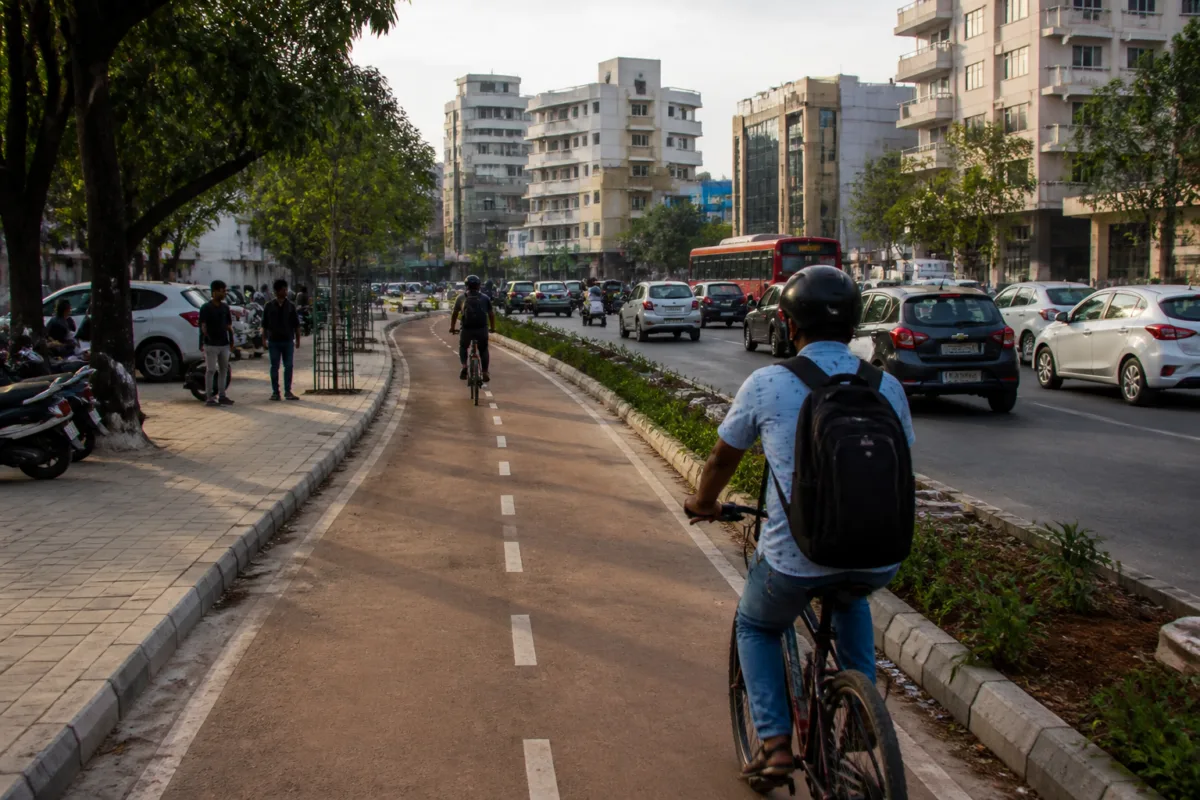
The Pune Municipal Corporation’s plan to develop 75 kilometres of continuous and safe cycle routes is not simply a fresh infrastructure announcement. It is also an attempt to repair a planning failure in which earlier cycle tracks were built at considerable cost but were later weakened by encroachments, poor maintenance, road works and incomplete connections. The central question is whether Pune can create a network that remains usable after construction ends.
The municipal commissioner has directed the roads department to assess the condition of existing cycle routes, remove gaps and complete missing links. The proposed first phase will cover 75 kilometres, with a later expansion planned to 136 kilometres. The direction followed a meeting on Monday, October 19, at which the Institute for Transportation and Development Policy presented details of the proposed network and discussed shortcomings in the city’s existing routes.
That sequence matters because the problem identified in Pune is not the absence of isolated cycle tracks. It is the absence of a connected system. A cycle route that ends abruptly, is blocked by parked vehicles or disappears during road and footpath works cannot provide a reliable alternative for daily travel. The municipal discussion therefore shifts the focus from the length of infrastructure created to whether cyclists can travel safely from one usable segment to another.
Pune’s earlier cycle-track programme was planned around 2016-17. The city approved a Pune Cycle Plan and a Comprehensive Cycle Master Plan, after which tracks were constructed on different roads with spending running into crores of rupees, according to the report. But the resulting network did not remain continuous. Vehicles parked on the tracks, hawker encroachments and other obstructions reduced their practical utility. In some locations, road-widening projects damaged or removed the tracks; in others, footpath expansion works eliminated them altogether.
This history exposes a recurring weakness in urban infrastructure delivery: construction is often treated as the principal milestone, while protection, maintenance and coordination are handled later or not at all. In the case of Pune’s cycle tracks, the infrastructure was affected by several parts of the street system at once. Roads were widened, footpaths were redesigned, parking occupied designated space and traffic moved into areas intended for cyclists. Each intervention may have been considered separately, but the combined result was the erosion of the cycle network.
The proposed 75-km programme will therefore need to be read as a network-recovery exercise as much as a new construction programme. The municipal instructions call for an assessment of the present condition of routes, correction of deficiencies and completion of missing connections. That approach is different from announcing a standalone stretch because it recognises that continuity is the basic service being offered to cyclists.
The source report does not provide a final route map, project cost or completion deadline for the full 75-km network. It also does not establish how encroachments will be prevented, who will be responsible for routine maintenance or how future road and footpath projects will be required to protect the cycle routes. These details are significant because the earlier tracks did not fail only because of design or construction. They also failed because the space was not consistently protected after it was created.
The institutional structure adds another layer. The proposed work is to be coordinated with development activity linked to the Pune Grand Tour 2027. The report says the city wants to accelerate road and cycle-route development in that context. It also records discussion about developing cycle tracks on both sides of Ganeshkhind Road, where a track had previously been created on one side. The Ganeshkhind proposal is to be coordinated with projects involving the Pune Metropolitan Region Development Authority and Tata, although the final decision, cost and timeline have not yet been fixed.
This makes coordination central to the outcome. A cycle track located on a road affected by municipal, regional or private-sector projects cannot be planned in isolation. If one agency changes the carriageway, another modifies the footpath and a third executes a related development project, the cycle route can become discontinuous even when each individual project is completed. The proposed coordination with the Pune Metropolitan Region Development Authority and Tata acknowledges this risk, but the available information does not yet specify the institutional mechanism that will make coordination binding.
Pune’s stated objectives are broader than cycling alone. The municipal corporation has linked the programme to reducing traffic congestion, lowering dependence on private vehicles and encouraging environmentally friendly transport. Those objectives depend on whether the routes serve everyday journeys rather than only showcase or event-related movement. A cycle track that is safe for a short demonstration route but unreliable for commuting will have limited influence on travel behaviour.
The contrast between international cycling events and ordinary cycling conditions sharpens this issue. Pune is preparing for international-standard cycling competitions, while residents still face a shortage of safe and continuous routes for regular travel. The report argues that infrastructure developed in the run-up to the Pune Grand Tour 2027 should not remain limited to competition routes. It should also be useful for the city’s residents in their daily journeys. That is a question of public infrastructure value: whether spending associated with a high-visibility event creates a durable everyday asset.
The proposed increase from 75 kilometres in the initial network to 136 kilometres in a later phase also raises a sequencing question. Expansion can increase the reach of cycling infrastructure, but only if the first network is connected, protected and maintained. Otherwise, a larger total length may reproduce the earlier problem at a bigger scale. The material available in the report does not indicate whether the 136-km target has a sanctioned design, budget or implementation schedule.
The focus on Ganeshkhind Road illustrates why route-level decisions will matter. Providing tracks on both sides could improve usability on a major corridor, but the proposal remains under discussion. Its feasibility will depend on how available road space, footpaths, traffic movement and linked projects are reconciled. Since no final cost or timeline has been announced, the proposal currently represents a planning direction rather than a confirmed project commitment.
The evidence presently supports three conclusions. First, Pune’s cycle-track challenge is primarily about continuity and usability, not just aggregate kilometres. Second, the earlier network was undermined by weak protection and by the lack of coordination between street works and cycling infrastructure. Third, the new programme has been framed around correcting existing deficiencies, but its delivery framework remains incomplete in the information available.
The next stage will show whether the municipal corporation converts the commissioner’s direction into a route-level plan with defined responsibilities and implementation milestones. The proposed 75-km network, the possible 136-km expansion and the Ganeshkhind Road plan will need to be assessed not only by how much track is built, but by whether cyclists can use it continuously and safely after other urban works resume. That is the test that the earlier cycle-track programme did not pass.

