


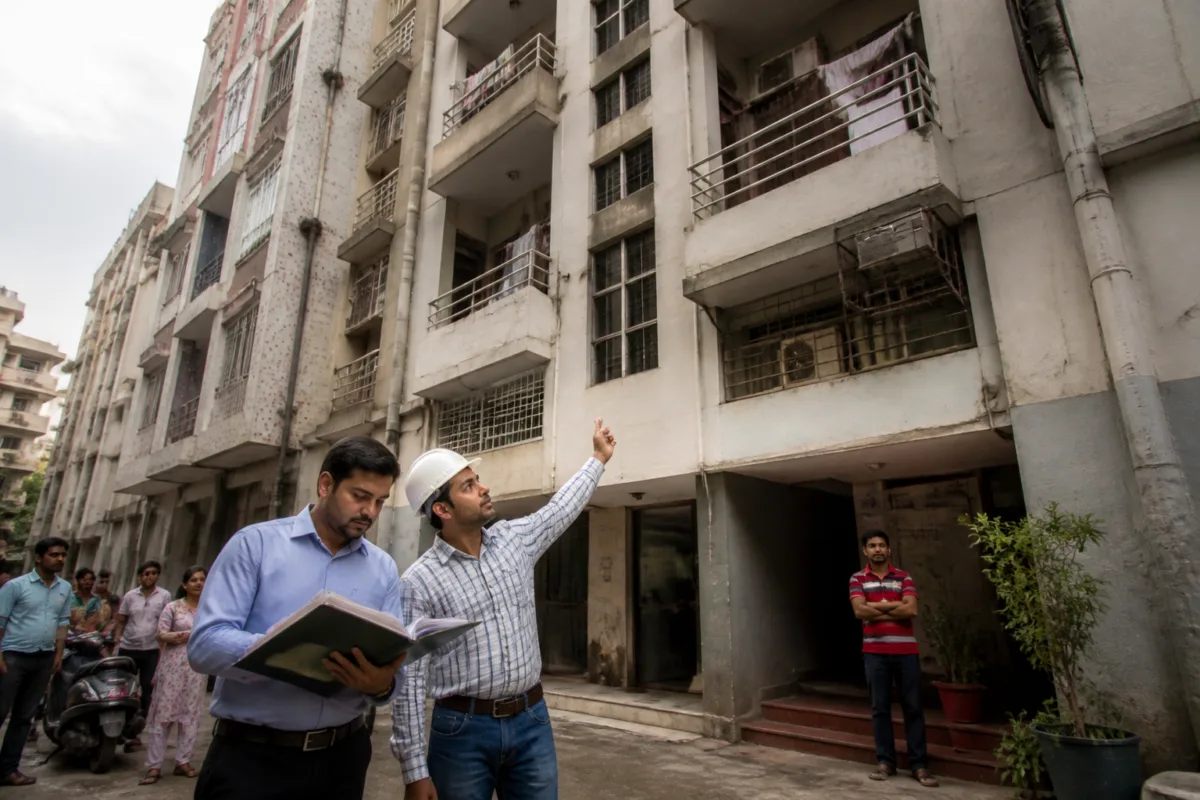
The Delhi Municipal Corporation has received structural safety certificates from only 53 of the 2,457 paying guest accommodations surveyed across its 12 zones, a compliance rate of about 2.2%. The figure, recorded after the collapse of a PG facility in Satya Niketan that killed seven people and critically injured six, exposes a gap between a court-directed safety exercise and the city’s ability to complete it.
The immediate exercise was triggered by the Satya Niketan collapse and directions from the Delhi High Court. The civic body physically surveyed PG accommodations within its jurisdiction and asked owners to obtain fresh structural safety audits from engineers empanelled with the MCD. Owners and occupants were given 15 days to complete the survey and submit certificates.
The central question is not only why so few certificates have been submitted. It is also whether Delhi’s existing system is designed to identify and manage structural risks in buildings that may have changed use, increased occupancy or operated without regular technical assessments.
The MCD has said it will wait until the end of October for owners and occupants to complete the exercise. From November, it plans to send reminders and begin necessary action against defaulters under applicable norms, according to an MCD official quoted by the Times of India. The official also said the number of empanelled structural engineers is limited and that completing audits takes time.
That constraint is significant because the audit requirement is not a routine administrative formality. A structural audit is a technical assessment of a building’s structural health, stability, safety and load-bearing capacity. It can identify defects that may not be visible during ordinary visual inspections. In a city where private buildings are frequently adapted for different uses, the distinction between a visual survey and a technical audit is central to public safety.
A PG accommodation can bring a different intensity of use to a building. Rooms may be occupied by several residents, common areas may experience higher daily movement, and spaces originally intended for one purpose may be used for another. The material supplied in the report does not establish how many of the surveyed buildings had unauthorised alterations or structural defects. It does, however, show that the civic authority is seeking certificates specifically to verify structural safety and compliance with construction permissions, building bylaws and statutory approvals.
The court-directed survey also places PGs within a wider governance problem: enforcement often becomes visible only after a fatal incident. The MCD’s intervention followed the Satya Niketan collapse, rather than emerging from a continuously operating certification system covering all buildings with elevated public occupancy. This does not establish that the surveyed buildings are unsafe, but it does show that the city lacks a completed, readily available safety record for most of the PGs examined in the exercise.
The legal framework described in the report helps explain part of that gap. The Delhi Municipal Corporation Act, 1957, does not specifically mandate routine structural audits of all ageing private buildings, unlike some provisions in other municipal laws. Section 348, however, empowers municipal authorities to inspect, repair or demolish structures considered dangerous or ruinous.
This creates a system that is stronger in responding to apparent danger than in ensuring periodic prevention. The power to act against a dangerous building is not the same as a universal requirement for owners to obtain recurring structural certification. Without a clear audit cycle, defined responsibility and adequate technical capacity, inspections can remain event-driven and dependent on complaints, visible deterioration, court intervention or a major accident.
The current exercise also illustrates how responsibility is distributed. Owners have been asked to engage structural engineers empanelled with the MCD and submit the resulting certificates. The MCD, meanwhile, is responsible for surveying buildings within its jurisdiction, checking permissions and approvals, and taking action against non-compliant establishments. The report also states that the civic body does not have an in-house facility to conduct structural audits.
That arrangement makes the empanelled engineer network a critical part of the enforcement chain. If the pool is limited, as the MCD official said, a deadline-based compliance drive can face a capacity bottleneck even when owners are willing to comply. The number of certificates received may therefore reflect a combination of owner response, access to qualified engineers, audit time and the administrative process for submitting and checking reports. The supplied information does not separate these factors.
The numbers nevertheless indicate the scale of the unfinished task. Of 2,457 PG accommodations surveyed, 2,404 had not submitted certificates at the time of the report. The 53 certificates received represent a small fraction of the total. The result is not proof that the remaining buildings are structurally unsafe, but it means their compliance status has not yet been documented through the process ordered after the collapse.
The distinction matters for both residents and enforcement agencies. A certificate is evidence that an audit has been conducted and submitted; it is not, by itself, a guarantee that a building will remain safe indefinitely. Conversely, the absence of a submitted certificate does not by itself prove a structural defect. The immediate governance task is to establish which buildings have valid permissions, which have undergone a competent audit, which require repairs or further action, and which are operating without the required approvals.
The report says the High Court directed the MCD to check whether PG accommodations had valid construction permissions, complied with building bylaws and possessed necessary safety and statutory approvals. Structural safety, therefore, is only one part of the compliance picture. A building may require scrutiny not only because of its physical condition but also because of how it was approved, occupied, altered or used.
This is particularly relevant to the regulation of privately operated accommodation. The report does not provide a separate licensing framework for PGs or identify how many establishments were found to have violations. It does show that the MCD’s survey is expected to connect building safety with permissions and statutory approvals. That approach recognises that risk is produced through the interaction of construction, occupancy and enforcement, rather than through structural condition alone.
The proposed policy response is also still taking shape. Sources cited in the report said the MCD and Delhi government were working on a stricter policy for periodic structural audits and safety certifications, particularly for older buildings used for public activities. The official expectation was that the audit process would be accelerated after the current exercise.
Until that policy is formally defined, important operational questions remain open. The supplied report does not specify the proposed frequency of audits, the age threshold for buildings, the penalties for non-compliance, the process for closing or restricting unsafe premises, or how audit findings will be made available to occupants. It also does not state whether the future system will cover only PGs or extend to other older private buildings used for public activities.
These details will determine whether the current drive becomes a temporary response or the beginning of a durable safety regime. A recurring system would require more than a deadline. It would need a clear register of covered buildings, a credible pool of qualified auditors, a process for reviewing certificates, mechanisms for urgent repairs and a way to ensure that occupancy continues only when basic statutory and structural requirements are met.
The immediate evidence is clear on one point: Delhi has surveyed a large number of PG accommodations, but documentation of structural safety remains incomplete. The MCD has set the end of October as the current waiting period and indicated that reminders and action against defaulters will follow from November. The next test will be whether the remaining establishments submit certificates, whether the authority can process and act on them, and whether the proposed periodic-audit policy moves from discussion to a defined administrative framework.
For residents, the issue is not simply whether a certificate exists. It is whether the city’s institutions can ensure that buildings used for accommodation are legally approved, technically assessed and monitored before a collapse forces attention on them.

