


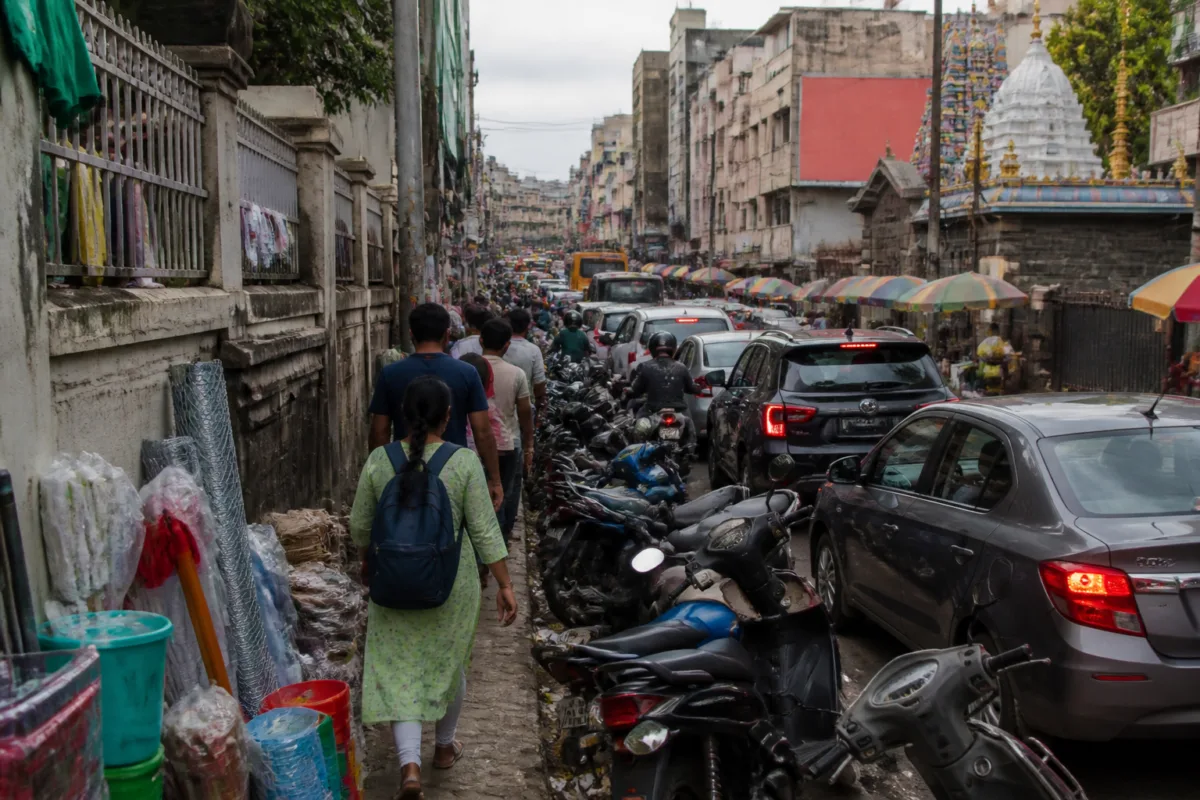
Shivajinagar’s footpath encroachments are forcing pedestrians onto narrow roads shared with moving traffic, according to a report by Bangalore Mirror, exposing a wider failure in how Bengaluru protects and manages public walking space. Along Meenakshi Koil Street, OPH Road, Ibrahim Sahib Street and adjoining crossroads, shop owners, vendors and, residents allege, some religious institutions have occupied parts of pavements and roads for commercial or institutional use.
The immediate consequence is visible at street level: people are being pushed into the carriageway because the space intended for walking is unavailable. The report says the problem is particularly acute on narrow, crowded stretches where pedestrians and vehicles compete for the same limited road space. That makes the issue more than a dispute over shopfronts. It is a question of whether a formally designated public right of way remains usable after several private and institutional claims are allowed to accumulate.
The account also shows why footpath encroachment is difficult to treat as a single-actor problem. The reported obstructions involve established shops, vendors, a temple and tenants of shops rented by a Muzrai Department temple. Different agencies and property managers may therefore be involved, while pedestrians experience the result as one continuous failure: the absence of a safe, uninterrupted walking route.
## A public space gradually converted into private frontage
On Meenakshi Koil Street, the report states that one side has no footpath, while shops on the stretch extend their business activity onto pavements and the road. The distinction between a shop and a street-side extension becomes important here. A business may operate from a lawful premises, but the use of adjoining public space for displaying goods, serving customers or storing material can reduce the effective width available to pedestrians.
Rajesh N, a two-wheeler rider quoted in the report, said that crowds leave little room for vehicles and that shop owners, rather than only street vendors, occupy many of the footpaths. He called for the police and Bengaluru Central City Corporation authorities to ensure that shop owners comply with established norms. His observation points to a recurring enforcement challenge: action focused only on informal vendors cannot resolve a problem when formal shops also expand into public space.
Residents have also alleged that Sri Sugreeva Anjaneya Swamy Sametha Sree Venugopala Swamy Sannidhi occupies the footpath along OPH Road. The report does not describe any formal action against the temple, but the allegation illustrates how public-space enforcement can become institutionally sensitive when an obstruction is linked to a religious property. For pedestrians, however, the practical effect remains the same if the walking corridor is blocked.
The report further refers to Meenakshi Amman Koil, which comes under the Muzrai Department and has rented out two small shops. A department employee said tenants had been advised not to encroach on the footpath but continued to do so, adding that the department was “helpless”. This statement, as reported, suggests that warnings have not translated into compliance or removal. It also raises a basic administrative question: which authority has the power and responsibility to act when a tenant linked to an institution continues using public space after being warned?
## The Bowring Hospital stretch shows the cost of delayed restoration
The pedestrian problem is compounded beside Bowring and Lady Curzon Hospital. A section of the hospital compound wall collapsed in April, according to the report, after which authorities barricaded much of the adjoining footpath for demolition and reconstruction. Six months later, workers had not completed the new wall, leaving pedestrians with only a limited stretch.
This is a separate obstruction from the shop encroachments, but the two conditions combine on the ground. A footpath narrowed by safety barricades has less capacity to absorb crowds, while commercial spillover and vendor activity further reduce the available space. The result is a street where temporary restrictions and long-standing encroachments reinforce each other.
The report does not establish why reconstruction has taken six months, whether a revised completion date exists, or which agency is supervising the work. Those gaps matter because a temporary pedestrian diversion can become a long-term condition when construction management is not tied to a clear public-access plan. Even where barricading is necessary for safety, maintaining a usable walking route should remain part of the worksite arrangement.
## A vacant vendor facility points to a coordination problem
Pedestrian Syed Hussain told Bangalore Mirror that makeshift sheds on the crossroad opposite Meenakshi Ammal Koil had been abandoned and were being used for vehicle parking. He suggested relocating vendors to the designated sheds instead of allowing them to occupy footpaths.
The report does not confirm whether the sheds are officially operational, whether they meet present vendor requirements or why vendors are not using them. It does, however, identify a clear mismatch between the existence of a designated space and its use. A facility intended to organise vending cannot improve pedestrian access if it is left unused, inaccessible, unsuitable or not enforced as the approved location for vendors.
This is where the Shivajinagar case moves beyond a simple enforcement drive. Clearing an obstruction without addressing the activity that created it can shift the problem to the next street. Conversely, providing an alternative space without ensuring that it is usable and protected from competing uses may leave both vendors and pedestrians without a workable arrangement. The supplied report does not provide enough evidence to determine which of these conditions applies, but it shows that the designated sheds are not currently delivering the intended public-space function.
## What the reported complaints reveal about governance
The residents’ demand is straightforward: police and Bengaluru Central City Corporation authorities should keep businesses within their premises, prevent occupation of footpaths and restore safe walking space. Yet the reported locations suggest that responsibility is distributed across several administrative functions. Police may be involved in traffic and obstruction-related enforcement. The civic authority is responsible for public roads and footpaths. The Muzrai Department and individual temple managements are relevant where institutional properties and rented shops are involved. Hospital authorities or the agency executing the wall work are connected to the barricaded stretch.
When each agency addresses only the part under its immediate control, pedestrians can remain trapped in the gaps. A civic body may clear one pavement, while a temple or shop continues to occupy another. A hospital wall may be rebuilt, but the adjacent footpath may still be too narrow or blocked. Vendors may be assigned sheds, but parking may prevent those sheds from functioning. The street user sees none of these administrative boundaries; they see an interrupted route.
The report also records repeated complaints and continued inaction, but it does not specify the number of complaints, the dates of enforcement visits, the legal notices issued or the penalties imposed. Those details would be necessary to assess whether the problem reflects inadequate powers, inconsistent enforcement, insufficient staffing, or a failure to sustain action after initial drives. What is established in the account is that warnings and complaints have not produced a safe, continuous pedestrian path in the locations described.
## The larger urban question is continuity
A footpath is useful only when it works as a continuous network. A short open section cannot compensate for a blocked junction, a missing stretch or a barricaded hospital edge if pedestrians must still step into traffic to complete their journey. Shivajinagar’s reported conditions show how small interruptions can undermine an entire walking route, particularly in dense commercial areas where road space is already contested.
The case also demonstrates why pedestrian safety cannot be separated from land-use management. Shopfront activity, religious properties, vending, vehicle parking and public works all meet on the same narrow streets. Each may appear manageable in isolation, but their cumulative effect is the removal of public walking space. Enforcement that treats only one category of occupant as the problem will not restore the network.
Bangalore Mirror’s report confirms that pedestrians in these Shivajinagar stretches are being forced to navigate roads amid moving traffic, while authorities have yet to resolve encroachments and the delayed hospital-wall reconstruction. It leaves several implementation questions open, including the status of the makeshift vendor sheds, the responsibility for the unfinished wall and the action taken on complaints. The next meaningful test will be whether the police, civic authorities, relevant property managers and worksite officials coordinate to restore a continuous, legally usable pedestrian route rather than addressing each obstruction separately.

