


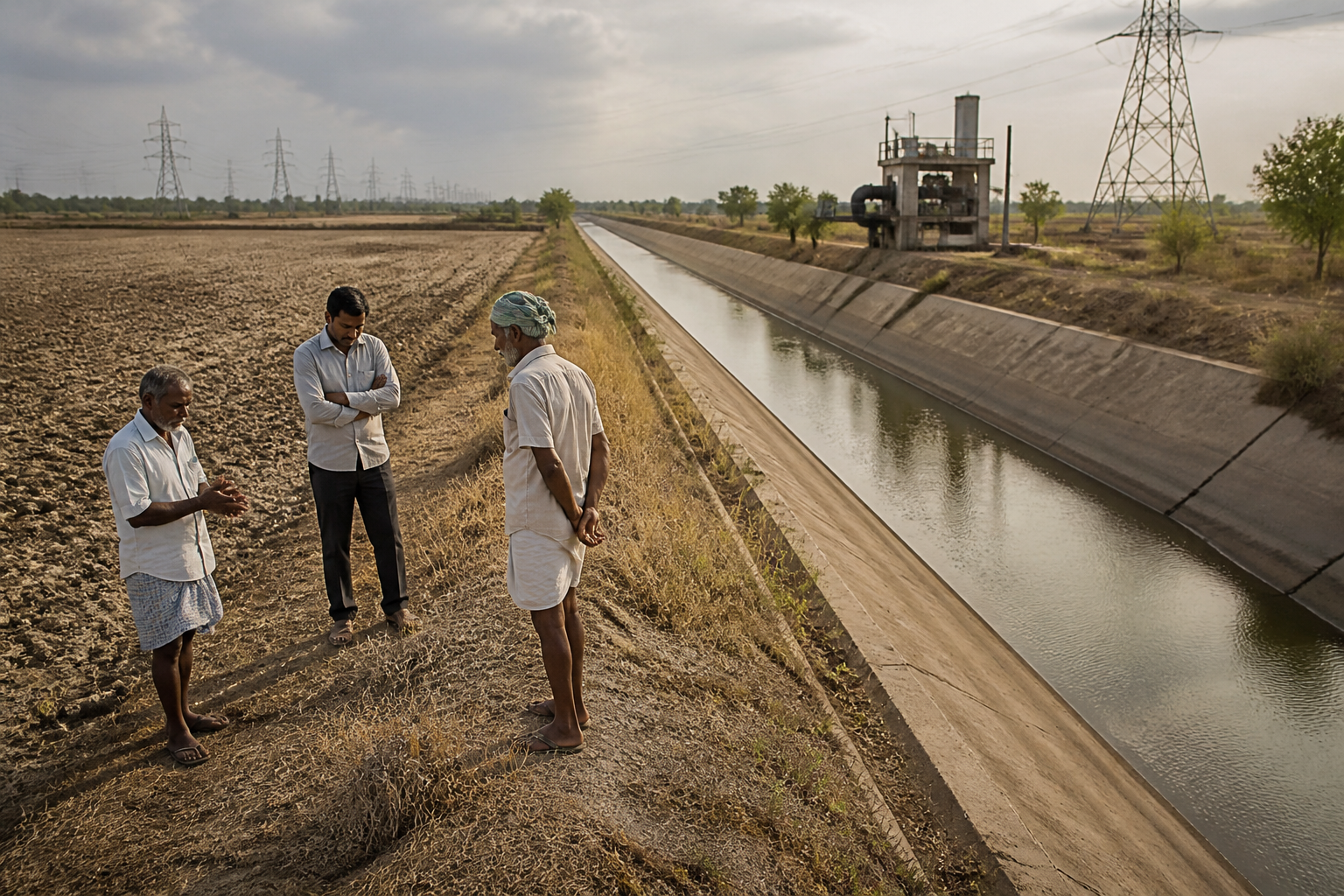
K T Rama Rao’s accusation that Telangana’s drought was “created” by government decisions places the state’s water crisis inside a wider governance dispute. At a meeting of Bharat Rashtra Samithi leaders in Hyderabad, the BRS working president alleged that the Congress government allowed large quantities of Godavari and Krishna water to flow downstream, failed to operate pumps at Kaleshwaram and left farmers facing crop losses and shortages of drinking and irrigation water. The government’s response to these claims is not included in the supplied report.
The political charge matters because it shifts the drought debate from rainfall and climate conditions to the management of infrastructure already built to move and store water. Rama Rao contrasted Telangana with neighbouring Andhra Pradesh, arguing that projects such as Pattiseema had helped divert water to areas far from the Krishna river, while Telangana had not supplied water to Mahabubnagar, which he described as being about 70 kilometres from the river. These comparisons were presented by Rama Rao as evidence of an administrative failure rather than an unavoidable natural shortage.
The supplied report does not independently establish the volume of water that was available, the operating condition of the relevant pumps, the timing of warnings about El Niño, or the reasons for any decision not to lift water. It records Rama Rao’s claim that about 1,000 thousand million cubic feet, or TMCft, was allowed to flow downstream: approximately 750 TMCft from the Godavari and 250 TMCft from the Krishna. Those figures therefore need to be read as an allegation made in a political speech, not as an independently verified water balance.
That distinction is central to understanding the dispute. Water infrastructure does not automatically guarantee water security. Reservoir levels, pumping decisions, power availability, river flows, command-area requirements, inter-state arrangements and the timing of crop cultivation all determine whether a project delivers benefits on the ground. The political argument in Telangana is consequently also an argument about who controls operational decisions, what information is disclosed and how responsibility is assigned when farmers do not receive expected supplies.
The Kaleshwaram reference adds another institutional layer. Rama Rao said the BRS had urged the government six months earlier to lift water through the project, but that the pumps had not been operated. The report does not provide the government’s explanation, the status of the pumping network, reservoir levels at the time, or any technical assessment of whether operating the system would have been feasible. Without those details, the allegation identifies a disputed decision point but does not establish why the pumps were not used.
The same speech connected water stress to Telangana’s electricity and coal systems. Rama Rao accused the Congress government of weakening Singareni Collieries Company Limited and creating a coal shortage to enable costly imports. He also alleged that coal production had fallen, while nearly Rs 60,000 crore in dues remained unpaid to the company. The report does not identify the creditors, the period covered by the dues figure or an official financial statement supporting the claim.
Singareni’s role in the dispute is significant because coal supply, power generation and irrigation pumping are linked through the state’s infrastructure chain. If coal availability affects electricity generation, and electricity is required to operate large pumping systems, a dispute over mining output can become a dispute over water delivery as well. But the available report does not establish a direct operational link between any coal shortage and the alleged failure to pump water during the period in question. That connection requires evidence from the company, power utilities and irrigation authorities.
Rama Rao also questioned the state’s power procurement policy. He contrasted an alleged previous purchase price of Rs 3.90 per unit with reported plans under the Congress government to buy power at Rs 15 per unit. He accused the Chief Minister of ordering an inquiry into earlier power purchases for political reasons while justifying current decisions by citing shortages. These are competing political claims. The report does not provide procurement contracts, tender documents, tariff orders, volumes purchased or the duration and conditions attached to either price.
The numbers nevertheless show why energy procurement is an urban and regional infrastructure issue, not only a political talking point. Power prices influence the cost of pumping, public water supply, irrigation, municipal services and industrial operations. A high per-unit price cannot be assessed in isolation: the comparison would need to account for the source of power, contracted capacity, availability, peak demand, transmission costs, emergency procurement and the time period involved. None of those supporting details is supplied in the report.
The drought argument also exposes the limits of a project-led approach to water security. Telangana’s irrigation infrastructure, as described in the report, includes systems intended to move river water over long distances and to support agriculture and reservoirs. Yet the existence of such systems does not settle questions about distribution. Water may be physically present in a river but unavailable to a particular command area because of pumping constraints, reservoir capacity, power supply, operational priorities or competing downstream claims.
Rama Rao’s comparison with Andhra Pradesh reflects this distribution question. He said water was being diverted through Pattiseema and other projects to locations as far as Kuppam, while Telangana could not supply Mahabubnagar. The comparison is political and the supplied material does not provide comparable data on water volumes, project capacities, crop areas, pumping costs or seasonal conditions in the two states. It does, however, point to a recurring governance challenge: infrastructure performance is experienced locally, while decisions about rivers, reservoirs and power are made across departments and administrative boundaries.
The controversy also raises the issue of public accountability for large infrastructure systems. Rama Rao demanded a sitting judge’s inquiry into alleged irregularities in Singareni and proposed foreign coal imports. He separately alleged a Rs 10,000-crore scam involving the Chief Minister’s brother-in-law and said he would expose an alleged solar power scam. These allegations were not substantiated in the supplied report, and no response from the people or institutions named was included. They should therefore remain clearly identified as political allegations.
For citizens, the immediate consequence of this dispute is not the rhetoric but uncertainty over the reliability of essential services. Farmers need to know whether irrigation water will be available before planting decisions are made. Households need dependable drinking-water supplies. Power utilities need predictable fuel and procurement arrangements. These systems are interdependent, but the institutional responsibility for each one is divided among irrigation departments, electricity utilities, coal companies and the state government.
The report confirms that Telangana’s drought debate is now being fought across those connected systems. It does not confirm whether the claimed 1,000 TMCft was available for storage, whether pumping could safely and legally have been undertaken, whether coal production declined by the amount alleged, or whether power procurement prices were comparable. Those are the factual questions that would determine whether the political accusation describes a management failure, a technical constraint, or a combination of both.
The next stage of the dispute will depend on documentary evidence: reservoir and river-flow records, pump-operation logs, coal-production and dues data, power procurement documents and official responses from the Telangana government and Singareni. Until those records are made available, the speech establishes the scale of the political conflict over Telangana’s water and energy infrastructure, but not the final responsibility for the drought conditions described.

