


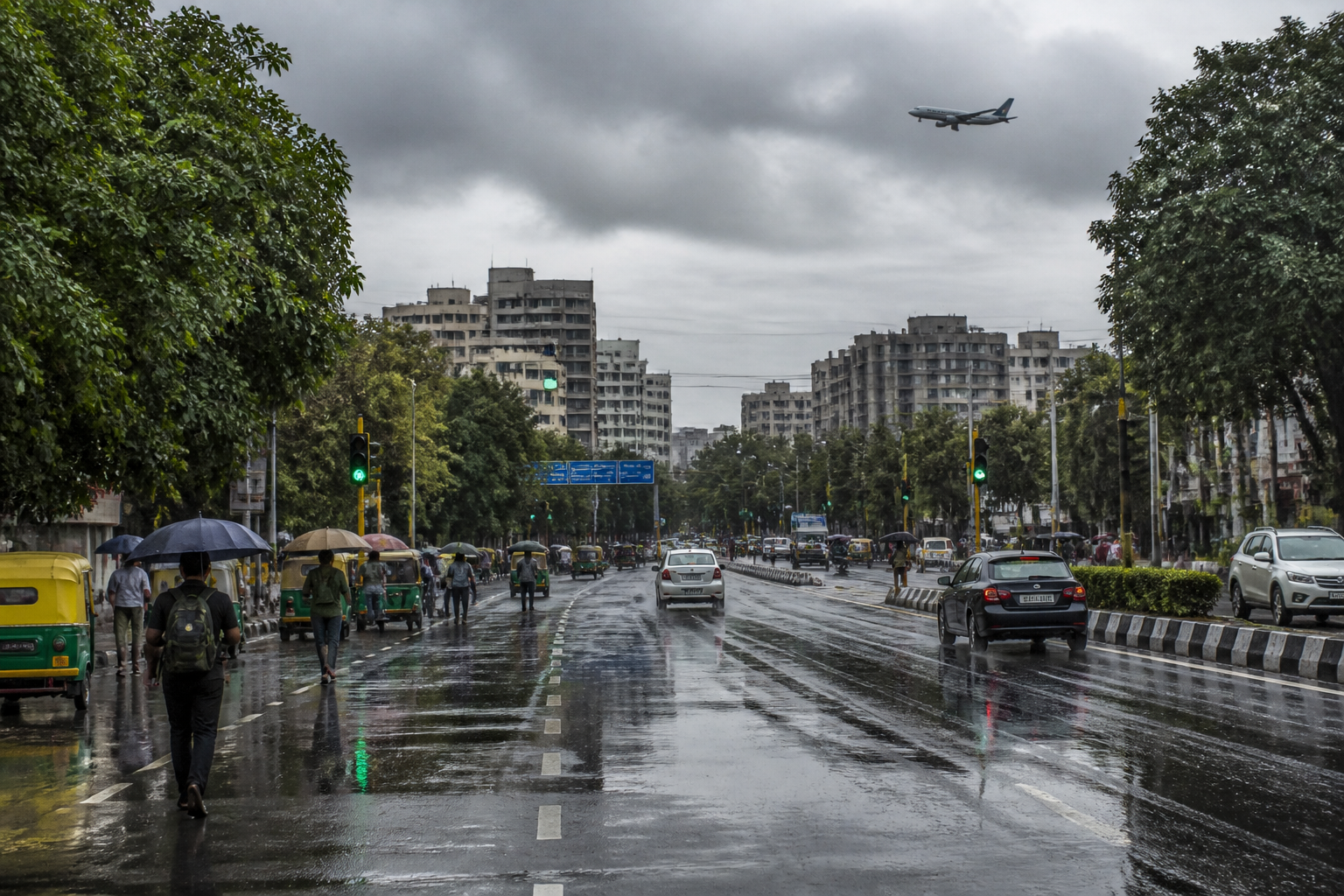
Delhi weather changed sharply on Thursday as rain, cloud cover and strong winds pushed daytime temperatures down by more than six degrees, improved the city’s air quality and disrupted flight operations. The India Meteorological Department has forecast continued cloud cover and light rain in parts of Delhi-NCR on Friday.
The maximum temperature at Safdarjung was recorded at 28.3 degrees Celsius, 4.9 degrees below normal, according to the weather report cited by Live Hindustan. The Ridge weather station recorded a maximum of 27.4 degrees Celsius, which was 6.3 degrees below normal. The cooler conditions followed rain and winds across the capital during the day.
The weather department has forecast a maximum temperature of 29 to 31 degrees Celsius and a minimum temperature of 18 to 20 degrees Celsius on Friday. Cloud cover is expected to continue, with light drizzle possible at isolated locations. Night temperatures are also expected to decline slightly, indicating that the change will not be limited to daytime conditions.
The department attributed the shift to the combined influence of a western disturbance over Punjab and nearby areas and a cyclonic circulation over Haryana and surrounding regions. The interaction of these systems brought light to moderate rain and strong winds to several parts of north India, including Delhi.
The Ridge recorded the highest rainfall among the stations mentioned in the report, with 25.2 mm. Lodhi Road received 20.0 mm, Safdarjung recorded 15.9 mm and Palam received 11.2 mm. These local variations indicate that the effect of the weather systems was uneven across the capital, with some areas receiving substantially more rain than others.
The rainfall also brought a measurable short-term improvement in Delhi’s air quality. According to the Central Pollution Control Board, the city’s average air quality index stood at 149 on Thursday, placing it in the moderate category. The previous day’s average AQI was 181, representing an improvement of 32 points over 24 hours.
The distribution of monitoring stations in the poor category also changed significantly. On Wednesday, 23 monitoring stations recorded AQI levels above 200, classified as poor. On Thursday, only four stations were reported in that category. The improvement coincided with rainfall and stronger winds, which can reduce the concentration of pollutants in the air, although the report does not establish how long the improvement will last.
The sudden weather change affected aviation as well. Five flights bound for Delhi were diverted because of the weather. Four were sent to Jaipur and one was diverted to Noida airport. The affected flights included three operated by Air India, one by Air India Express and a cargo aircraft arriving from Macau.
The Air India flights were travelling to Delhi from Ahmedabad, Bhopal and Bengaluru, while the Air India Express service was arriving from Bhubaneswar. The report said the five diversions included four flights routed to Jaipur and one moved to Noida airport. Further operational updates will depend on weather conditions and airport authorities’ handling of incoming services.

