


Delhi’s electric mobility transition is being framed as a much larger urban systems challenge than replacing petrol and diesel vehicles. In an opinion article published by The Hindu, Lieutenant-Governor Taranjit Singh Sandhu argued that the capital’s next phase of mobility will depend on how transport, energy, charging infrastructure, manufacturing, recycling and digital systems are planned together.
That framing matters because Delhi’s mobility problem is not limited to the fuel used by individual vehicles. Sandhu connected electric mobility to energy security, air quality, congestion, climate change, industrial capability and the quality of everyday urban life. His argument places the electric vehicle inside a wider ecosystem, raising a central question for the capital: can the transition deliver a more reliable and accessible transport system, rather than simply increase the number of electric vehicles on the roads?
The distinction is important for a city where public, shared and private transport operate within the same congested urban network. Sandhu wrote that Delhi faces interconnected pressures linked to mobility, air quality, congestion and urban expansion. In that setting, the effect of electric mobility will depend not only on vehicle adoption but also on whether public transport, last-mile connectivity, charging facilities and intelligent traffic management work together.
The intervention also reflects the changing policy vocabulary around electric mobility in India. Government support has so far included programmes such as FAME and the PM E-DRIVE scheme. According to Sandhu’s article, PM E-DRIVE has an outlay of ₹10,900 crore to support electric vehicles, charging infrastructure and related testing infrastructure. These measures indicate that public policy is attempting to support both demand for electric vehicles and the systems required to operate them.
However, a subsidy or vehicle-support programme cannot by itself create an urban mobility transition. Charging access, grid capacity, parking arrangements, fleet operations, maintenance, battery management and end-of-life recycling all influence whether electric mobility is practical at scale. Sandhu’s emphasis on the broader ecosystem points to an institutional challenge: transport authorities, electricity agencies, municipal bodies, manufacturers, technology companies and financial institutions must act within a connected framework, even though their responsibilities and investment cycles are different.
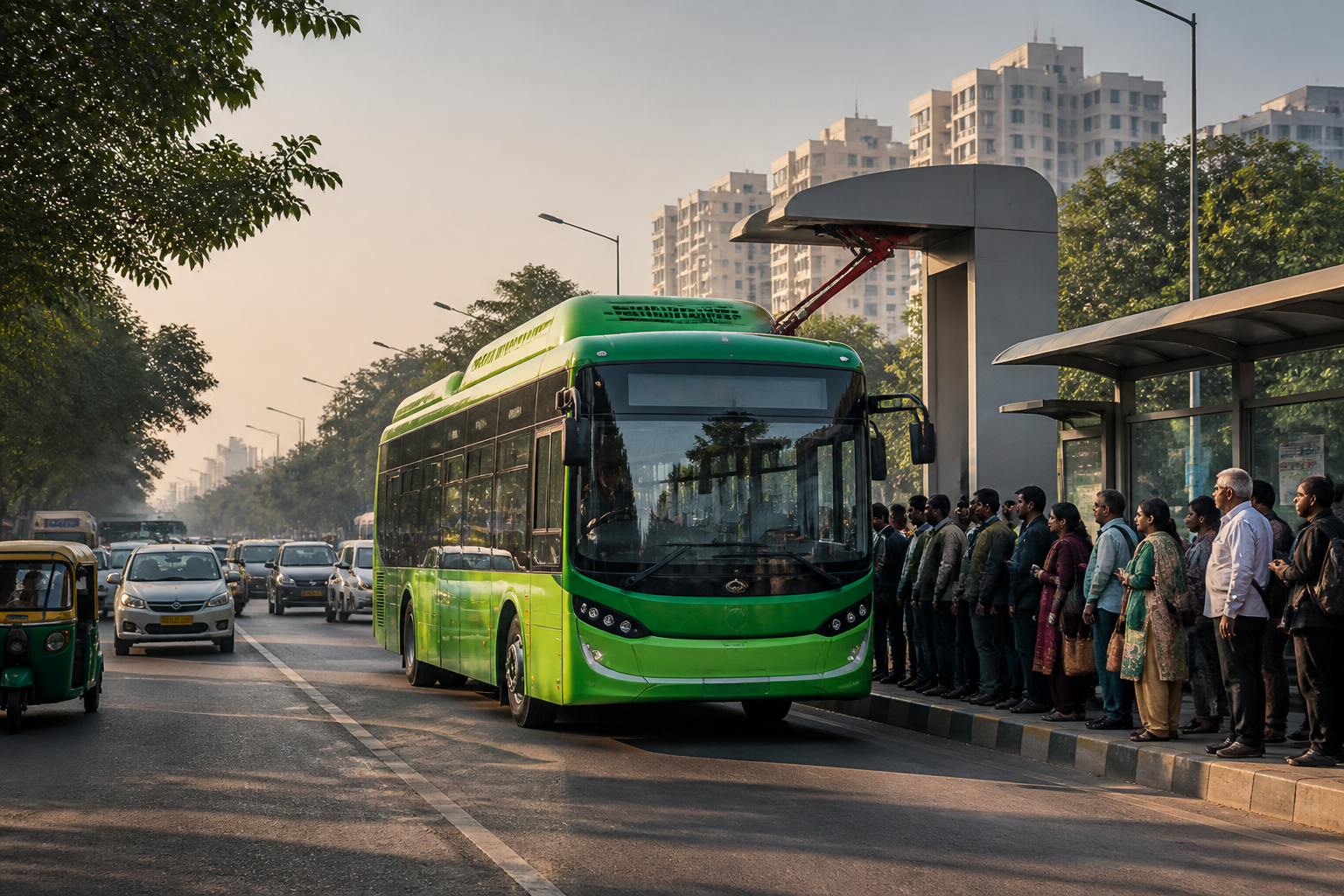
This is particularly significant for public transport. Sandhu noted that Delhi has seen growing adoption of electric buses and other forms of cleaner mobility, while identifying integrated public transport and last-mile connectivity as the next step. Electric buses can reduce tailpipe emissions, but their public value also depends on route planning, frequency, depot facilities, charging schedules and dependable operations. The source material does not establish the scale or performance of Delhi’s electric bus fleet, but it makes clear that the transition is being discussed as an operational issue rather than only a procurement exercise.
The same principle applies to private vehicles. A city may record higher electric vehicle adoption without necessarily solving congestion if the total number of vehicles continues to grow or if public transport remains inconvenient. Sandhu argued that the success of the transition should not be measured only by the number of electric vehicles on the roads. It should also be assessed through reliable public transport, convenient charging facilities and cleaner, more efficient ways of moving around the city.
That is a significant shift in the way electric mobility is evaluated. Vehicle registrations are relatively visible indicators, while accessibility and system performance are more difficult to measure. A citizen’s experience depends on whether a bus arrives on time, whether a shared journey can be completed without multiple gaps, whether charging is available near homes and workplaces, and whether the overall network reduces the time and cost of movement. The article places these questions at the centre of the transition, although it does not provide performance data on them.
Sandhu also linked Delhi’s mobility transition to India’s industrial ambitions. The electric vehicle ecosystem, he wrote, can create opportunities across engineering, electronics, software, battery manufacturing, component production, logistics and specialised services. Battery technology, alternative materials, energy storage and recycling were identified as particularly important capabilities for sustaining electric mobility at scale.
This industrial dimension changes the policy stakes. Electric mobility is not only an environmental programme or a transport intervention; it is also an attempt to build domestic technological and manufacturing capacity. Sandhu referred to the automobile sector as a platform for investment, technology partnerships and participation in global value chains, and noted that India-made electric vehicles have begun entering international markets. The source does not specify the companies, destinations or volumes involved, so the wider industrial performance cannot be assessed from the article alone. But the institutional direction is clear: policy is expected to support both cleaner movement and economic capability.
The emphasis on batteries and recycling is also important because it draws attention to the full life cycle of electric mobility. A vehicle transition requires materials, storage systems, manufacturing processes and end-of-life management. If these functions develop separately from urban planning and energy systems, cities may gain cleaner vehicles without building a resilient mobility network. Sandhu’s argument is that the ecosystem must be economically viable, technologically capable and accessible to citizens at the same time.
For Delhi, the governance challenge is intensified by the scale of its vehicle base. Sandhu stated that the capital has more registered vehicles than the other three metropolitan cities put together. The article does not provide the underlying registration figures or identify the three cities, so the comparison cannot be independently examined from the supplied material. Nevertheless, the claim underlines why Delhi is being positioned as a test bed for mobility policy: decisions made in the capital have consequences for air quality, road use, public transport and the development of urban technologies.
The article also assigns a role to universities, research institutions, entrepreneurs and technology companies. Their contribution, according to Sandhu, should be directed towards solutions suited to Indian cities. This is more demanding than importing vehicles or technology. Indian urban conditions require coordination between street design, high-density travel, public transport, charging systems, electricity supply and affordability. The source does not list specific research programmes or partnerships, but it identifies the need for solutions that can move from innovation to deployment at scale.
The question of access is central to this process. Sandhu wrote that electric mobility must remain accessible and that a citizen-centred transition should be judged by the quality of available transport, not simply by vehicle numbers. This places public transport and shared mobility alongside private electric vehicles in the policy framework. It also suggests that the benefits of the transition will depend on how infrastructure is distributed across the city and who can use it conveniently.
That distribution issue is not resolved by the announcement of a national outlay or by the expansion of vehicle technology. Charging facilities must be available where vehicles operate, while public transport must connect people to jobs, services and neighbourhoods. The source does not provide details of Delhi’s charging network, its geographic spread, tariffs or operating model. These are among the practical questions that will determine whether the stated ambition becomes a citywide system or remains concentrated in specific corridors and user groups.
The policy landscape described by Sandhu therefore has several layers. National schemes provide financial and institutional support for vehicles, charging and testing infrastructure. Delhi must coordinate public transport, last-mile connections and traffic management. Industry must develop vehicles, batteries, components and software. Research institutions must adapt technologies to Indian urban conditions. Financial institutions must support long-term investment. Municipal and energy systems must accommodate the infrastructure required for daily operations.
This division of responsibility also creates the possibility of implementation gaps. The article calls for collaboration between government, industry, academia and financial institutions, but it does not set out a specific governance mechanism, implementation timetable or accountability framework. Without such details, the policy direction remains broader than an actionable delivery plan. The next stage of scrutiny will therefore have to focus on how the different parts of the ecosystem are assigned, funded and measured.
The strongest message in the intervention is that electric mobility cannot be treated as a standalone vehicle market. It is connected to the structure of the city, the reliability of public transport, the design of energy systems and the industrial choices made by the country. Delhi’s congestion and air-quality pressures make the transition especially visible, but the institutional challenge is common to many Indian cities.
What the supplied evidence confirms is that Delhi’s electric mobility debate is moving towards integration. The Lieutenant-Governor has called for cleaner public transport, stronger last-mile connectivity, charging infrastructure and intelligent traffic management to work as one system, while also linking mobility to manufacturing and innovation. What remains unclear is how these priorities will be translated into specific projects, funding arrangements, service standards and measurable citizen outcomes. Those implementation details will determine whether Delhi’s electric mobility push changes how the city moves or only what powers some of its vehicles.

